Document Overview
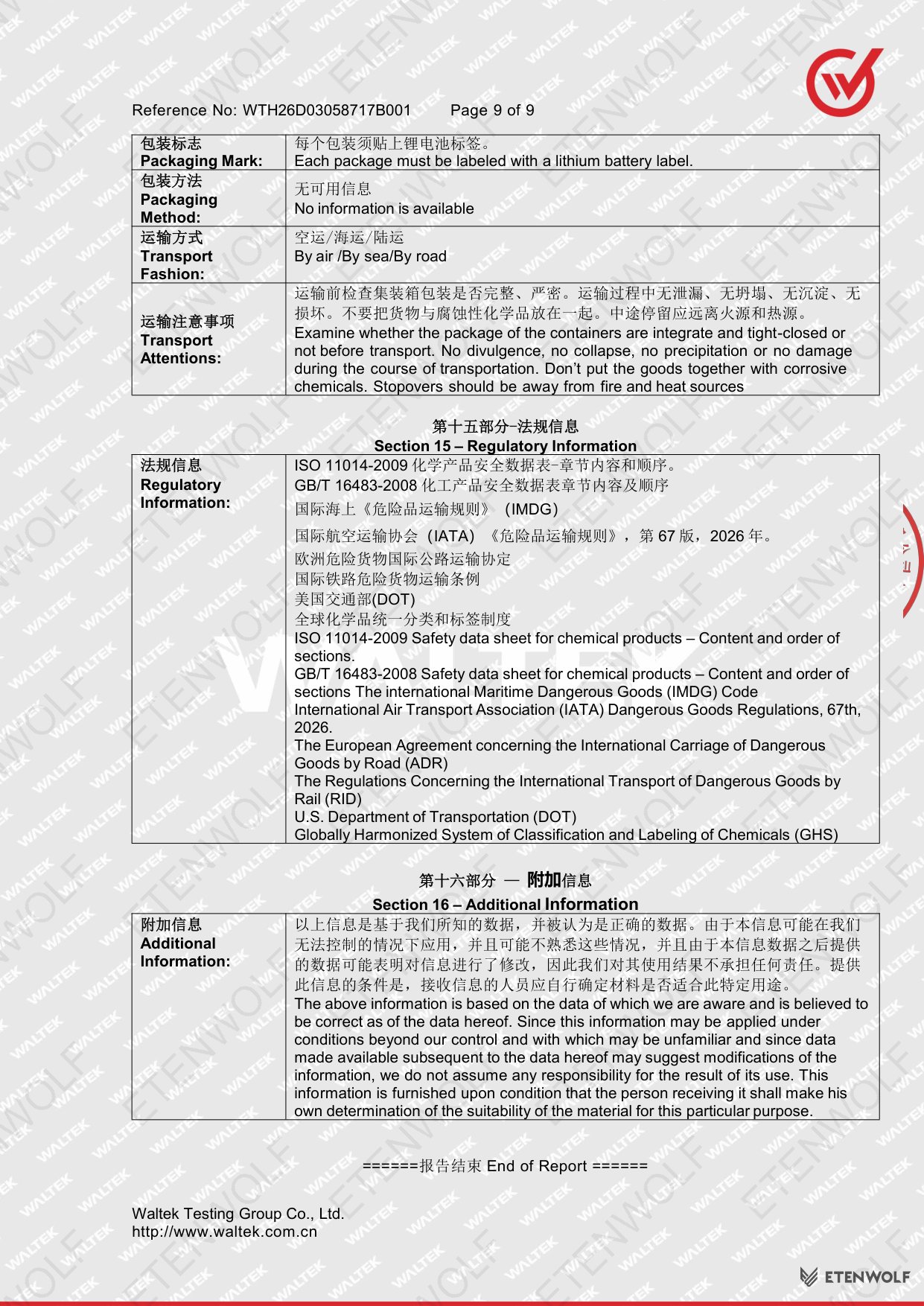
Document Overview This page presents the official Material Safety Data Sheet (MSDS) issued under reference number WTH26D03058717B001 for a Lithium-ion Battery Pack. The document was prepared and issued by Waltek Testing Group Co., Ltd. (www.waltek.com.cn), a professional third-party testing and certification laboratory headquartered at No.…
- Document type
- Certification Report
- Prepared by
- Michelle Torres
- Published
- Last reviewed
- Topics
- International Transportation: CB / MSDS / UN38.3
Document Overview
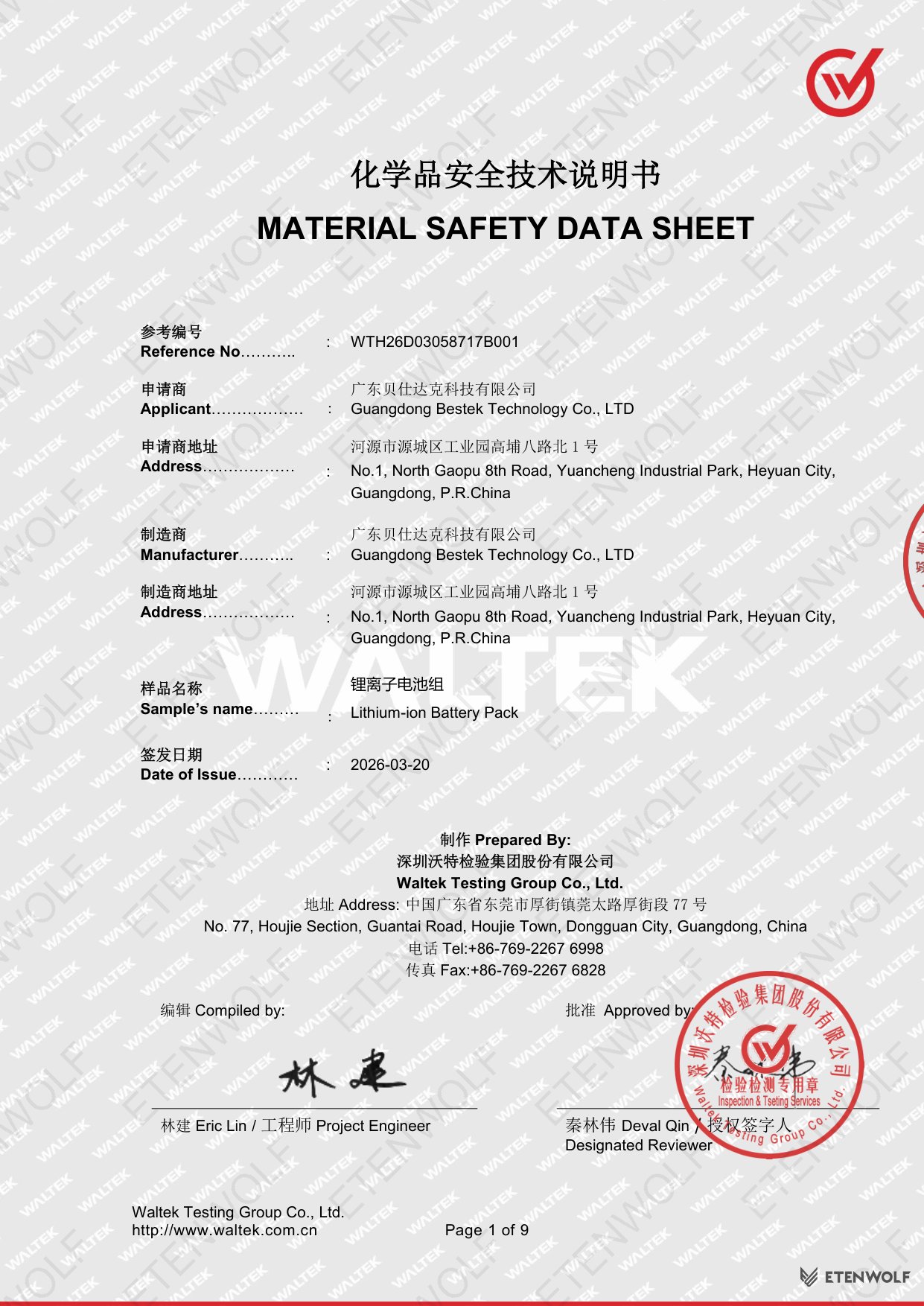
This page presents the official Material Safety Data Sheet (MSDS) issued under reference number WTH26D03058717B001 for a Lithium-ion Battery Pack. The document was prepared and issued by Waltek Testing Group Co., Ltd. (www.waltek.com.cn), a professional third-party testing and certification laboratory headquartered at No. 77, Houjie Section, Guantai Road, Houjie Town, Dongguan City, Guangdong, China.
The MSDS was compiled by Eric Lin (林建), Project Engineer, and approved by Deval Qin (秦林伟), Designated Reviewer. The document spans 9 pages and was issued on 2026-03-20. Its scope covers chemical composition, hazard identification, first-aid measures, fire-fighting procedures, accidental release measures, handling and storage guidelines, and emergency contact information for the battery pack in normal and fault conditions.
| Field | Detail |
|---|---|
| Reference Number | WTH26D03058717B001 |
| Document Type | Material Safety Data Sheet (MSDS) |
| Date of Issue | 2026-03-20 |
| Issuing Laboratory | Waltek Testing Group Co., Ltd. |
| Compiled By | Eric Lin / Project Engineer |
| Approved By | Deval Qin / Designated Reviewer |
| Total Pages | 9 |
Product Information
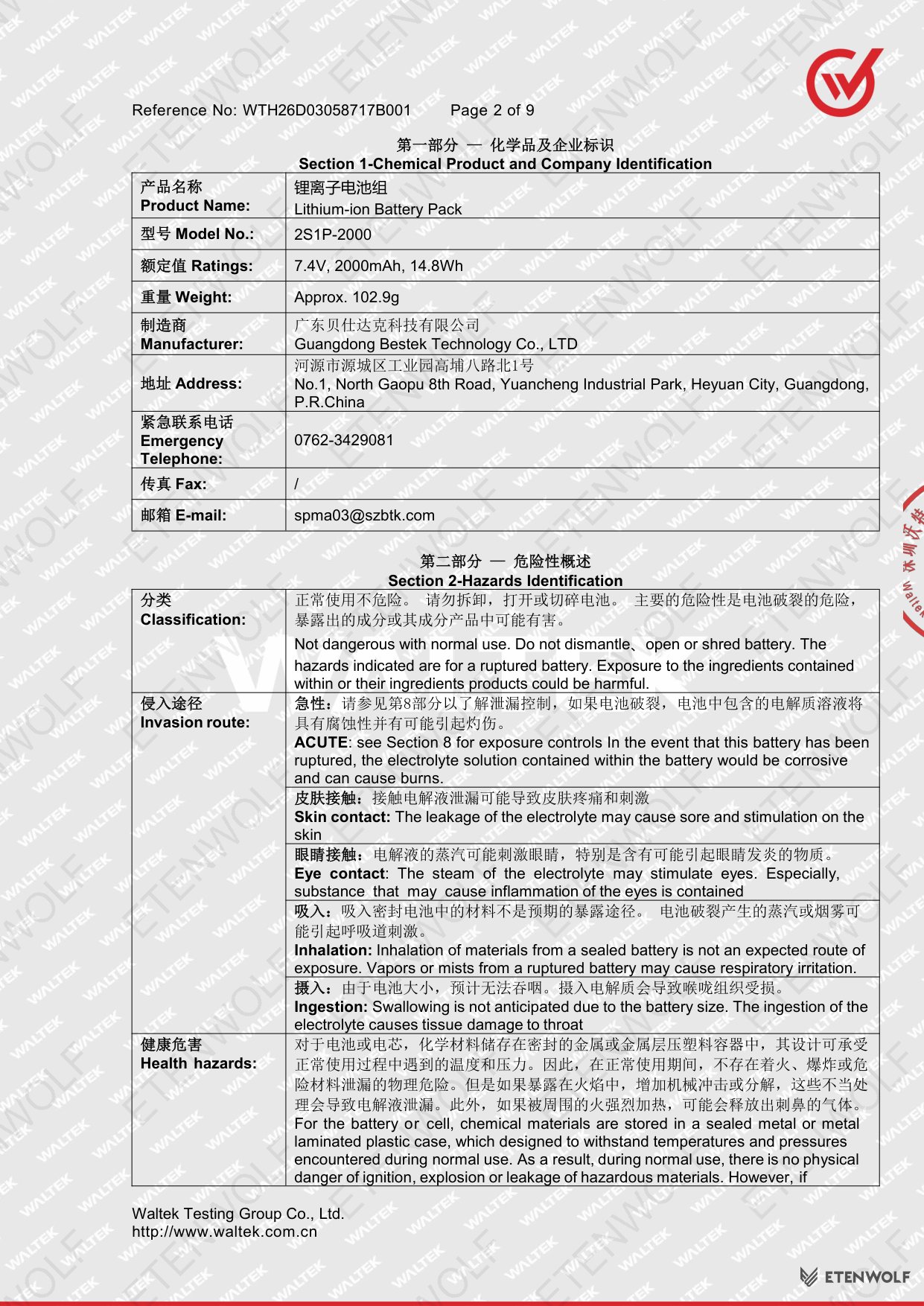
The subject of this MSDS is a Lithium-ion Battery Pack designed for use in portable power applications. Full product details are listed below.
| Field | Detail |
|---|---|
| Product Name | Lithium-ion Battery Pack |
| Model Number | 2S1P-2000 |
| Rated Voltage | 7.4 V |
| Rated Capacity | 2000 mAh |
| Energy | 14.8 Wh |
| Approximate Weight | 102.9 g |
| Applicant | Guangdong Bestek Technology Co., Ltd. |
| Applicant Address | No.1, North Gaopu 8th Road, Yuancheng Industrial Park, Heyuan City, Guangdong, P.R.China |
| Manufacturer | Guangdong Bestek Technology Co., Ltd. |
| Manufacturer Address | No.1, North Gaopu 8th Road, Yuancheng Industrial Park, Heyuan City, Guangdong, P.R.China |
| Emergency Telephone | 0762-3429081 |
| [email protected] |
The Lithium-ion Battery Pack 2S1P-2000 uses a sealed metal or metal-laminated plastic enclosure engineered to withstand the temperatures and pressures encountered during normal operation. Under standard usage conditions, no physical risk of ignition, explosion, or hazardous material leakage is present.
Key Details
Chemical Composition
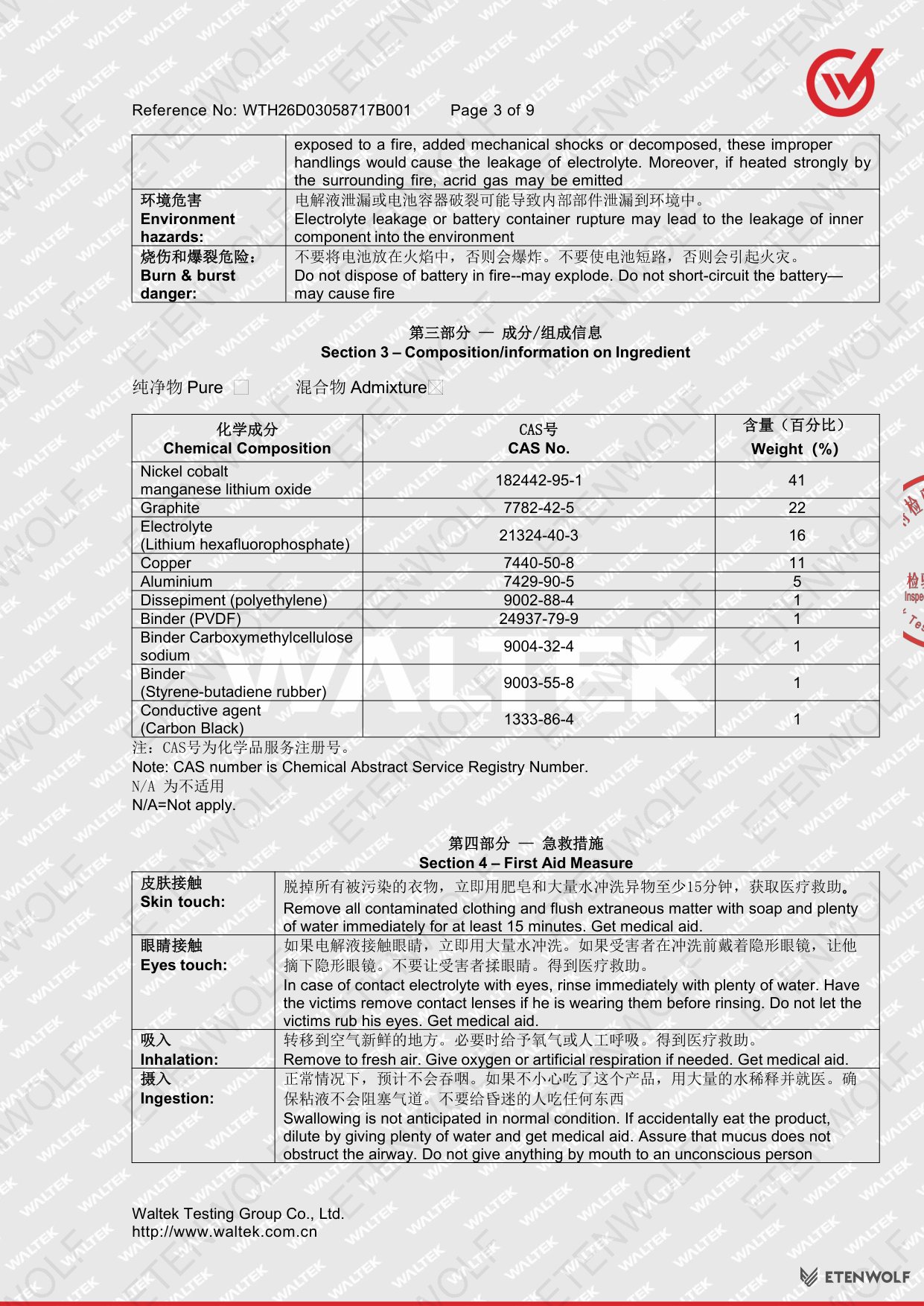
The battery pack is a mixture of the following chemical components. CAS numbers are Chemical Abstract Service Registry Numbers.
| Chemical Composition | CAS No. | Weight (%) |
|---|---|---|
| Nickel Cobalt Manganese Lithium Oxide (NMC) | 182442-95-1 | 41% |
| Graphite | 7782-42-5 | 22% |
| Electrolyte (Lithium Hexafluorophosphate) | 21324-40-3 | 16% |
| Copper | 7440-50-8 | 11% |
| Aluminium | 7429-90-5 | 5% |
| Dissepiment (Polyethylene) | 9002-88-4 | 1% |
| Binder (PVDF) | 24937-79-9 | 1% |
| Binder (Carboxymethylcellulose Sodium) | 9004-32-4 | 1% |
| Binder (Styrene-Butadiene Rubber) | 9003-55-8 | 1% |
| Conductive Agent (Carbon Black) | 1333-86-4 | 1% |
Hazard Identification Summary
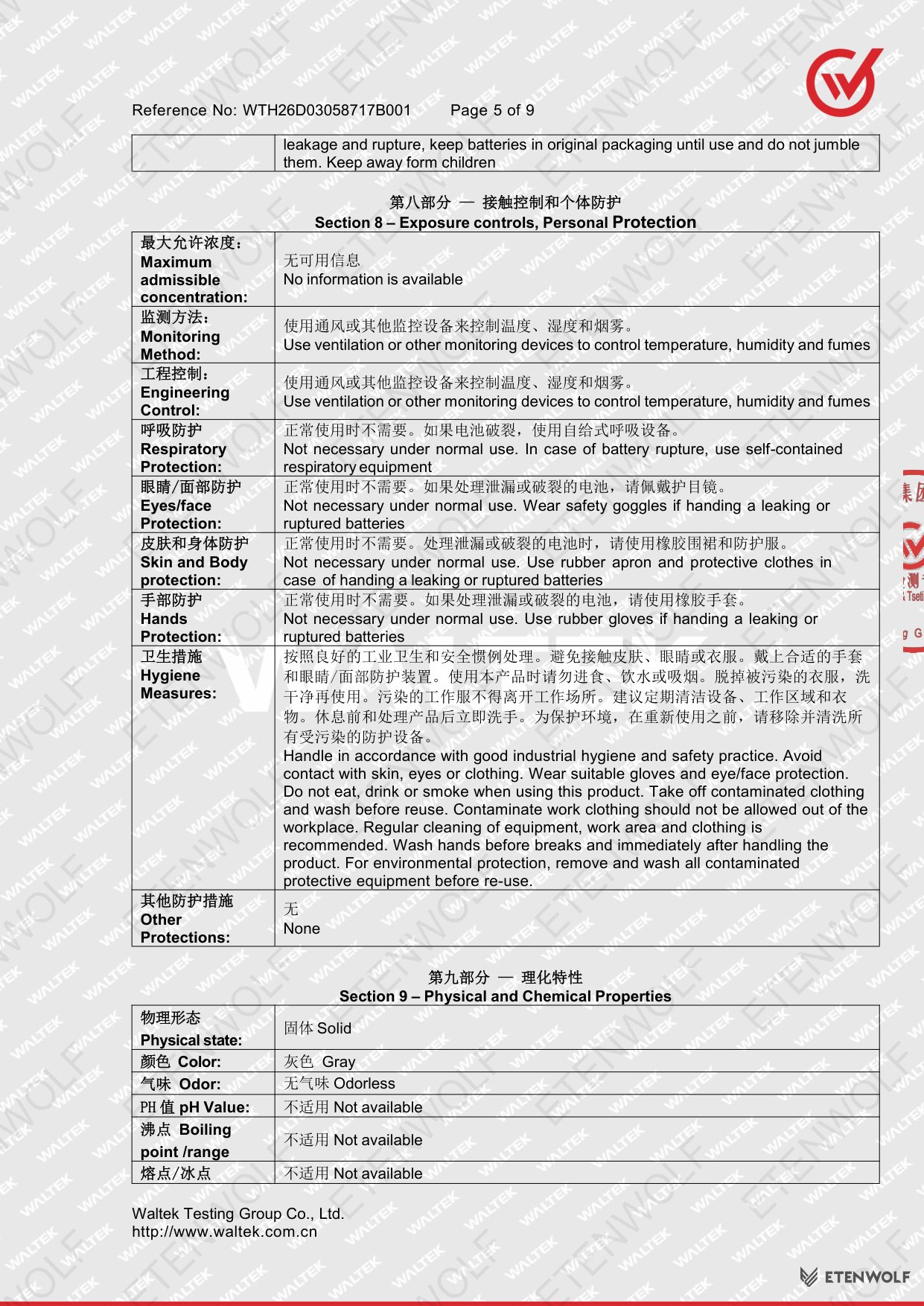
The Lithium-ion Battery Pack 2S1P-2000 is not dangerous under normal use. The following hazard information applies in the event of battery rupture or improper handling.
- Skin Contact: Electrolyte leakage may cause skin soreness and irritation. Remove contaminated clothing and flush with soap and plenty of water for at least 15 minutes. Seek medical aid.
- Eye Contact: Electrolyte vapour may cause eye irritation and inflammation. Rinse immediately with plenty of water; remove contact lenses before rinsing. Seek medical aid.
- Inhalation: Inhalation from a sealed battery is not an expected exposure route. Vapours or mists from a ruptured battery may cause respiratory irritation. Move to fresh air; administer oxygen or artificial respiration if needed.
- Ingestion: Swallowing is not anticipated due to battery size. If electrolyte is ingested, dilute with plenty of water and seek medical aid immediately. Do not give anything by mouth to an unconscious person.
- Environmental: Electrolyte leakage or container rupture may release inner components into the environment. Do not allow product to enter soil, groundwater, or drains.
Fire-Fighting Information
| Property | Detail |
|---|---|
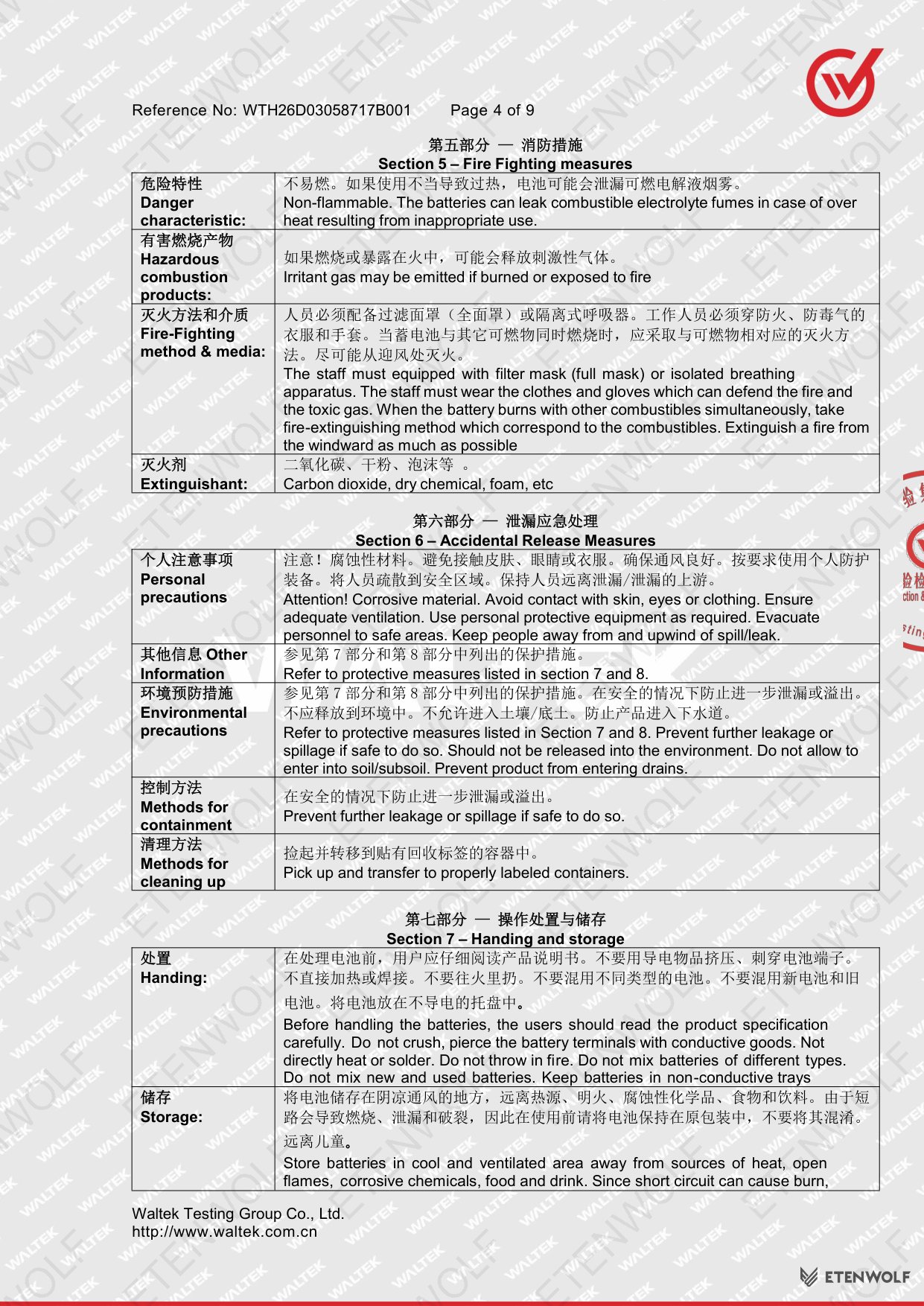
| Flammability | Non-flammable under normal conditions |
| Risk on Overheating | May leak combustible electrolyte fumes |
| Combustion Products | Irritant gases if burned or exposed to fire |
| Recommended Extinguishants | Carbon dioxide, dry chemical, foam |
| Protective Equipment | Full-face filter mask or isolated breathing apparatus; fire- and toxic-gas-resistant clothing and gloves |
Handling and Storage Guidelines
- Read the product specification carefully before handling.
- Do not crush, pierce, or short-circuit the battery terminals with conductive materials.
- Do not directly heat, solder, or dispose of in fire — risk of explosion.
- Do not mix different battery types or mix new and used batteries.
- Store in a non-conductive tray in a cool, well-ventilated area away from heat sources.
- Evacuate personnel and ensure adequate ventilation in the event of electrolyte spill.
- Contain spills and transfer material to properly labelled containers for recycling.
Standards & Compliance
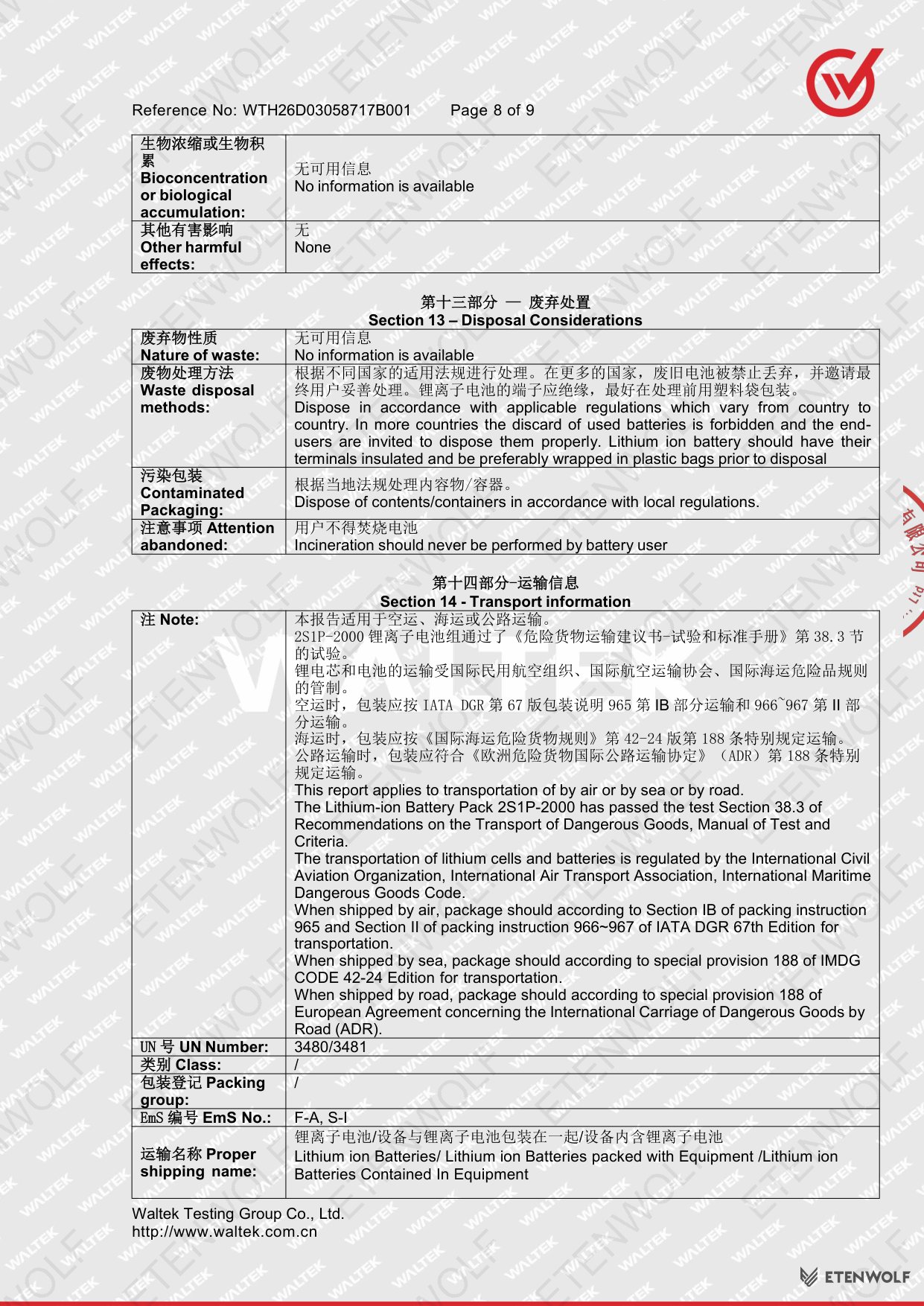
This MSDS document supports transport classification and hazard communication compliance for lithium-ion battery cells and packs. The Lithium-ion Battery Pack 2S1P-2000 is subject to the following regulations and standards:
| Standard / Regulation | Scope |
|---|---|
| UN38.3 | United Nations Manual of Tests and Criteria, Part III, Section 38.3 — Transport testing requirements for lithium metal and lithium-ion batteries |
| MSDS / SDS (GHS) | Globally Harmonised System of Classification and Labelling of Chemicals — safety data sheet requirements for hazardous materials documentation |
| IATA Dangerous Goods Regulations | Air transport classification for lithium batteries as dangerous goods |
| IMDG Code | International Maritime Dangerous Goods Code for sea transport |
| IEC 62133 | Safety requirements for portable sealed secondary lithium cells and batteries |
| RoHS | Restriction of Hazardous Substances in electrical and electronic equipment |
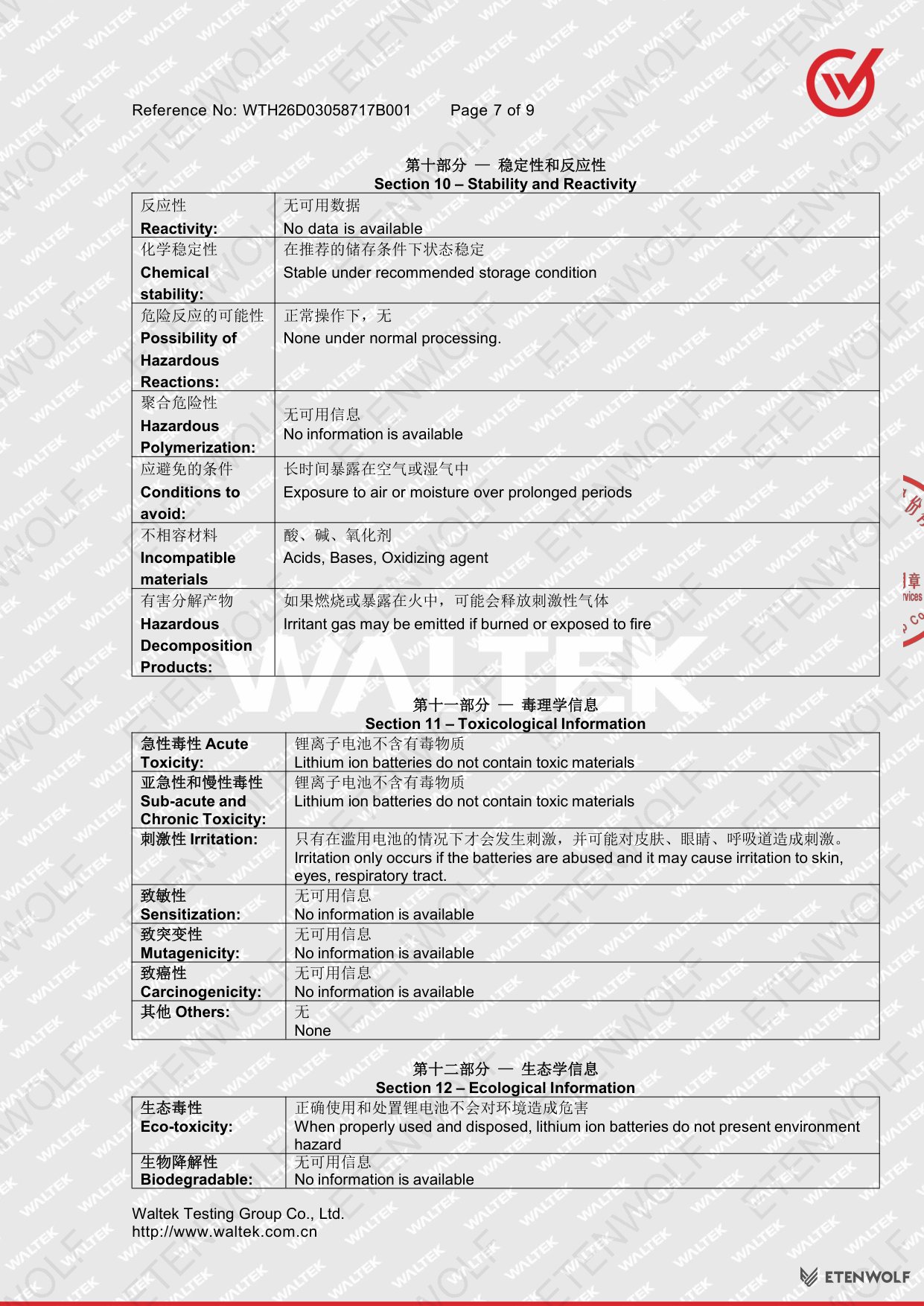
Under normal operating conditions, the battery pack does not present ignition, explosion, or hazardous leakage risks. All hazard classifications referenced in this document apply specifically to fault or damage scenarios such as mechanical shock, short circuit, or exposure to fire.
Validity & Certification Body
This Material Safety Data Sheet was issued on 2026-03-20 and carries reference number WTH26D03058717B001. MSDS documents of this type do not carry a fixed expiry date but must be reviewed and updated whenever the product formulation, applicable regulations, or new hazard data change materially.
| Field | Detail |
|---|---|
| Reference Number | WTH26D03058717B001 |
| Date of Issue | 2026-03-20 |
| Issuing Body | Waltek Testing Group Co., Ltd. |
| Laboratory Address | No. 77, Houjie Section, Guantai Road, Houjie Town, Dongguan City, Guangdong, China |
| Telephone | +86-769-2267 6998 |
| Fax | +86-769-2267 6828 |
| Laboratory Website | www.waltek.com.cn |
| Compiled By | Eric Lin (林建) — Project Engineer |
| Approved By | Deval Qin (秦林伟) — Designated Reviewer |
Waltek Testing Group Co., Ltd. is an accredited third-party testing and certification organisation operating across multiple international standards. Their accreditation covers chemical safety documentation, electrical safety testing, and transport compliance testing including UN38.3 for lithium batteries.
Frequently Asked Questions
- What does reference number WTH26D03058717B001 identify?
- Reference number WTH26D03058717B001 is the unique document identifier assigned by Waltek Testing Group Co., Ltd. to the Material Safety Data Sheet for the Lithium-ion Battery Pack model 2S1P-2000 (7.4V, 2000mAh, 14.8Wh) manufactured by Guangdong Bestek Technology Co., Ltd. It allows the document to be traced back to its issuing laboratory and specific product batch.
- Is the Lithium-ion Battery Pack 2S1P-2000 dangerous during normal use?
- No. Under normal operating conditions, the Lithium-ion Battery Pack 2S1P-2000 presents no risk of ignition, explosion, or hazardous material leakage. Chemical materials are stored in a sealed enclosure designed to withstand normal temperature and pressure ranges. Hazards described in the MSDS apply only in fault scenarios such as mechanical damage, short circuit, fire exposure, or improper dismantling.
- What first-aid steps should be taken if the battery ruptures and electrolyte contacts skin?
- Remove all contaminated clothing immediately and flush the affected area with soap and plenty of water for at least 15 minutes. Seek medical aid promptly. If electrolyte contacts eyes, rinse with plenty of water immediately, remove contact lenses before rinsing if worn, and do not allow the person to rub their eyes. In all cases of significant exposure, professional medical assistance should be obtained.
- What fire extinguishants are safe to use on a burning lithium-ion battery pack?
- Carbon dioxide (CO2), dry chemical powder, and foam extinguishants are recommended. Fire-fighting personnel must use a full-face filter mask or an isolated breathing apparatus and wear clothing and gloves resistant to fire and toxic gas. Where the battery is burning alongside other combustible materials, apply the fire-fighting method appropriate to those combustibles and extinguish from upwind where possible.
Related Documents
The following certification and compliance document types are typically required alongside an MSDS for a Lithium-ion Battery Pack such as the 2S1P-2000. Obtaining a complete compliance package ensures the product meets international transport, safety, and market-access requirements.
- UN38.3 Test Report — Mandatory transport safety test report covering altitude simulation, thermal test, vibration, shock, external short circuit, impact/crush, overcharge, and forced discharge tests for lithium batteries shipped by air, sea, or road.
- IEC 62133 Certification — Safety certification for portable sealed secondary lithium cells and battery packs, required for many consumer electronics markets.
- CE Declaration of Conformity — Required for placing the battery or end-product on the European market, covering relevant EU directives including the Battery Regulation and Low Voltage Directive.
- RoHS Compliance Report — Confirms that restricted hazardous substances (lead, mercury, cadmium, hexavalent chromium, PBB, PBDE, etc.) are within permitted concentration limits.
- Packing Instructions PI 965 / PI 966 / PI 967 (IATA) — Relevant IATA Dangerous Goods packing instruction documentation for lithium batteries shipped by air freight.
- Battery Safety Certification (KC / PSE / BIS) — Country-specific safety certifications required for markets including South Korea (KC mark), Japan (PSE), and India (BIS).
Document Pages