Document Overview
Document Overview This page presents the CB Test Report issued under the IECEE CB Scheme for the lithium-ion battery pack used in the ETENWOLF P100 inflation tool. The report was prepared by TÜV SÜD Certification and Testing (China) Co., Ltd. Shenzhen Branch and issued under…
- Document type
- Certification Report
- Prepared by
- Michelle Torres
- Published
- Last reviewed
- Topics
- International Transportation: CB / MSDS / UN38.3
Document Overview
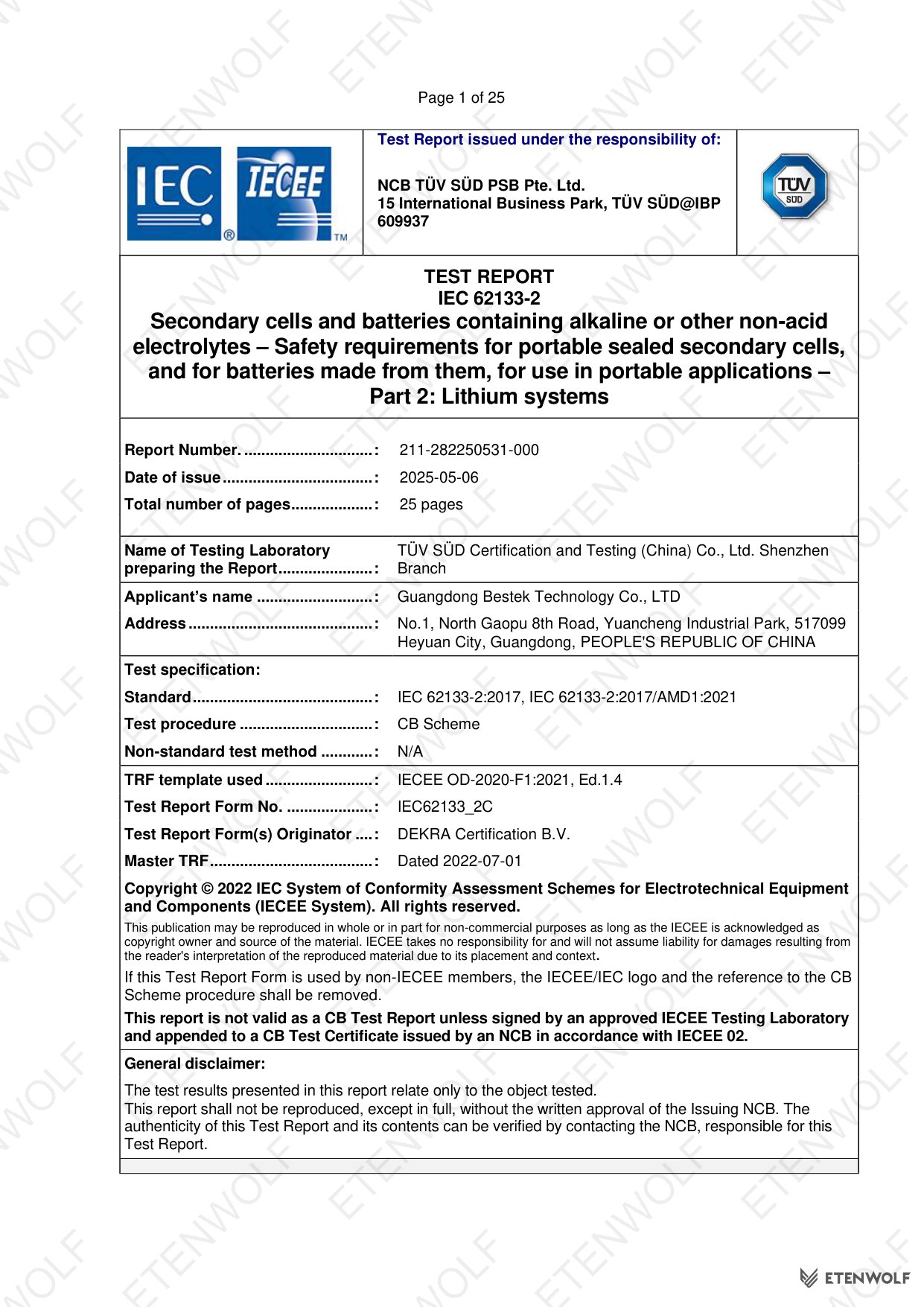
This page presents the CB Test Report issued under the IECEE CB Scheme for the lithium-ion battery pack used in the ETENWOLF P100 inflation tool. The report was prepared by TÜV SÜD Certification and Testing (China) Co., Ltd. Shenzhen Branch and issued under the responsibility of the National Certification Body (NCB) TÜV SÜD PSB Pte. Ltd., located at 15 International Business Park, TÜV SÜD@IBP, Singapore 609937.
- Report Number: 211-282250531-000
- Date of Issue: 2025-05-06
- Total Pages: 25
- Document Type: CB Test Report
- Test Scheme: IECEE CB Scheme
- Applicable Standard: IEC 62133-2:2017 and IEC 62133-2:2017/AMD1:2021
- TRF Template: IECEE OD-2020-F1:2021, Ed.1.4
- Test Report Form No.: IEC62133_2C
- TRF Originator: DEKRA Certification B.V.
- Master TRF Dated: 2022-07-01
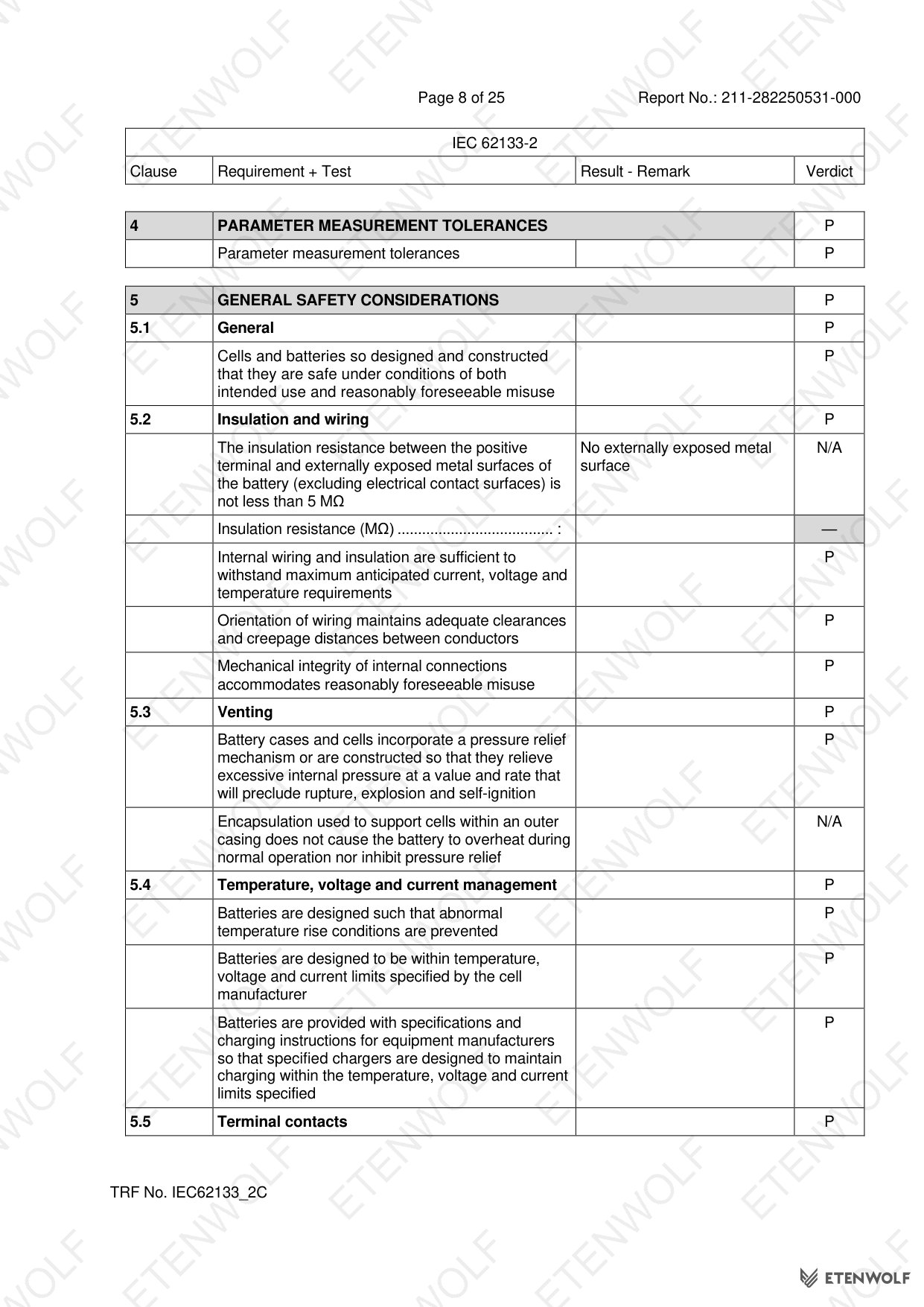
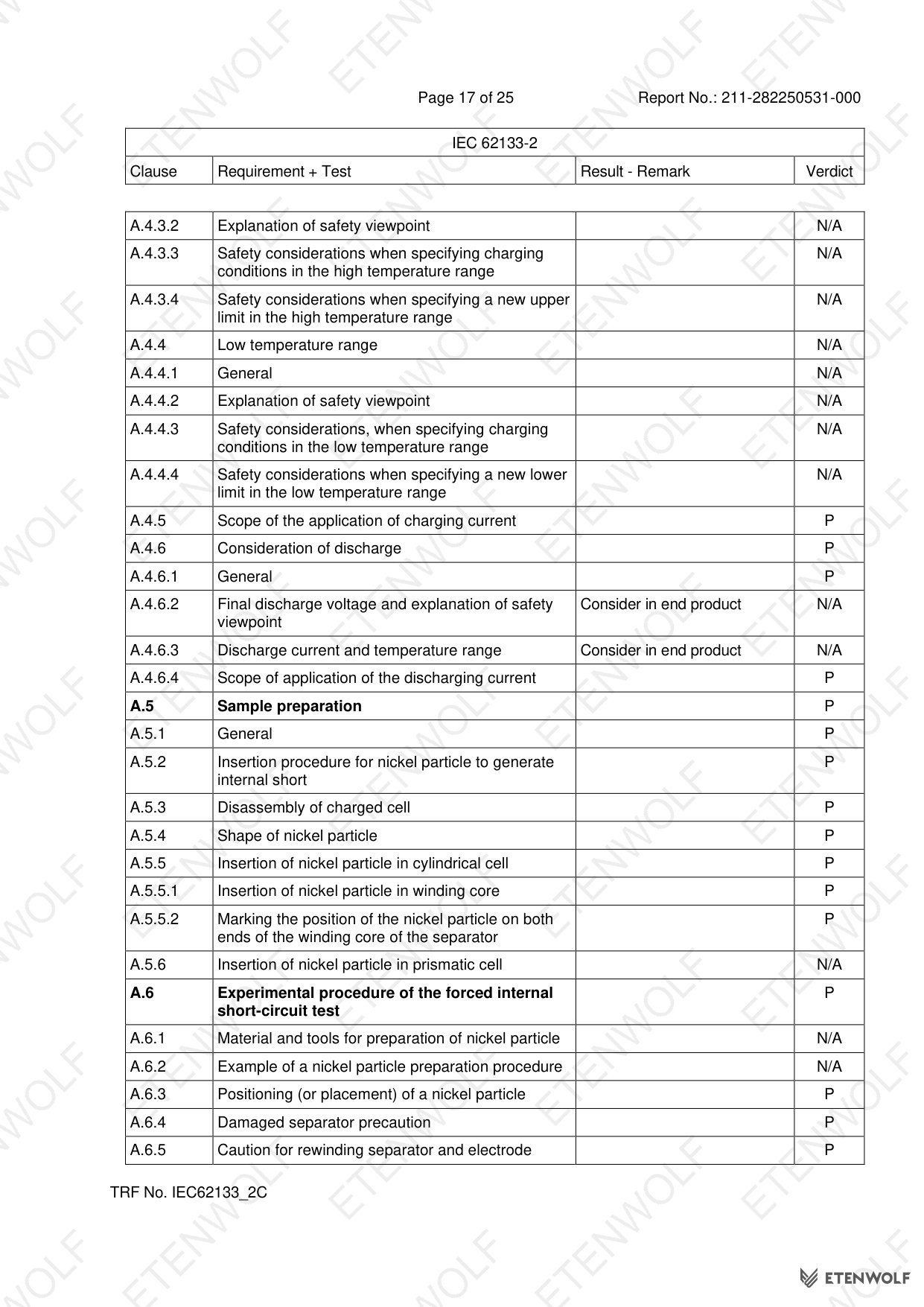
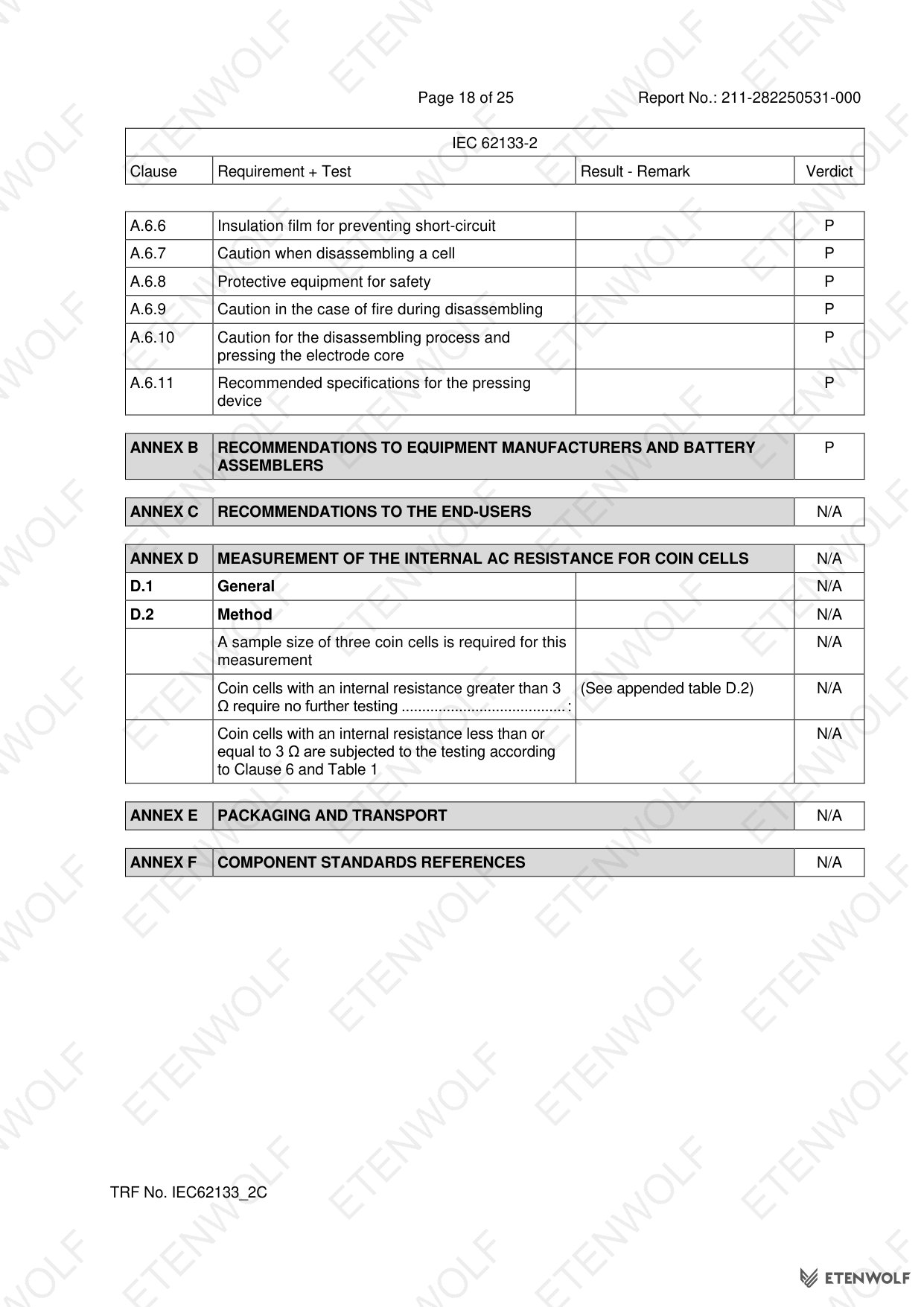
The report covers safety requirements for portable sealed secondary lithium cells and batteries for use in portable applications, per Part 2: Lithium systems of the IEC 62133 series.
Product Information
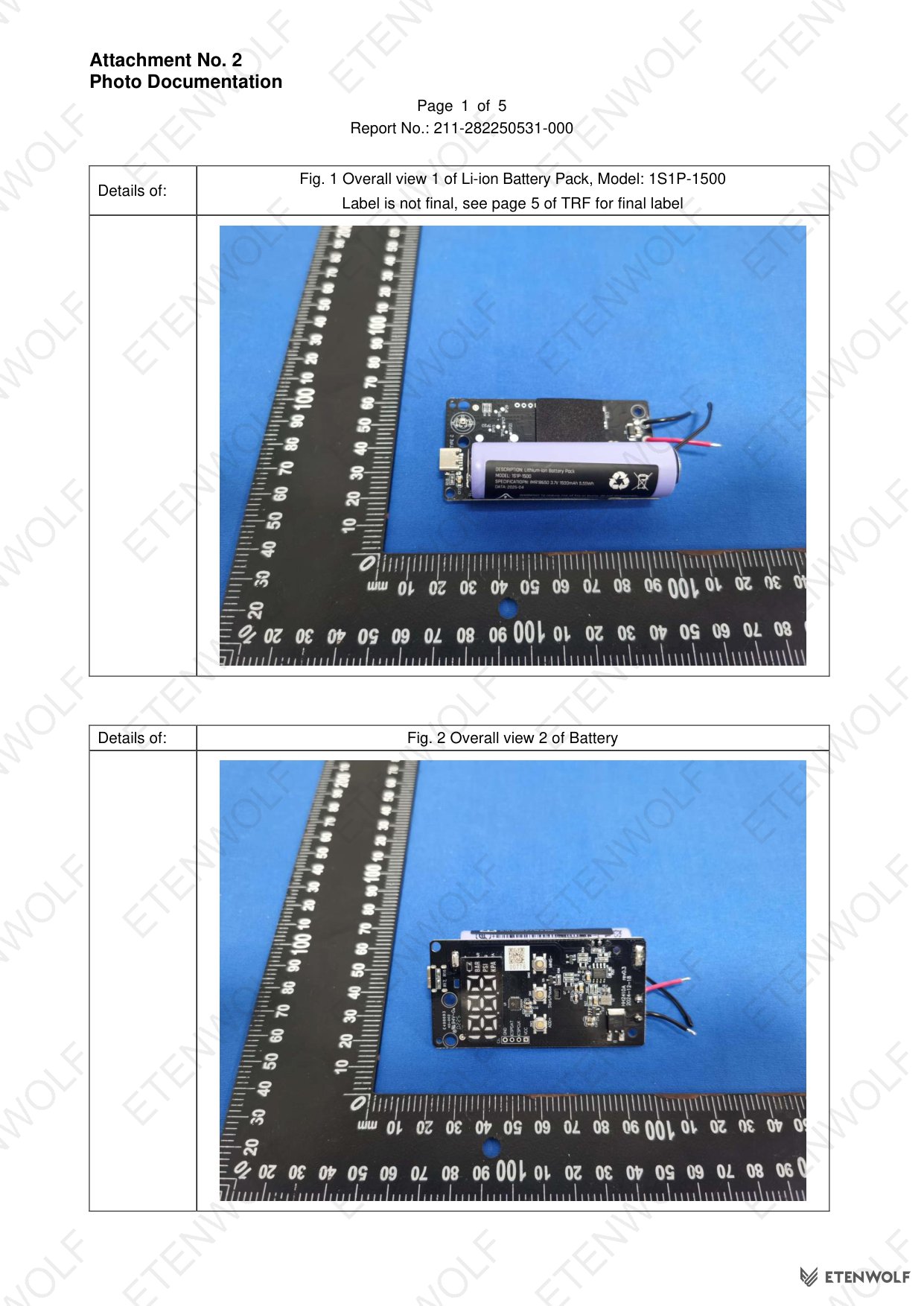
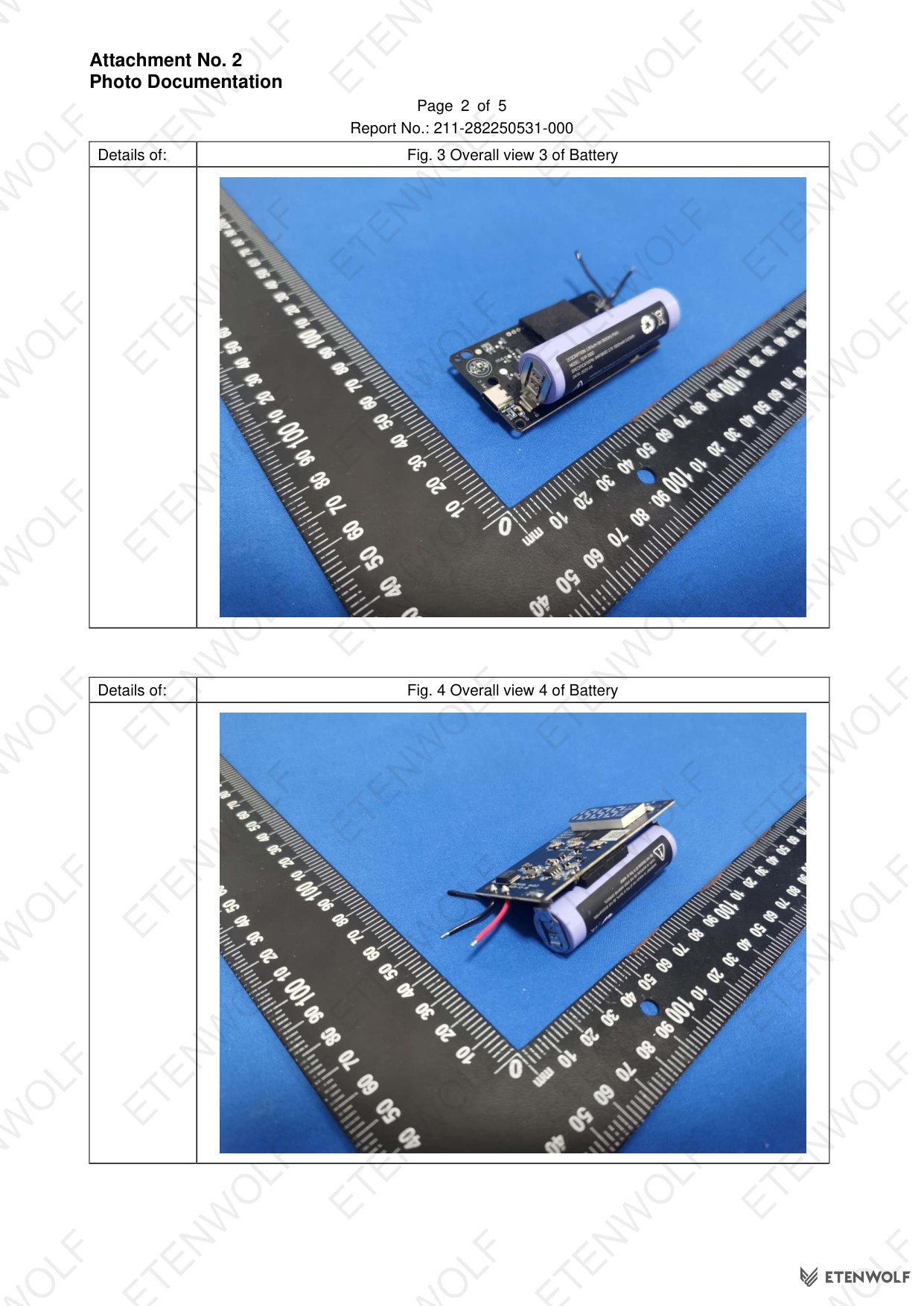
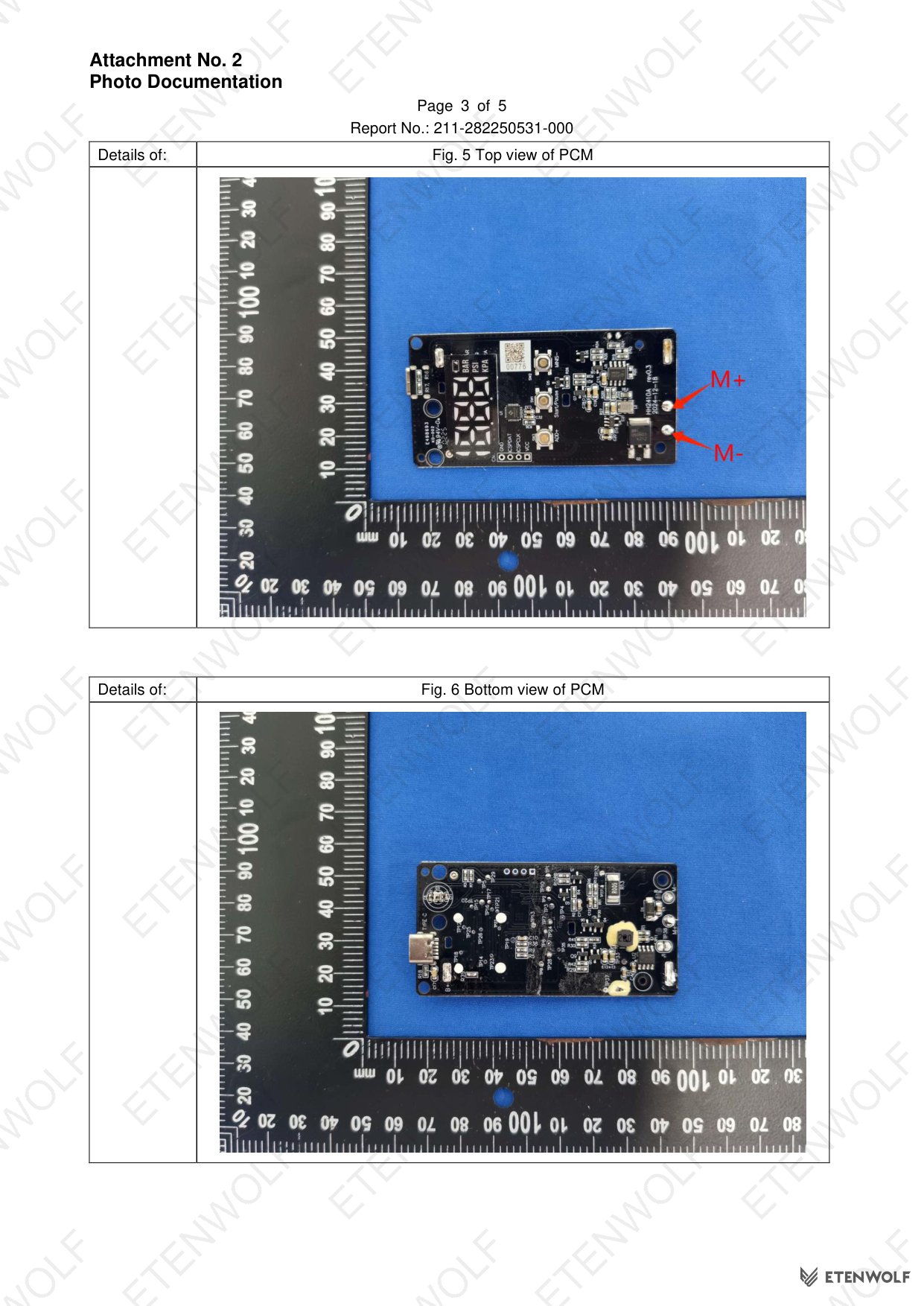
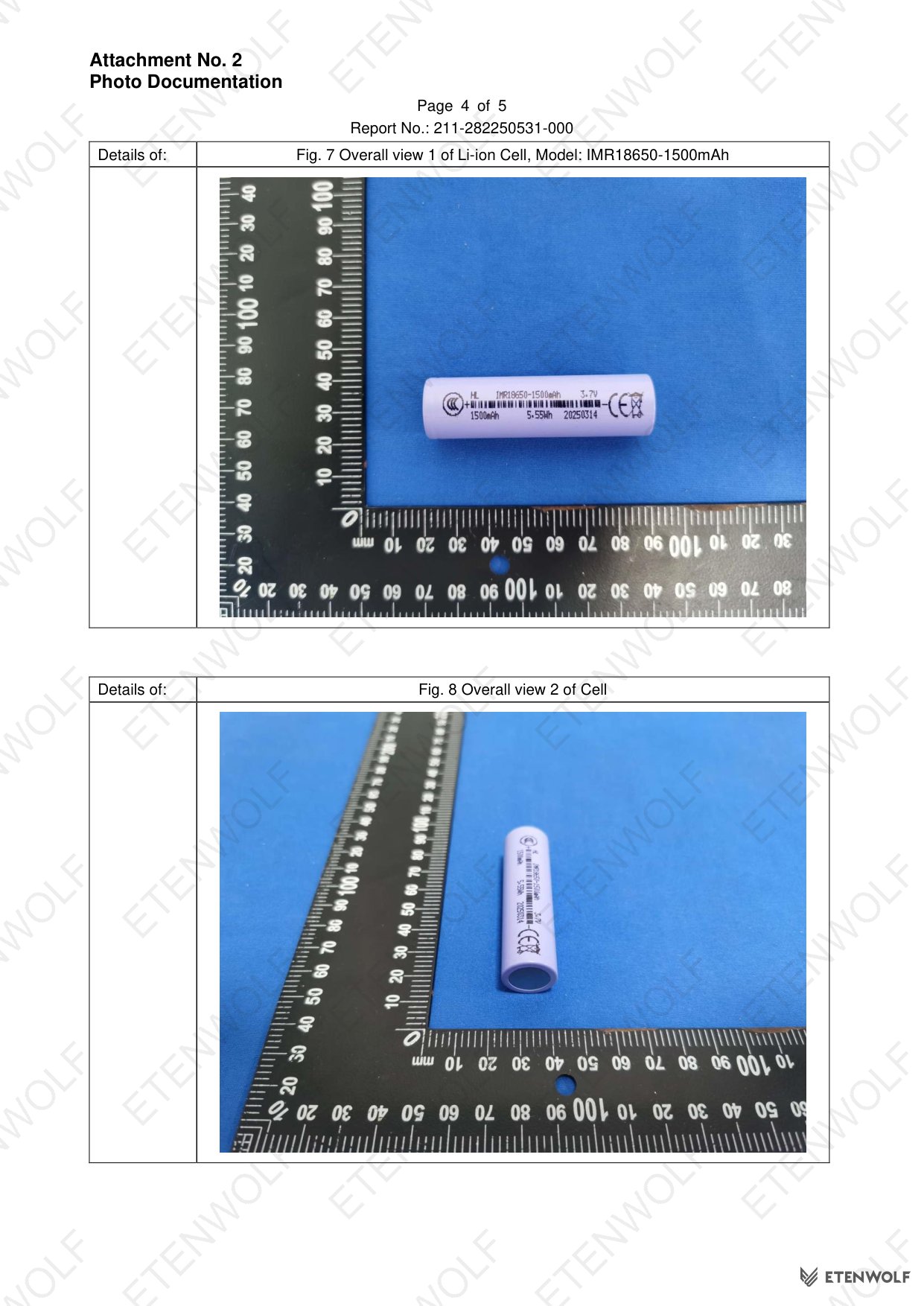
The tested product is the lithium-ion battery pack integrated into the ETENWOLF P100 portable inflation tool. Full product details as recorded in the test report are listed below.
| Field | Details |
|---|---|
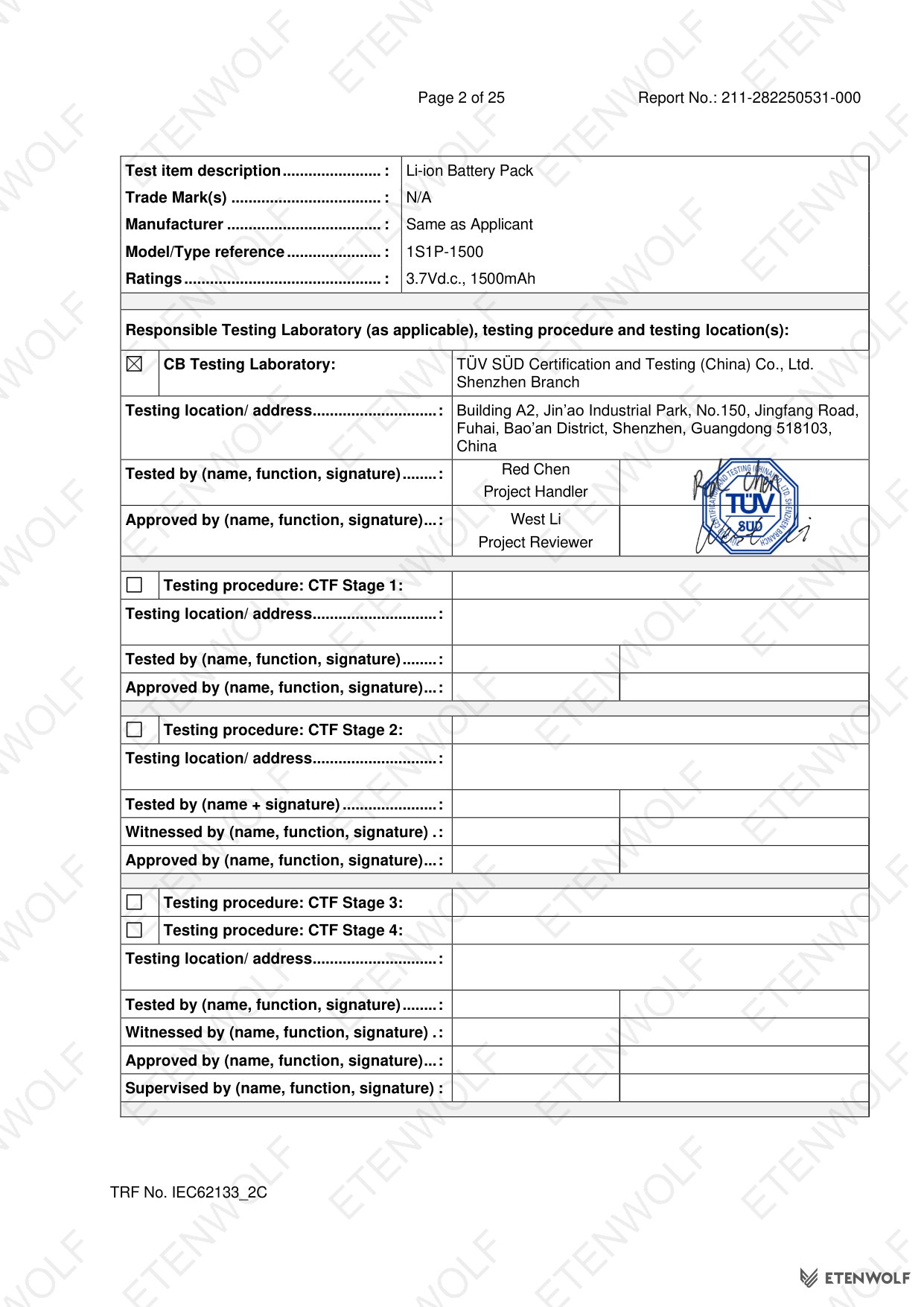
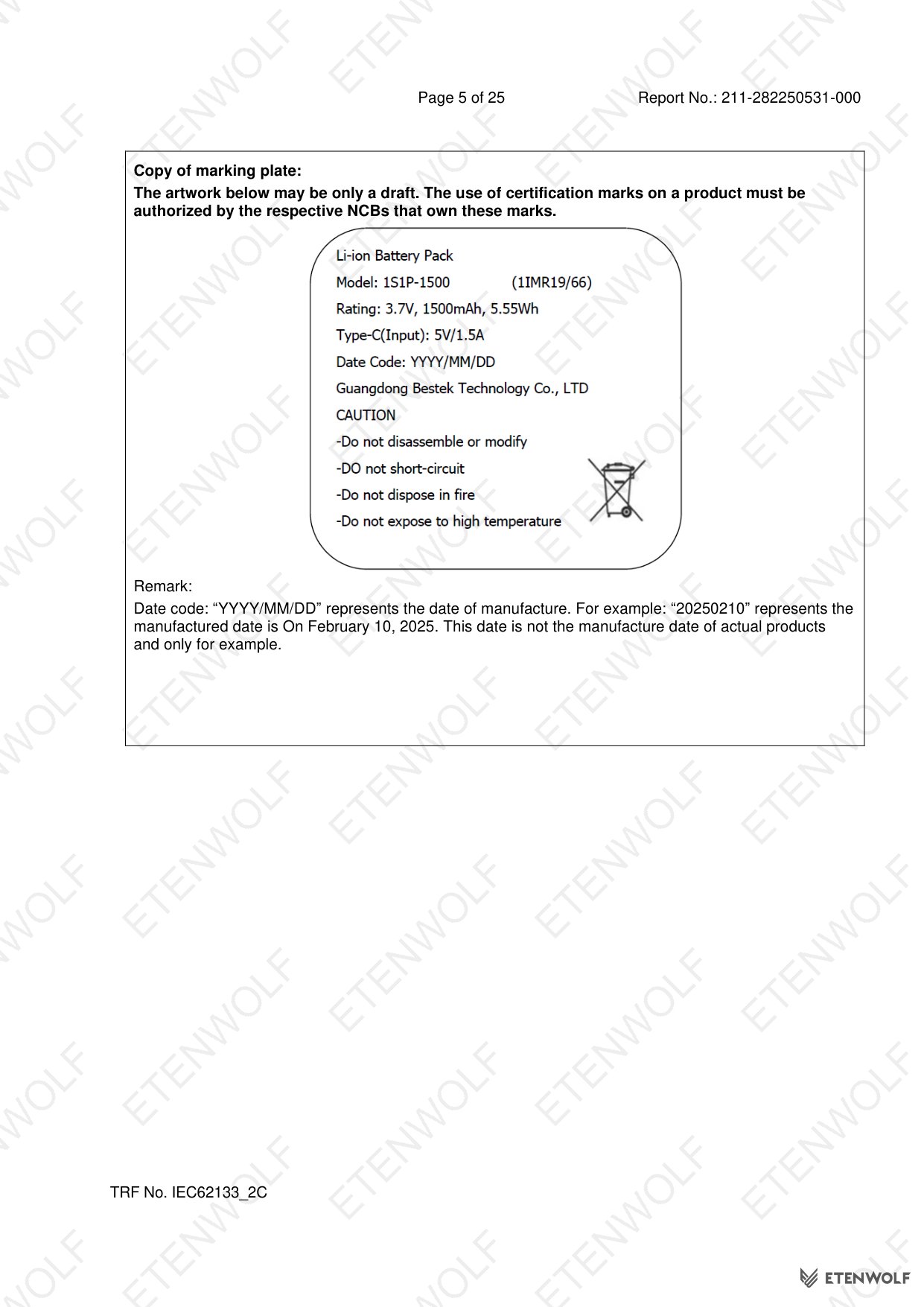
| Test Item Description | Li-ion Battery Pack |
| Model / Type Reference | 1S1P-1500 |
| Trade Mark(s) | N/A |
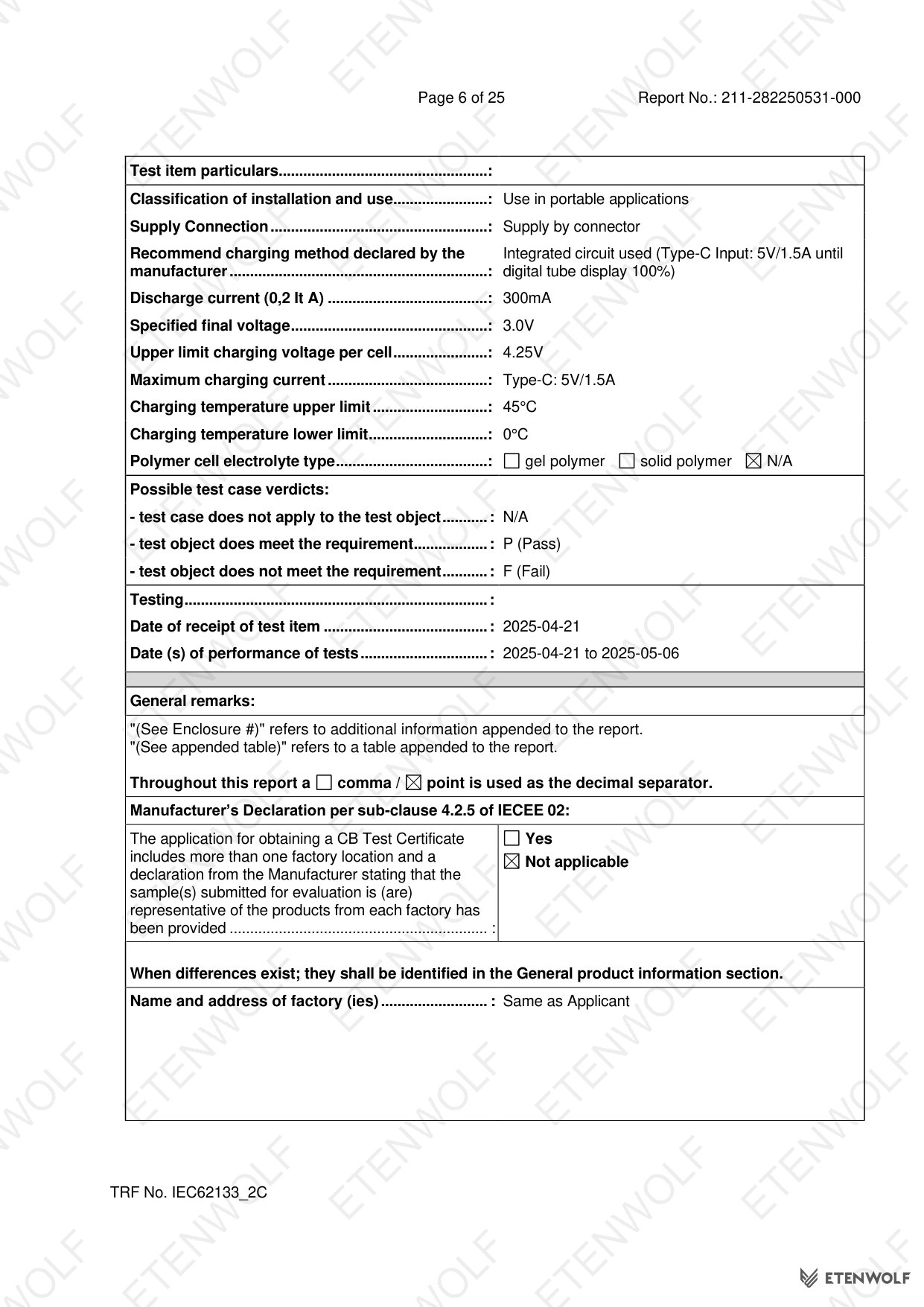
| Manufacturer | Same as Applicant |
| Applicant Name | Guangdong Bestek Technology Co., LTD |
| Applicant Address | No.1, North Gaopu 8th Road, Yuancheng Industrial Park, 517099 Heyuan City, Guangdong, People’s Republic of China |
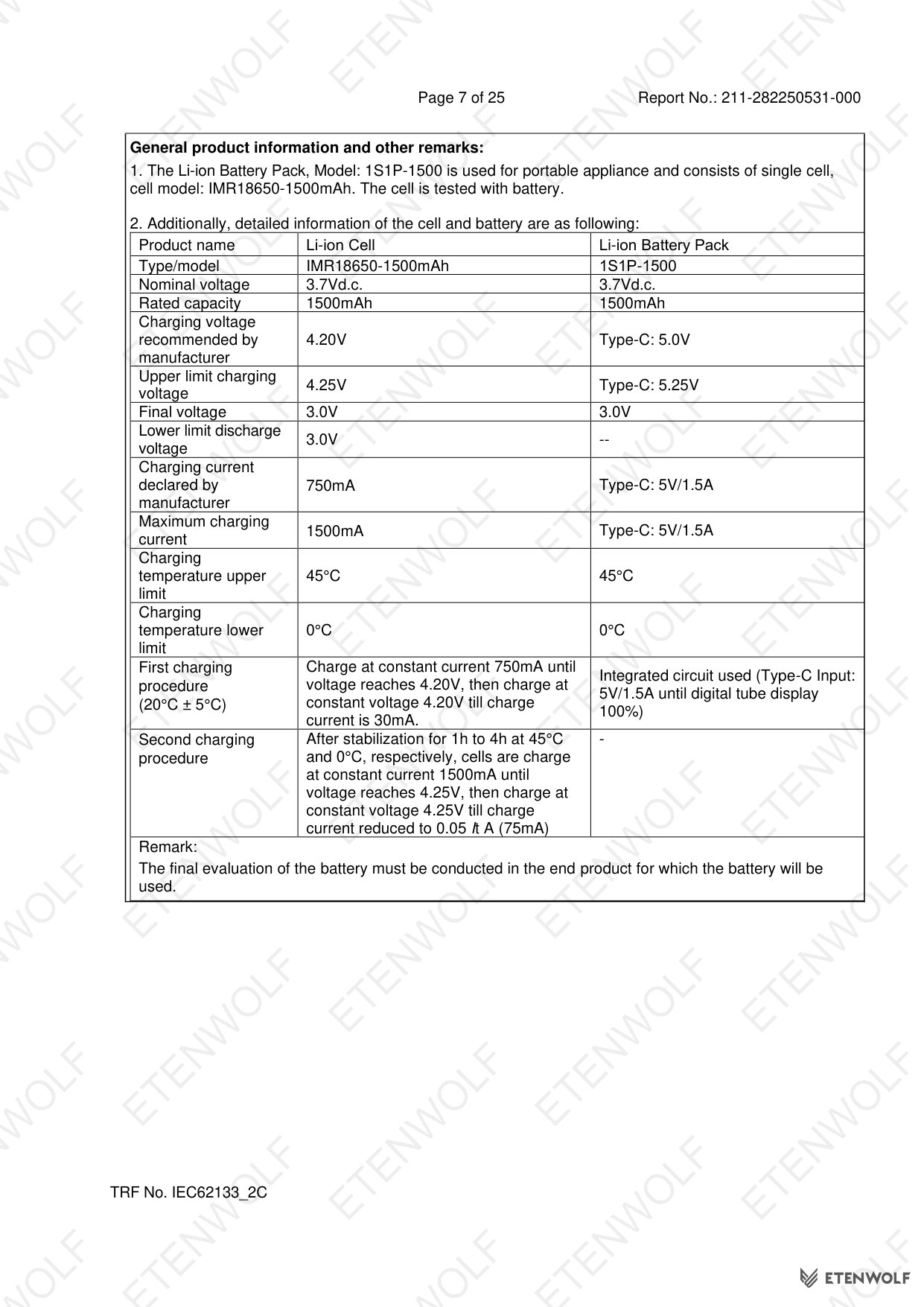
| Rated Voltage | 3.7 V d.c. |
| Rated Capacity | 1500 mAh |
| Date Code Format | YYYY/MM/DD (e.g., 20250210 = February 10, 2025) |
The battery pack is classified for portable use and is designed to power the ETENWOLF P100 cordless inflation device.
Key Details
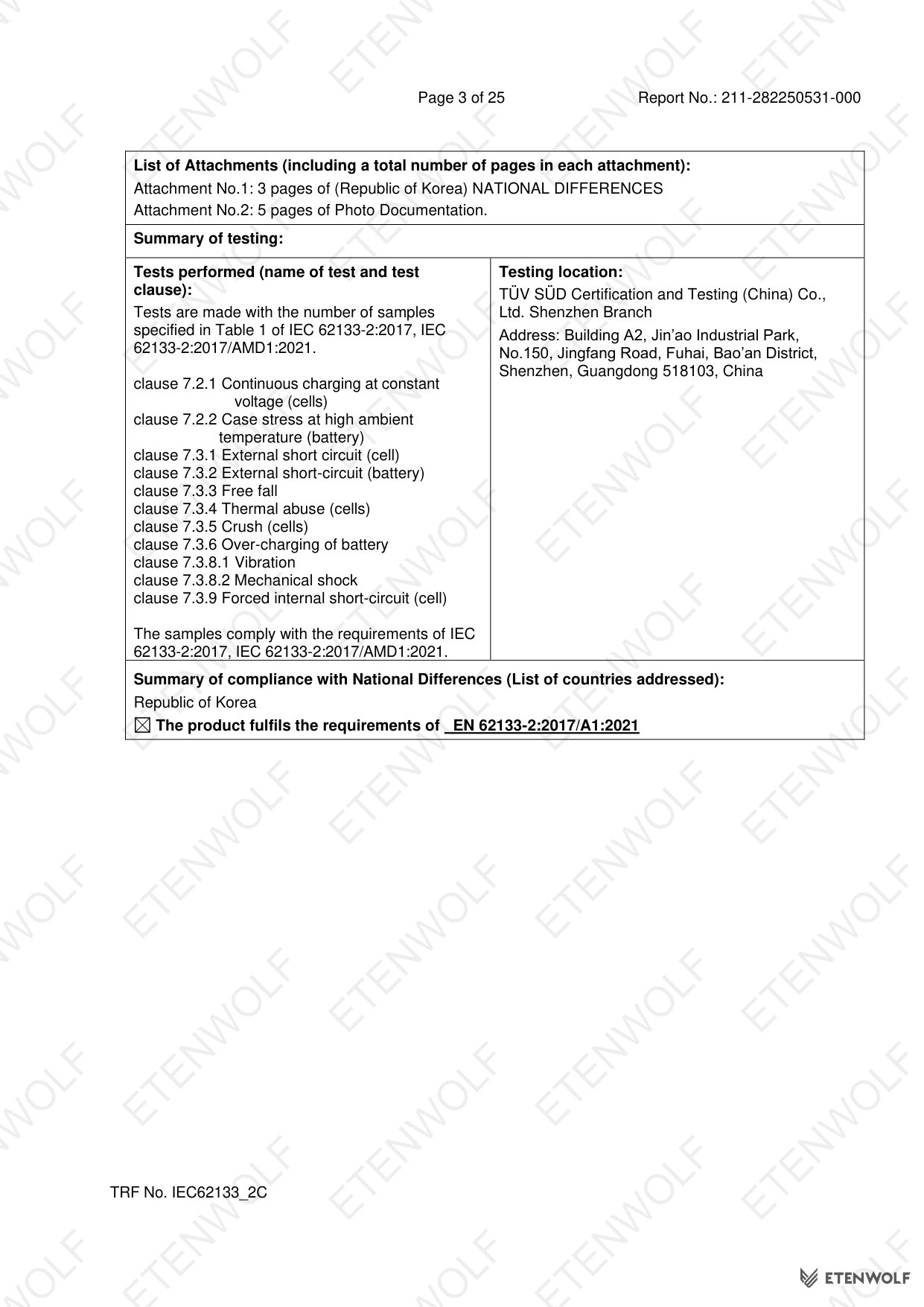
The following tests were conducted in accordance with the sample quantities specified in Table 1 of IEC 62133-2:2017/AMD1:2021. All tests were performed at the TÜV SÜD Certification and Testing (China) Co., Ltd. Shenzhen Branch, Building A2, Jin’ao Industrial Park, No. 150, Jingfang Road, Fuhai, Bao’an District, Shenzhen, Guangdong 518103, China.
| Test Clause | Test Name | Result |
|---|---|---|
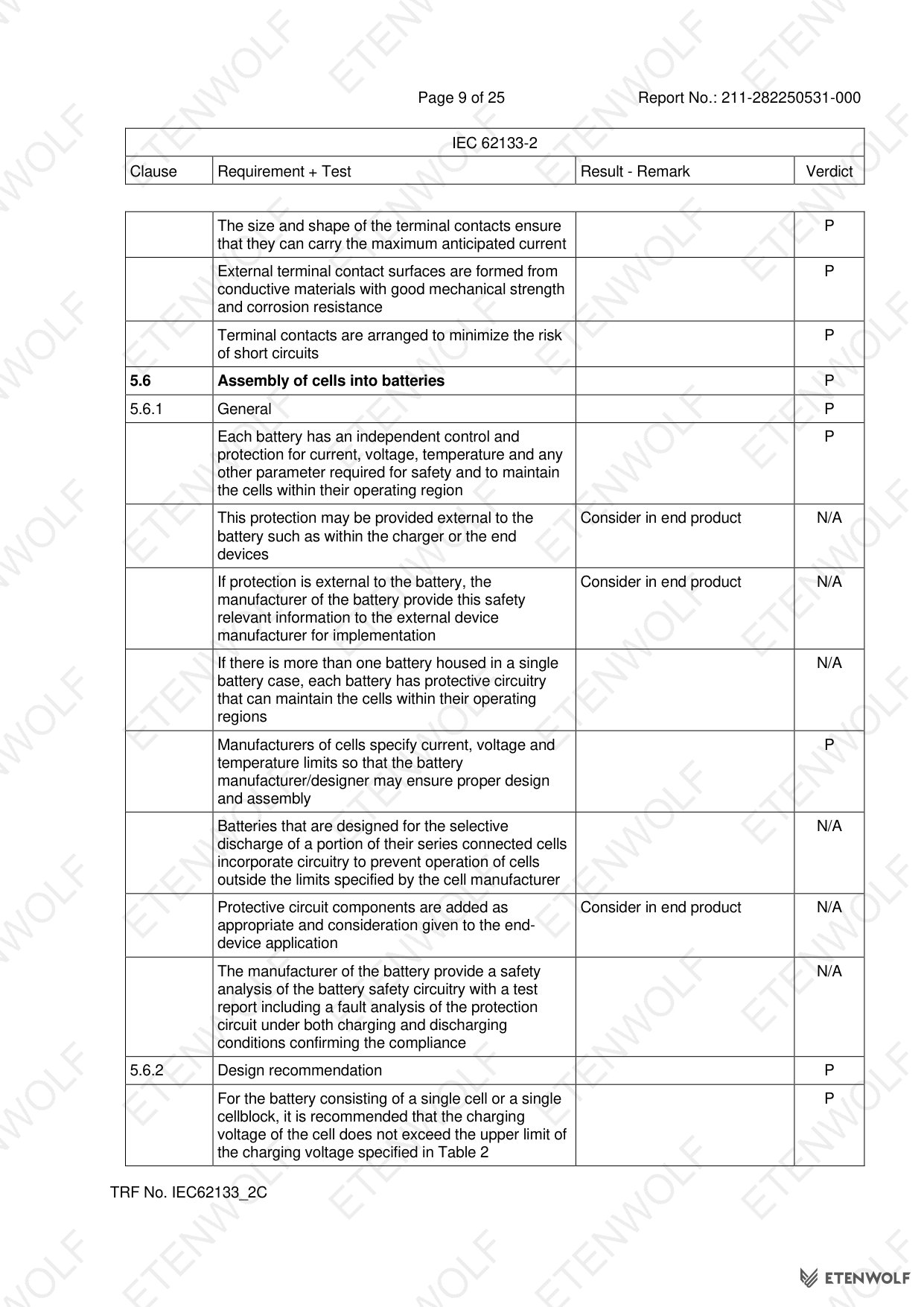
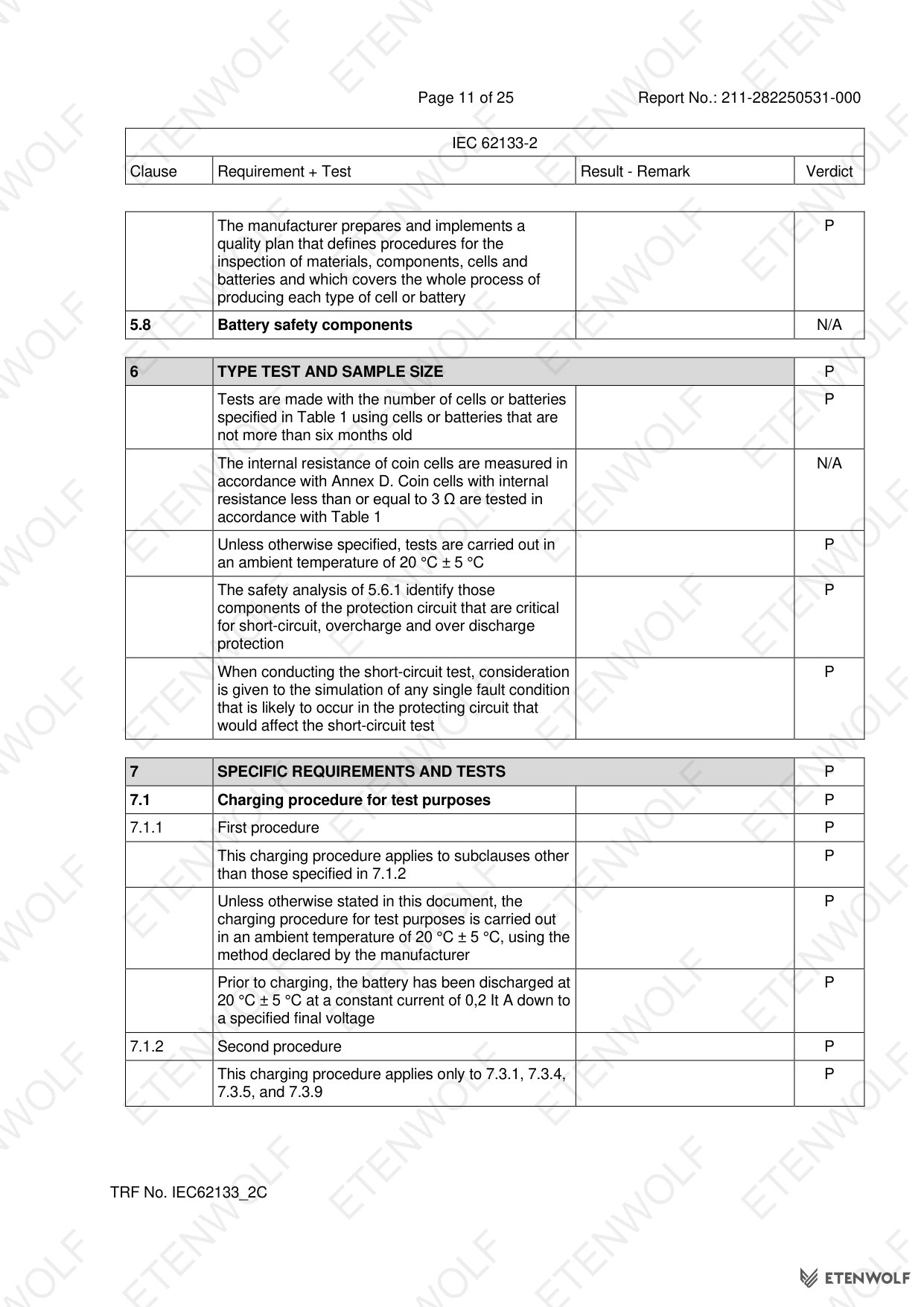
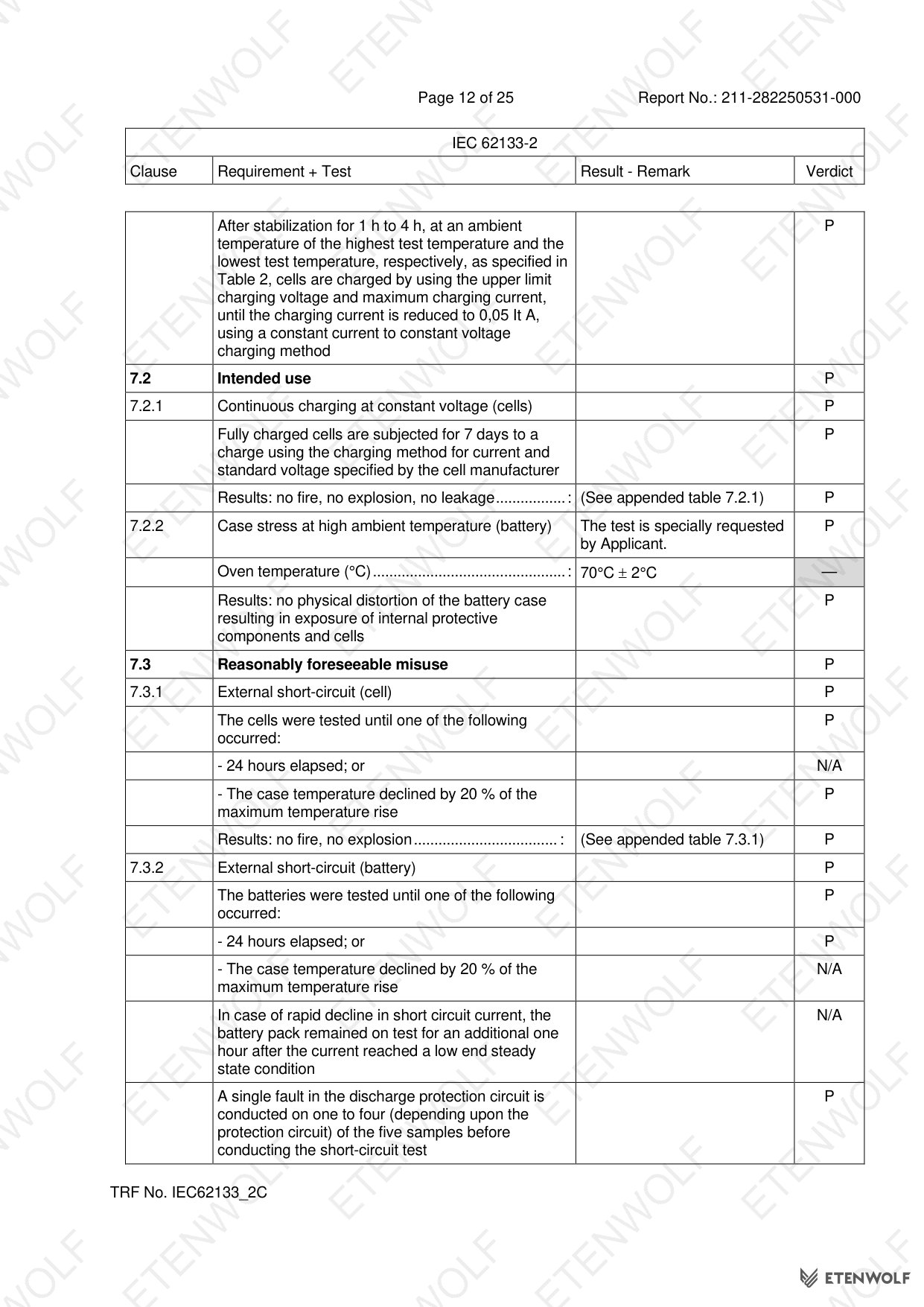
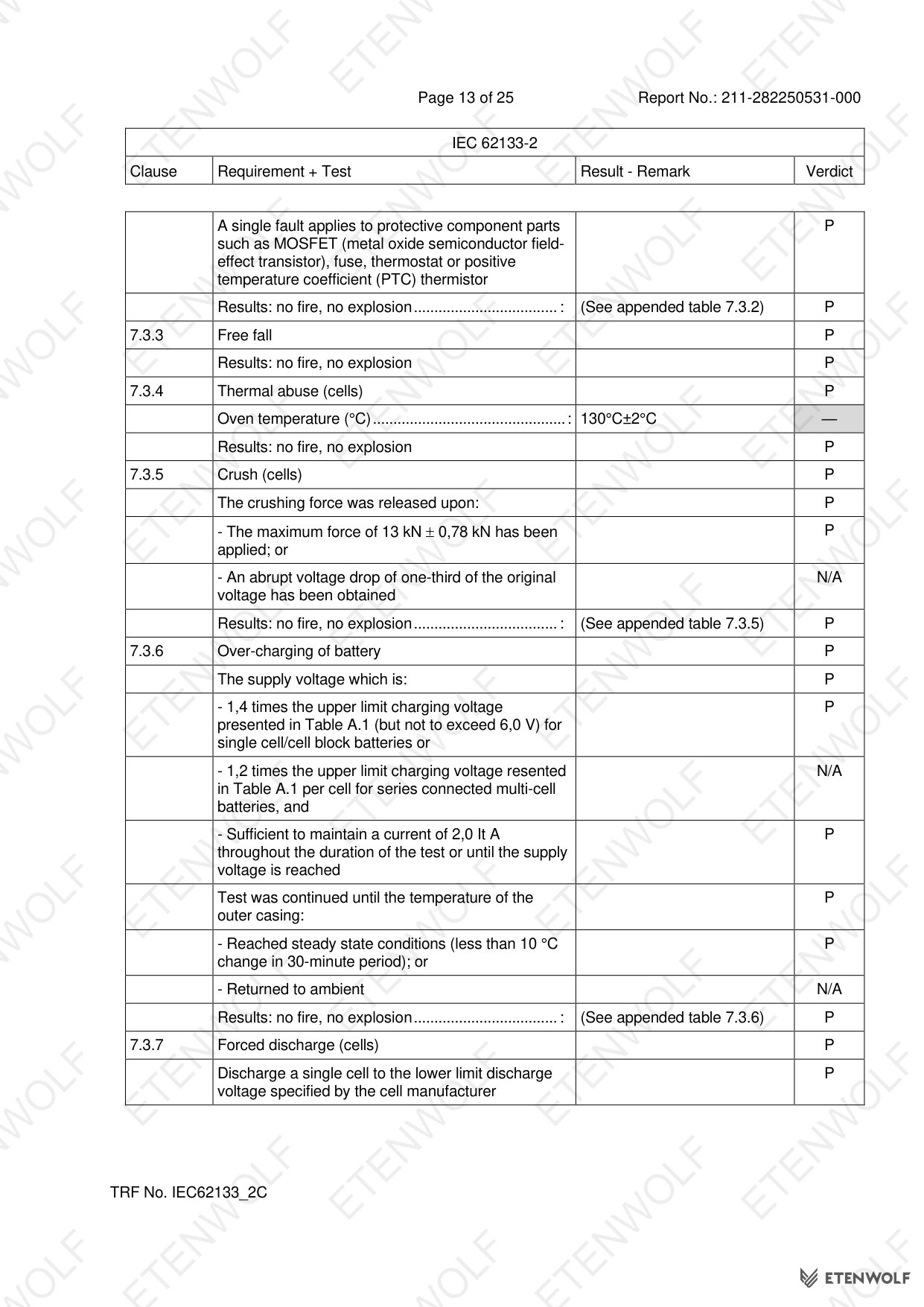
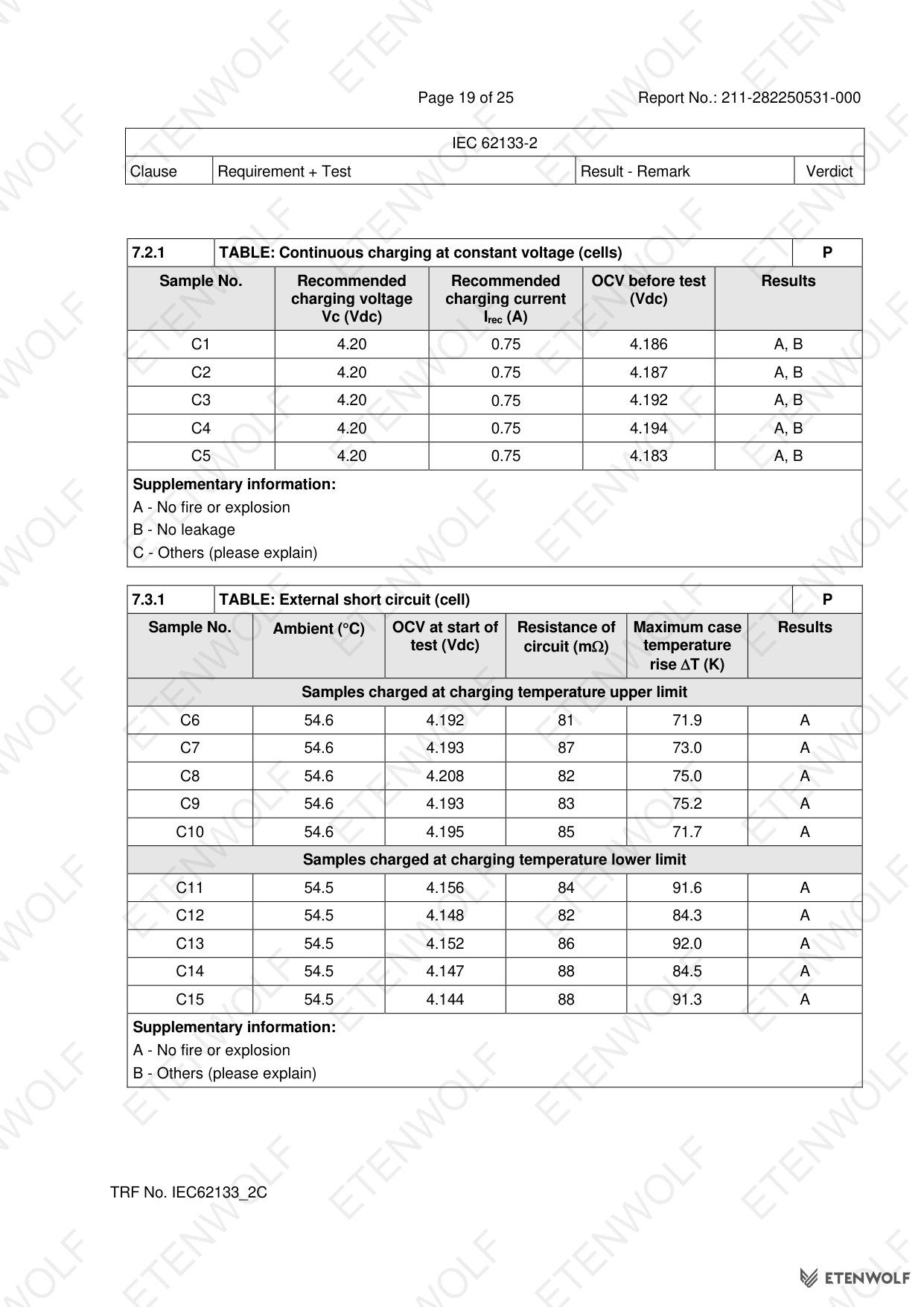
| 7.2.1 | Continuous charging at constant voltage (cells) | Pass |
| 7.2.2 | Case stress at high ambient temperature (battery) | Pass |
| 7.3.1 | External short circuit (cell) | Pass |
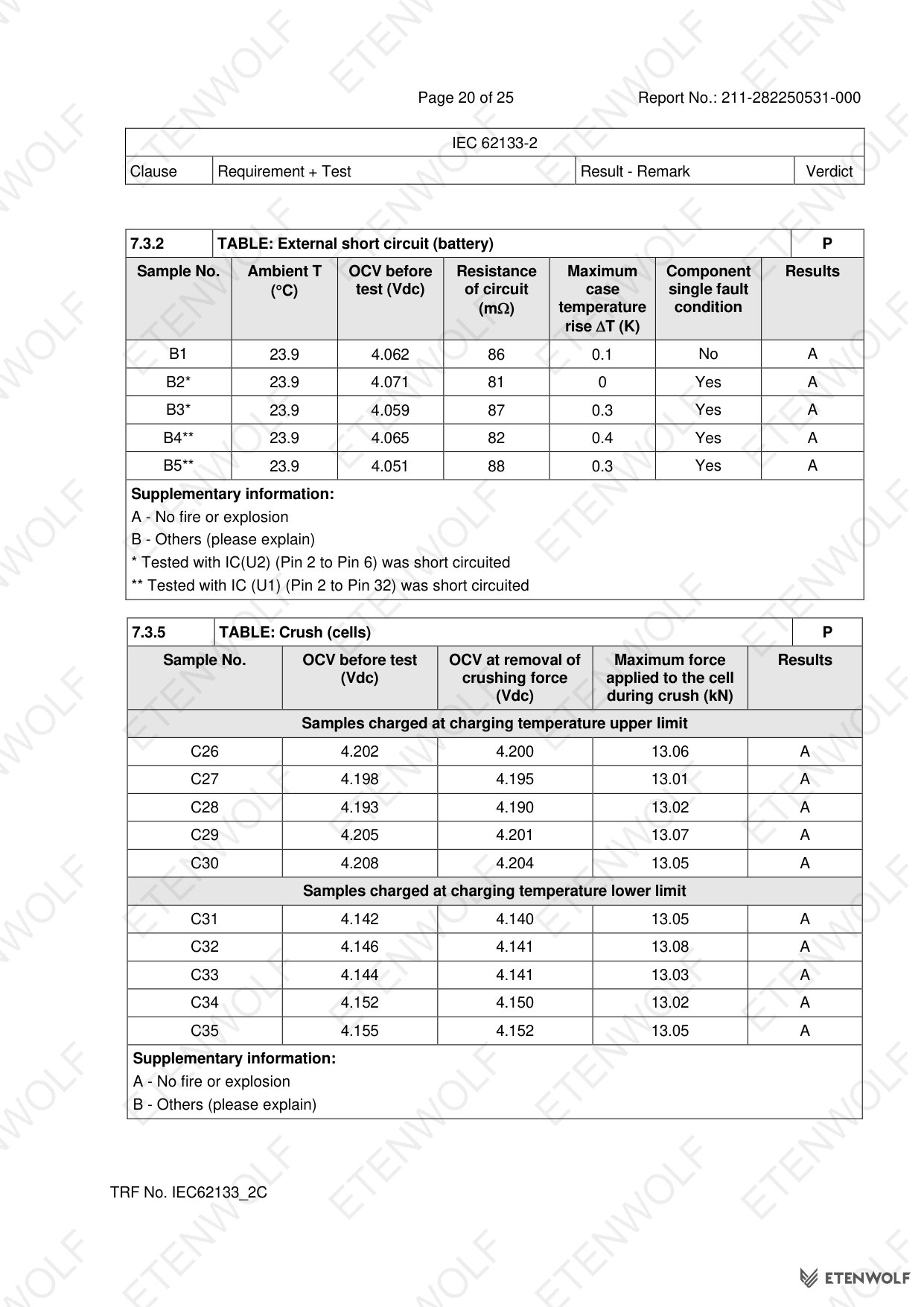
| 7.3.2 | External short-circuit (battery) | Pass |
| 7.3.3 | Free fall | Pass |
| 7.3.4 | Thermal abuse (cells) | Pass |
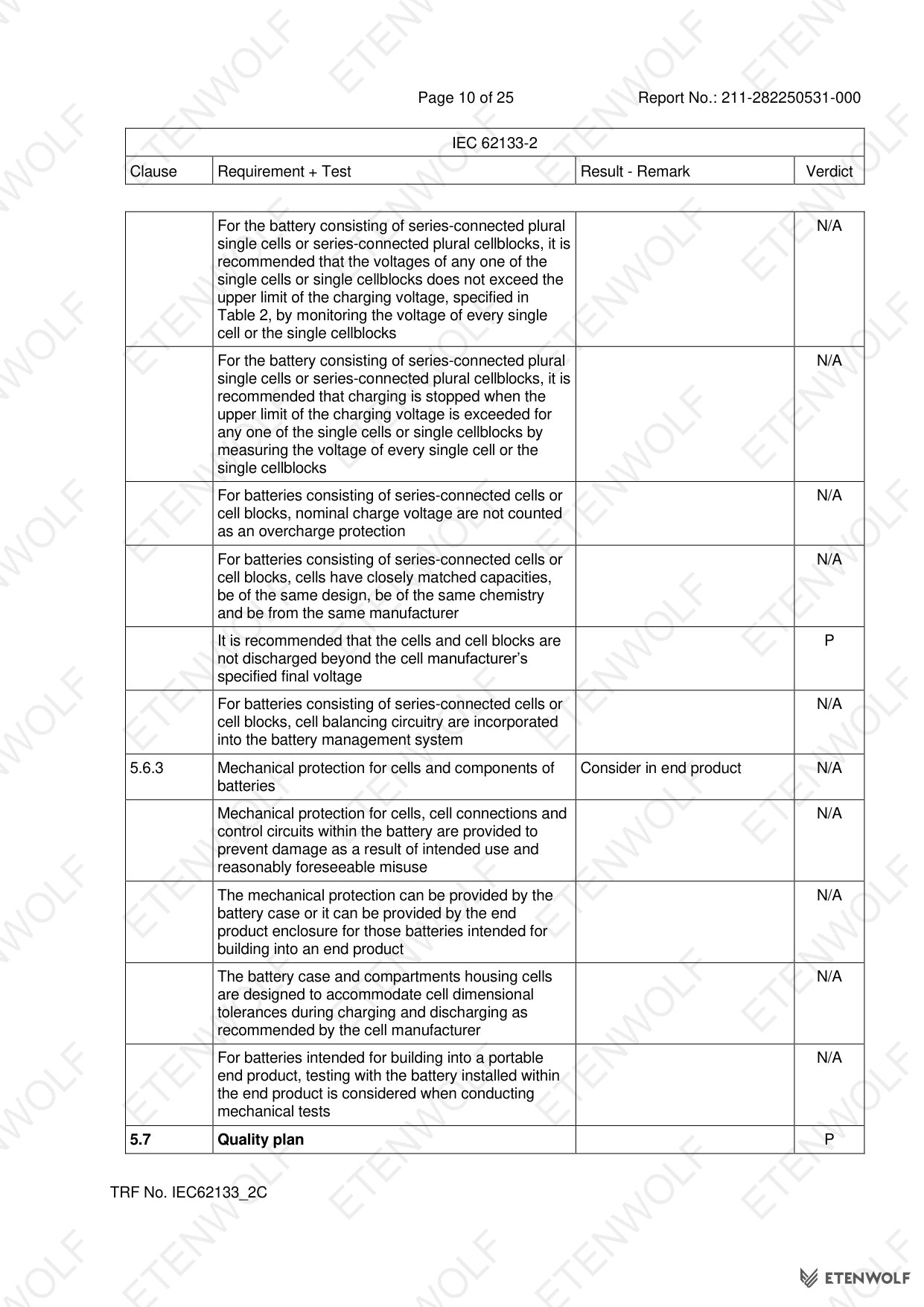
| 7.3.5 | Crush (cells) | Pass |
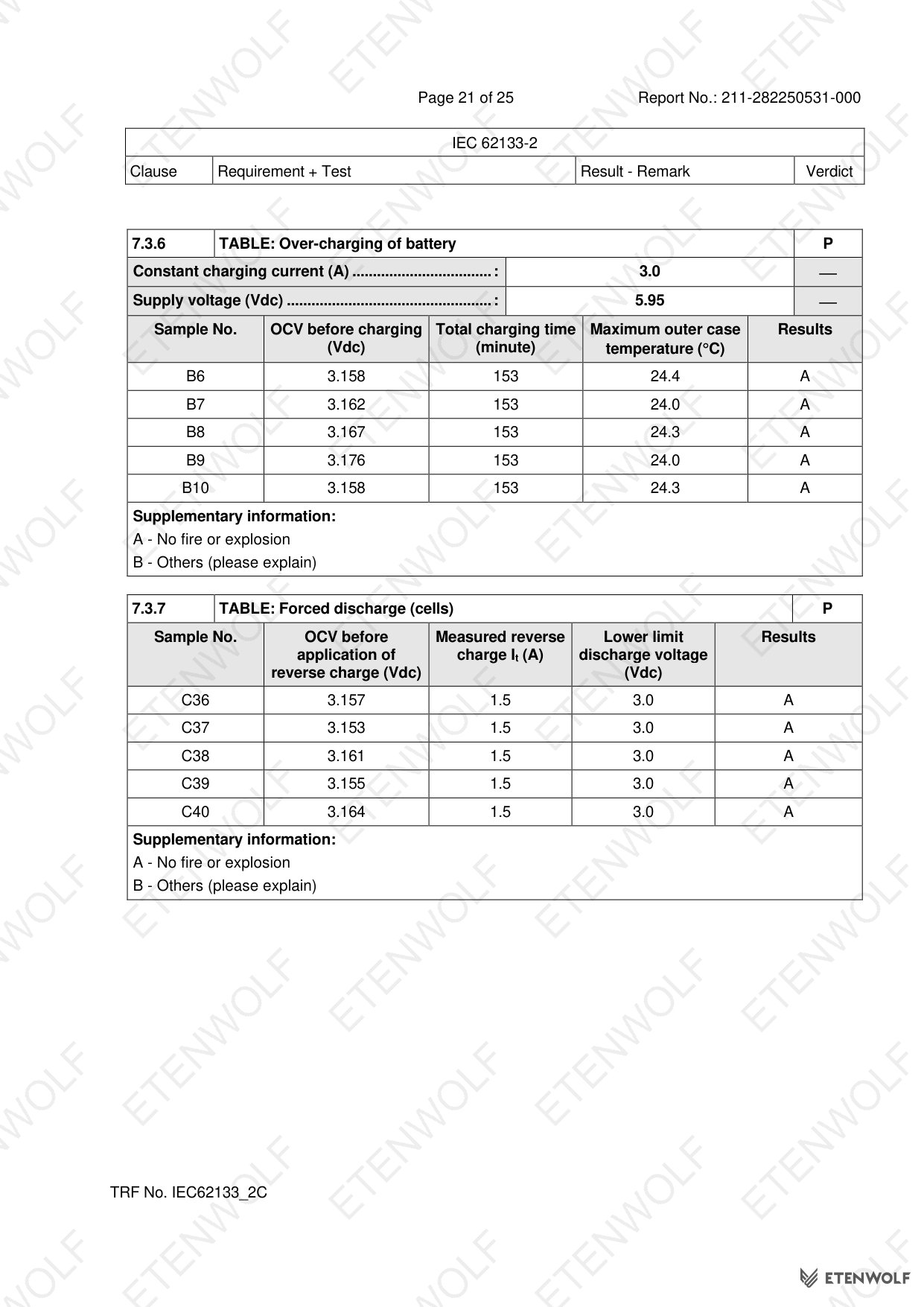
| 7.3.6 | Over-charging of battery | Pass |
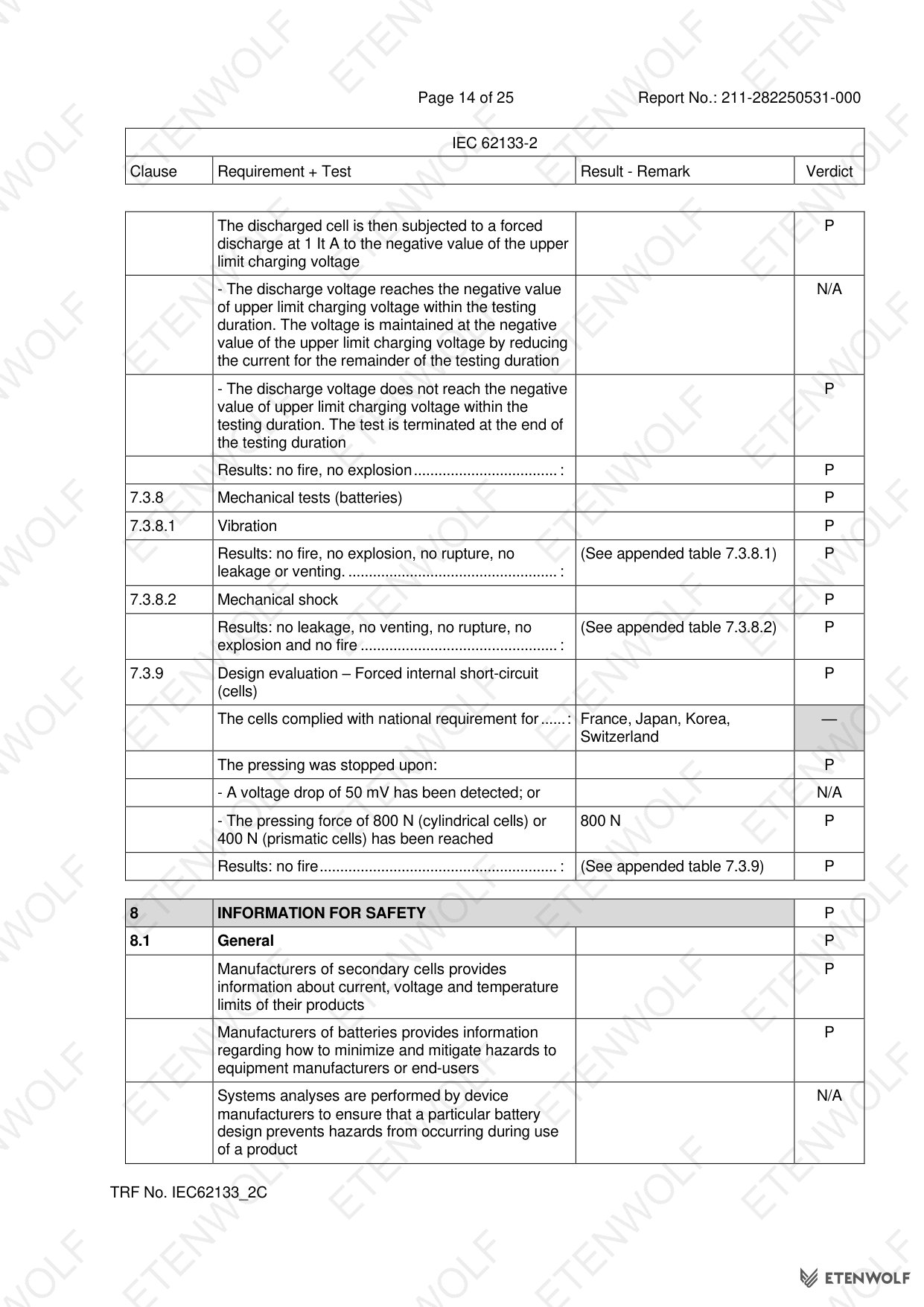
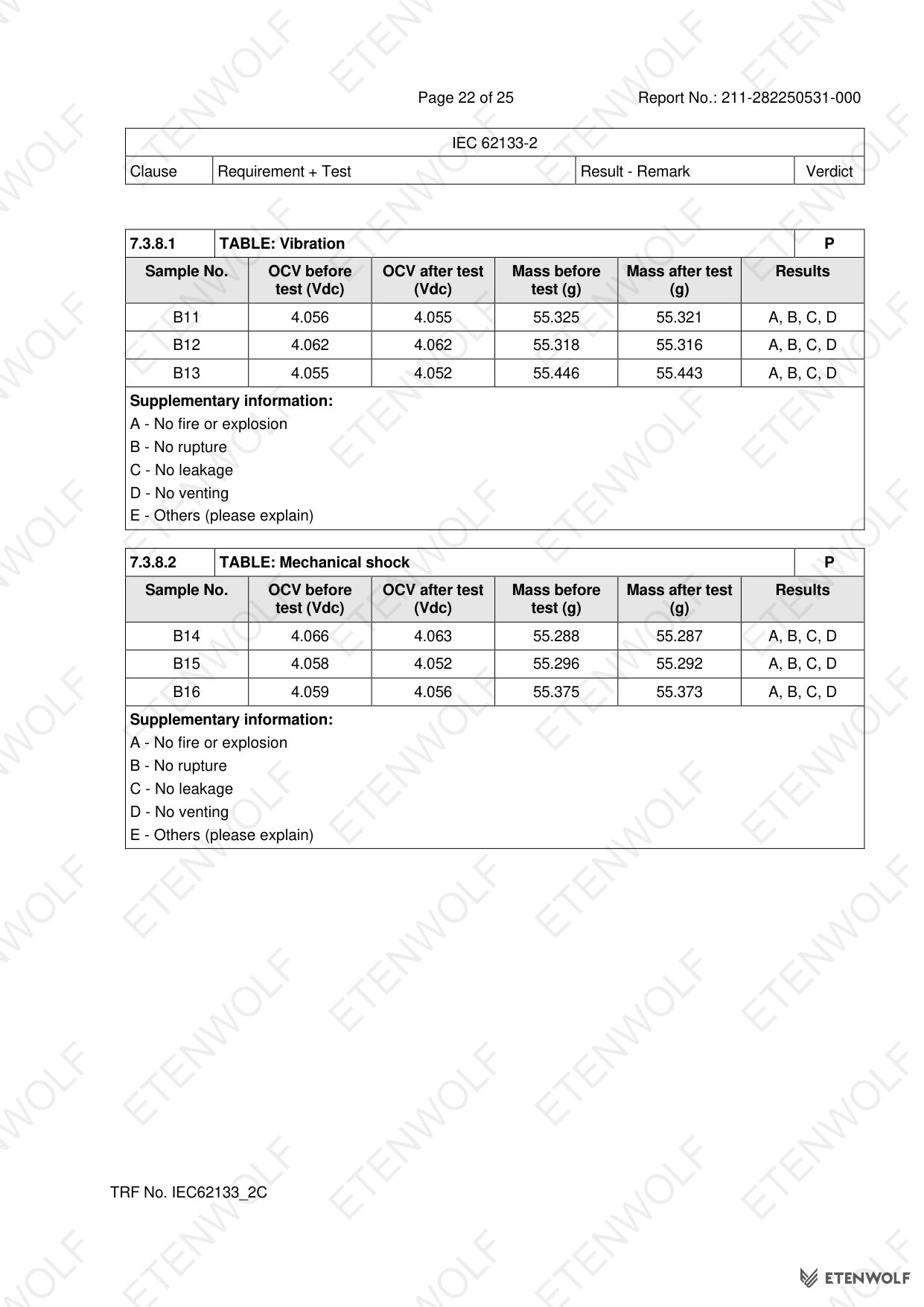
| 7.3.8.1 | Vibration | Pass |
| 7.3.8.2 | Mechanical shock | Pass |
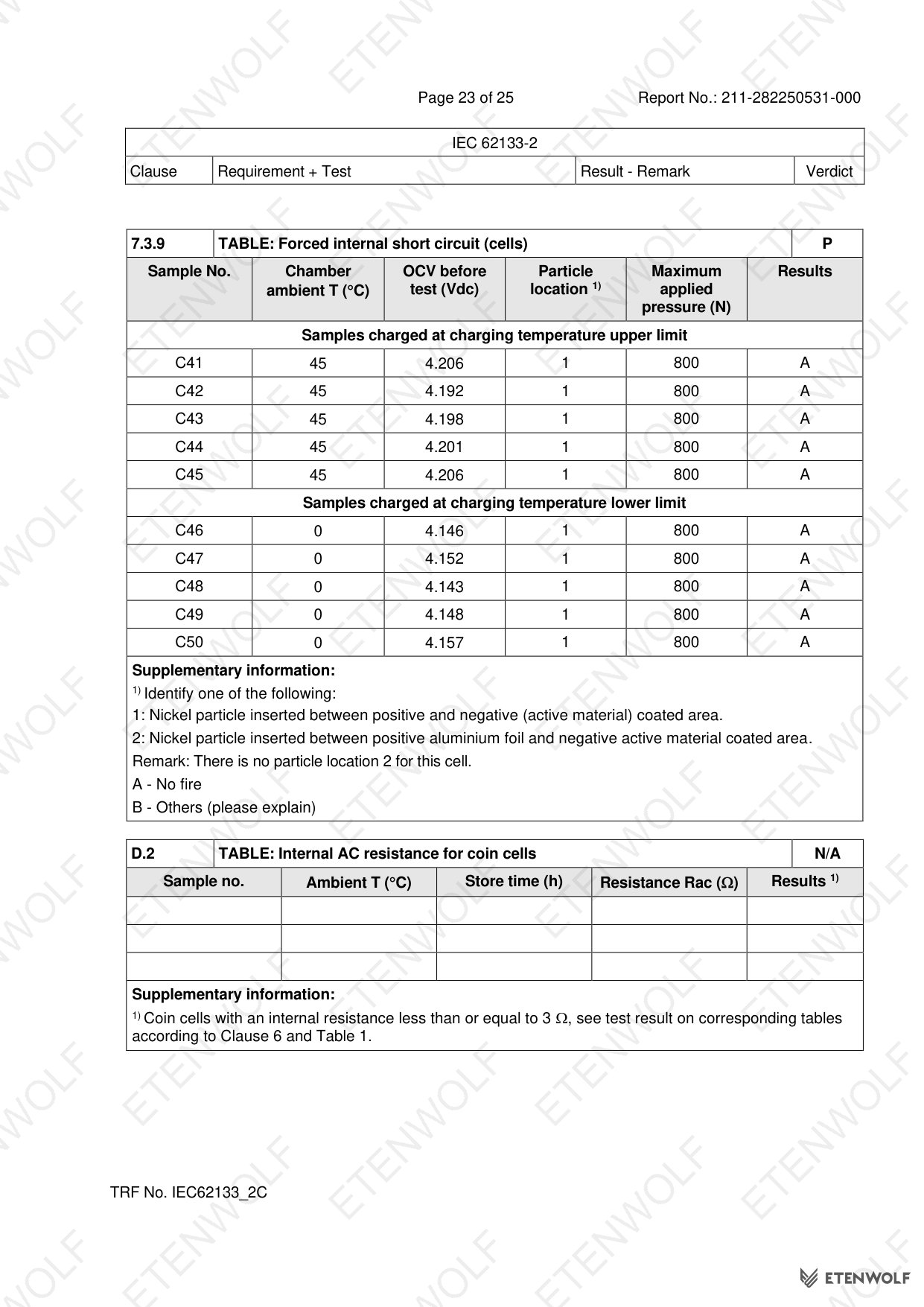
| 7.3.9 | Forced internal short-circuit (cell) | Pass |
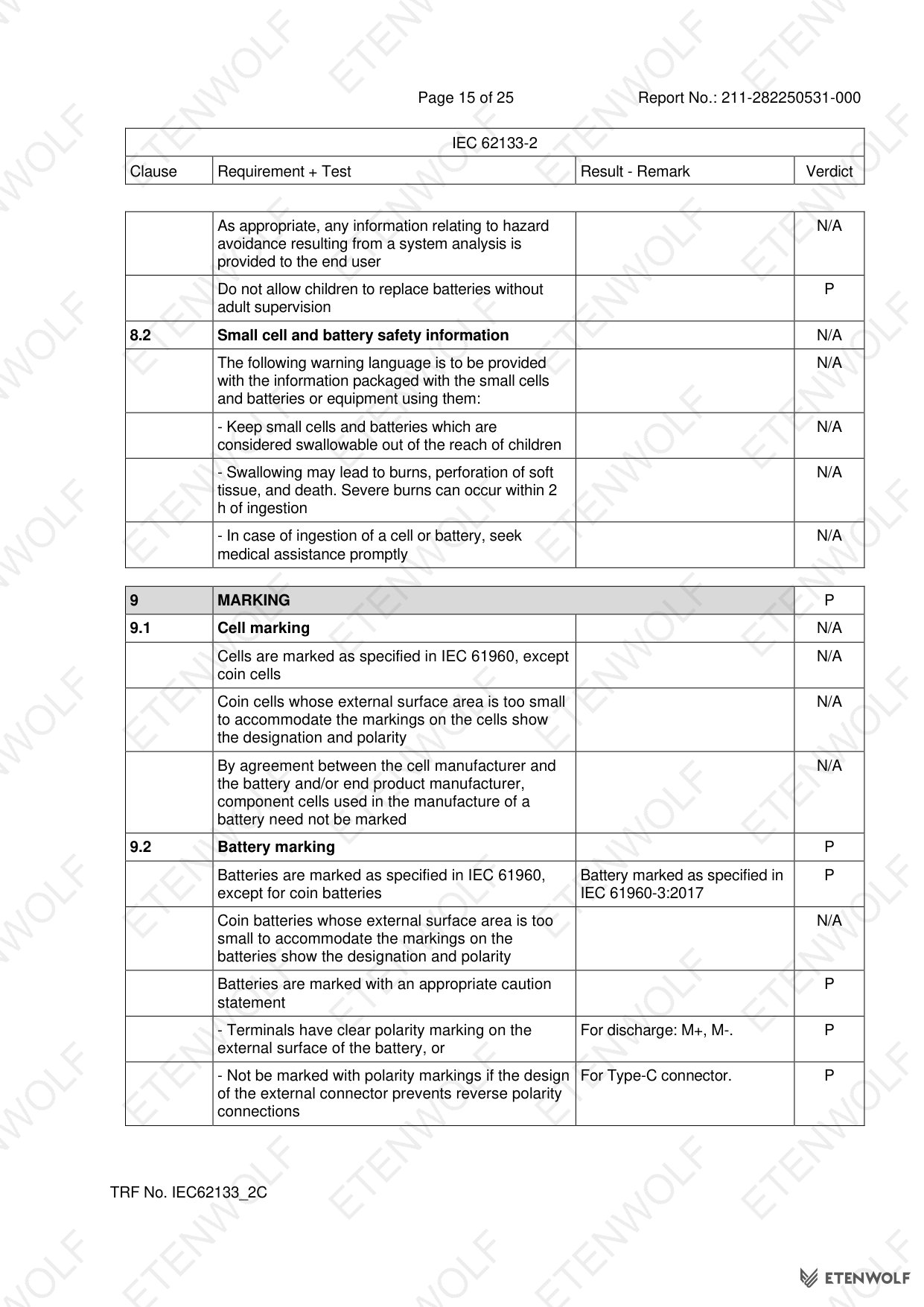
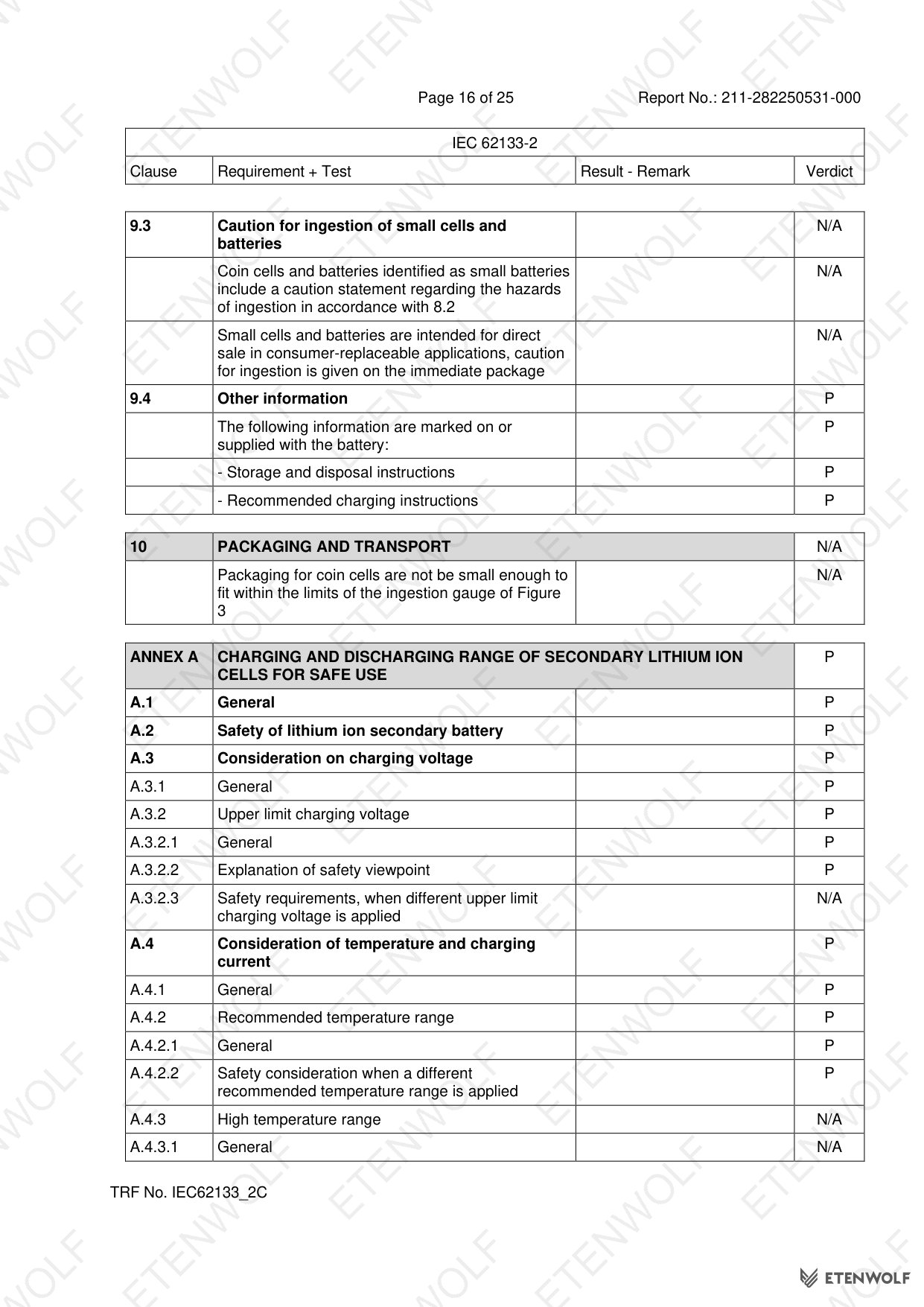
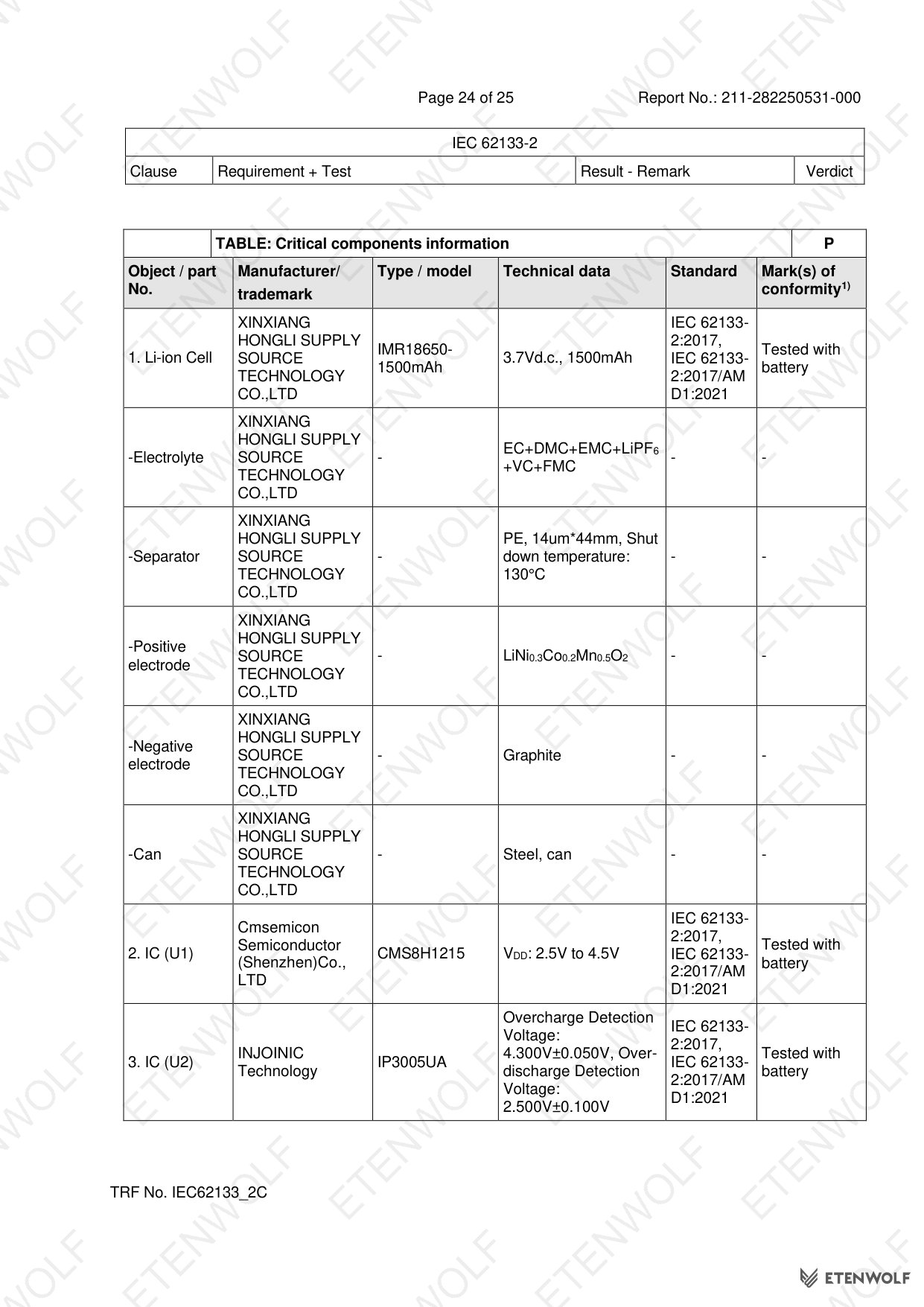
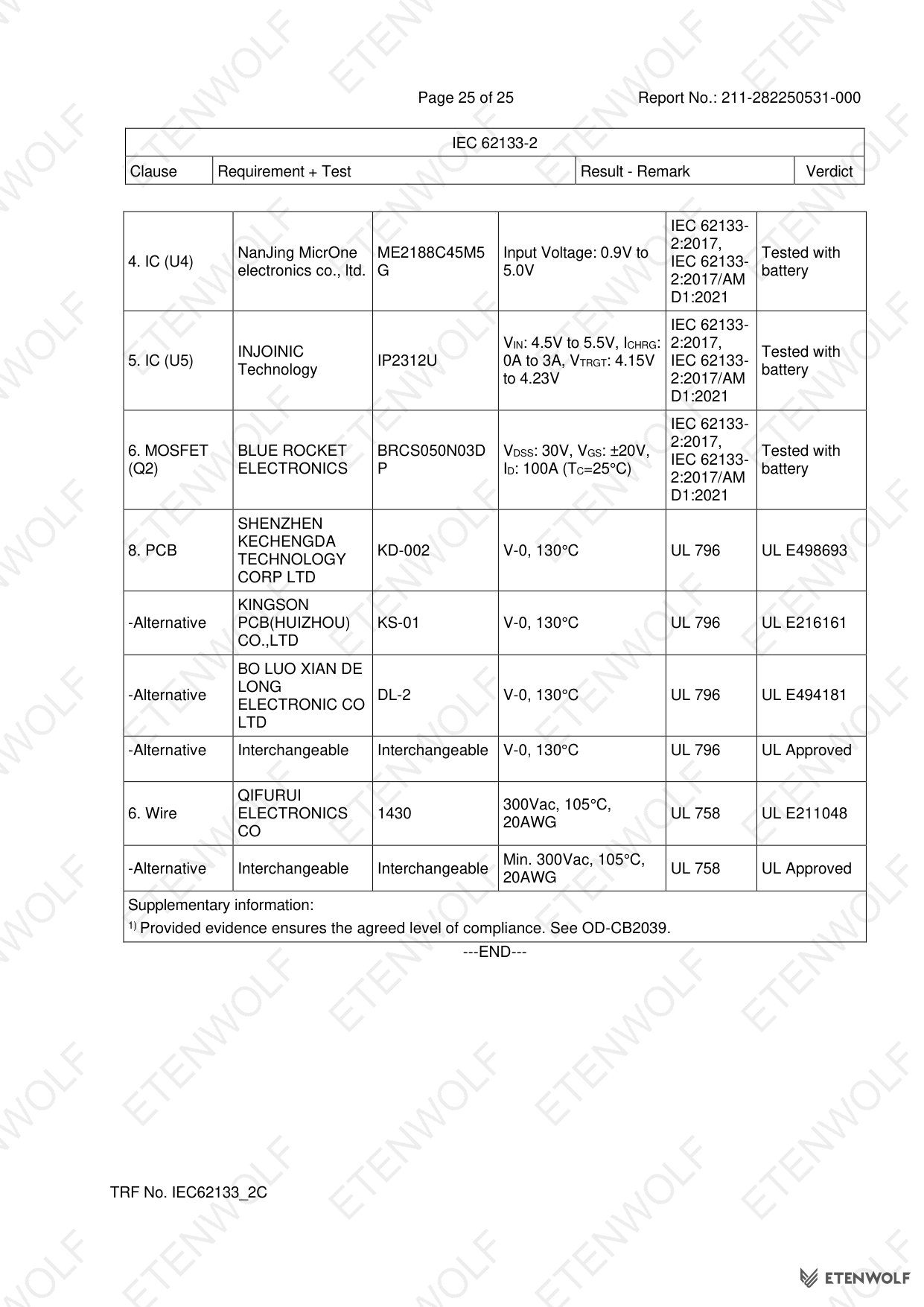
Overall conclusion: The samples comply with the requirements of IEC 62133-2:2017 and IEC 62133-2:2017/AMD1:2021.
Testing was carried out by Red Chen (Project Handler) and reviewed and approved by West Li (Project Reviewer).
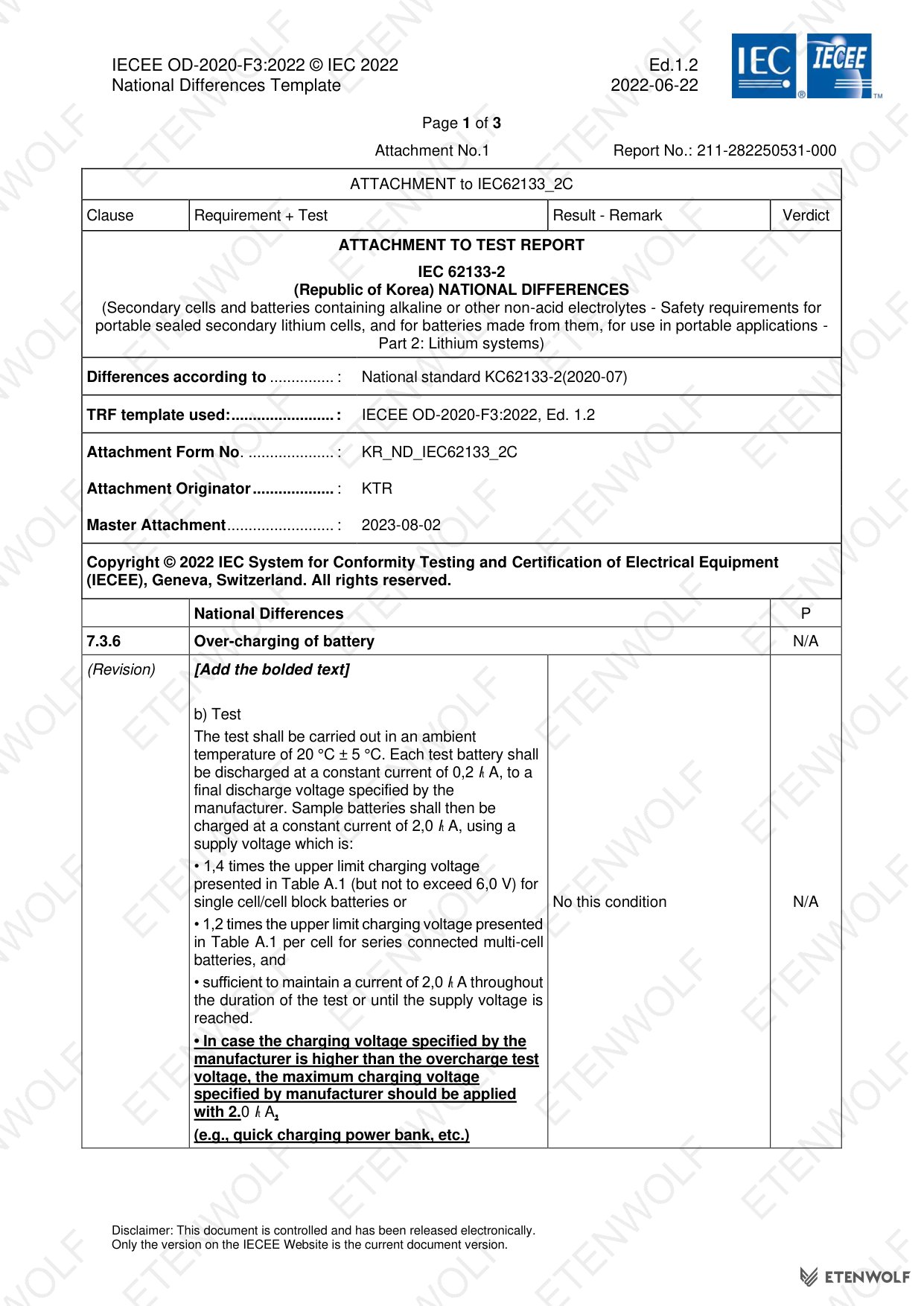
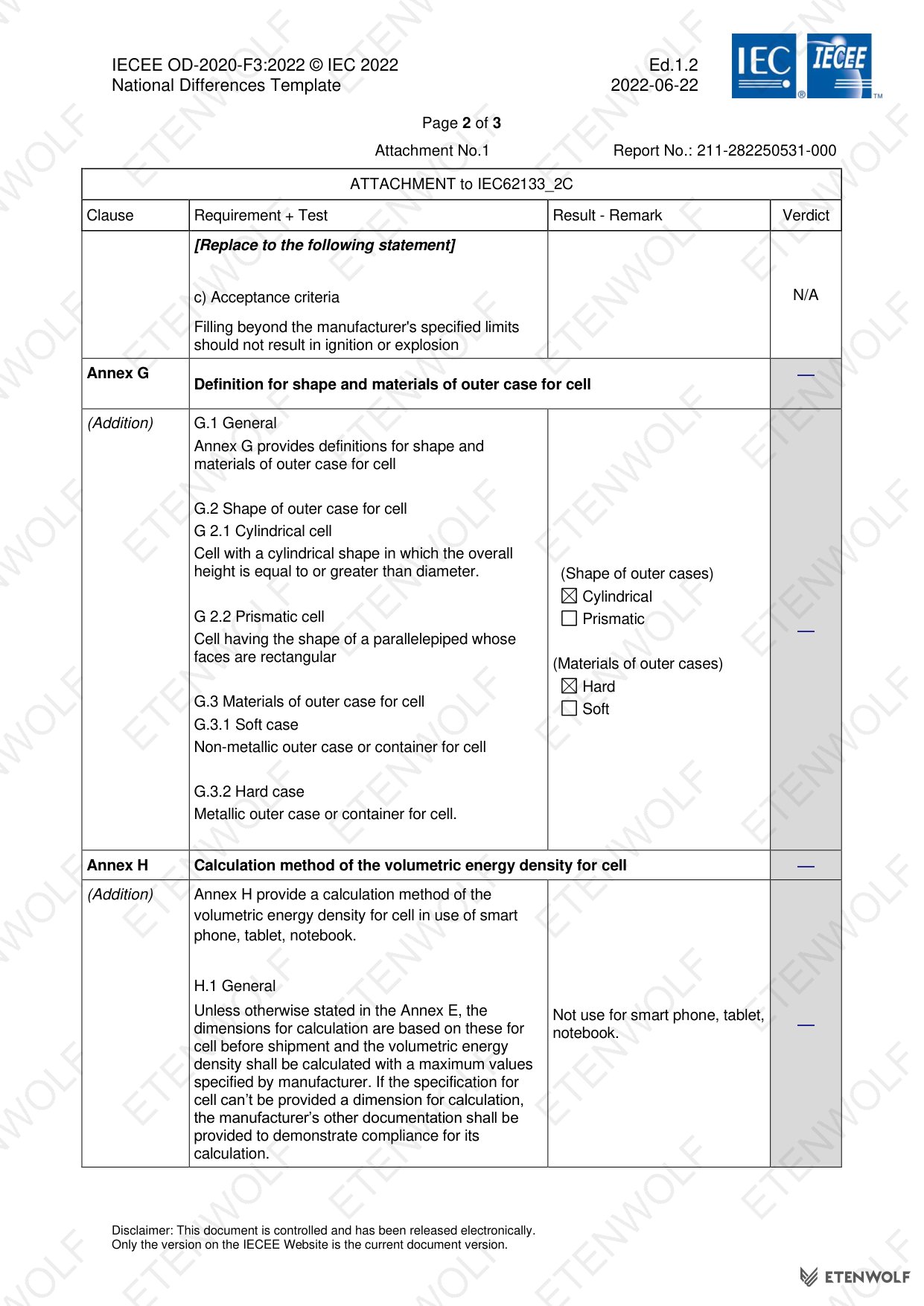
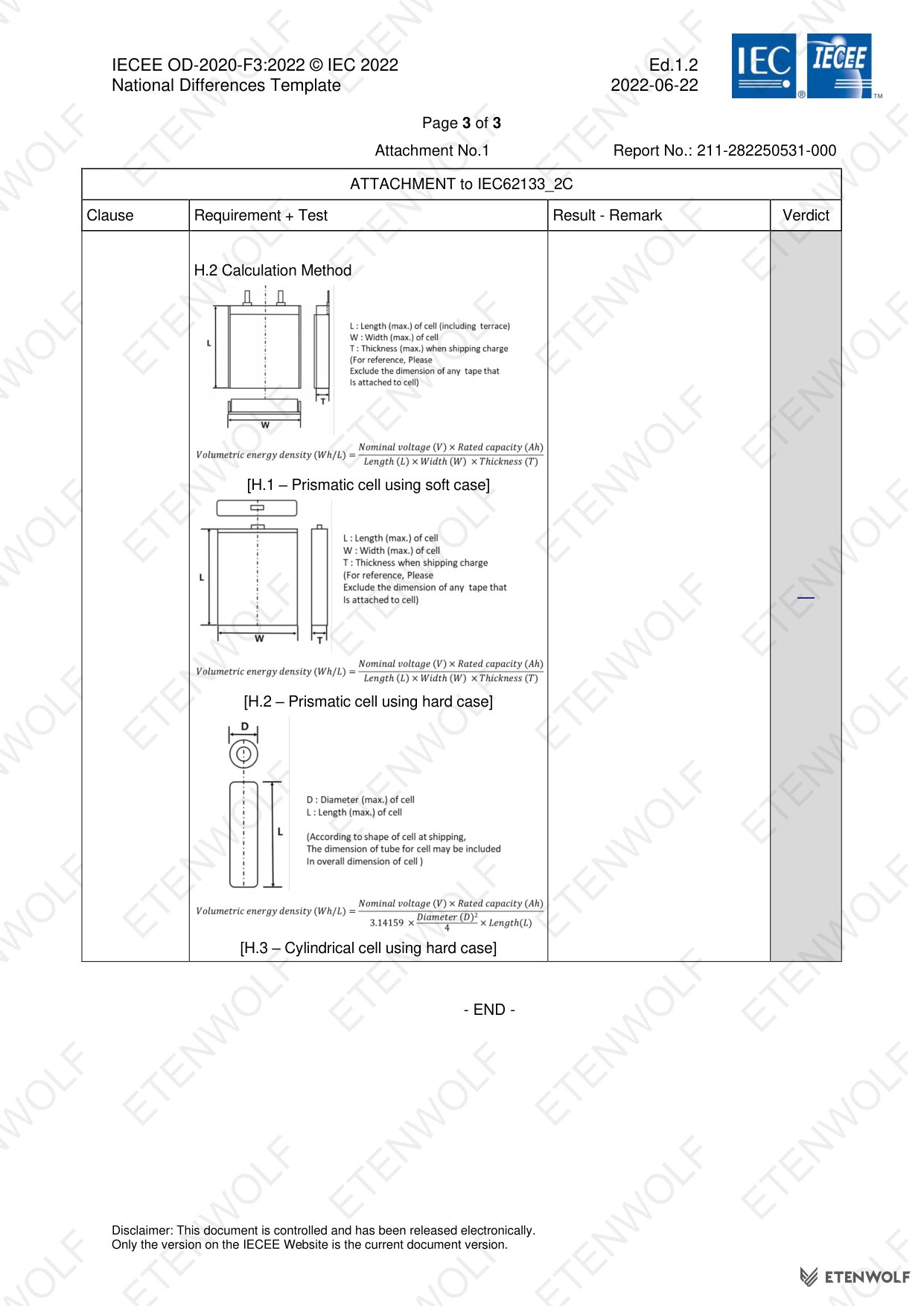
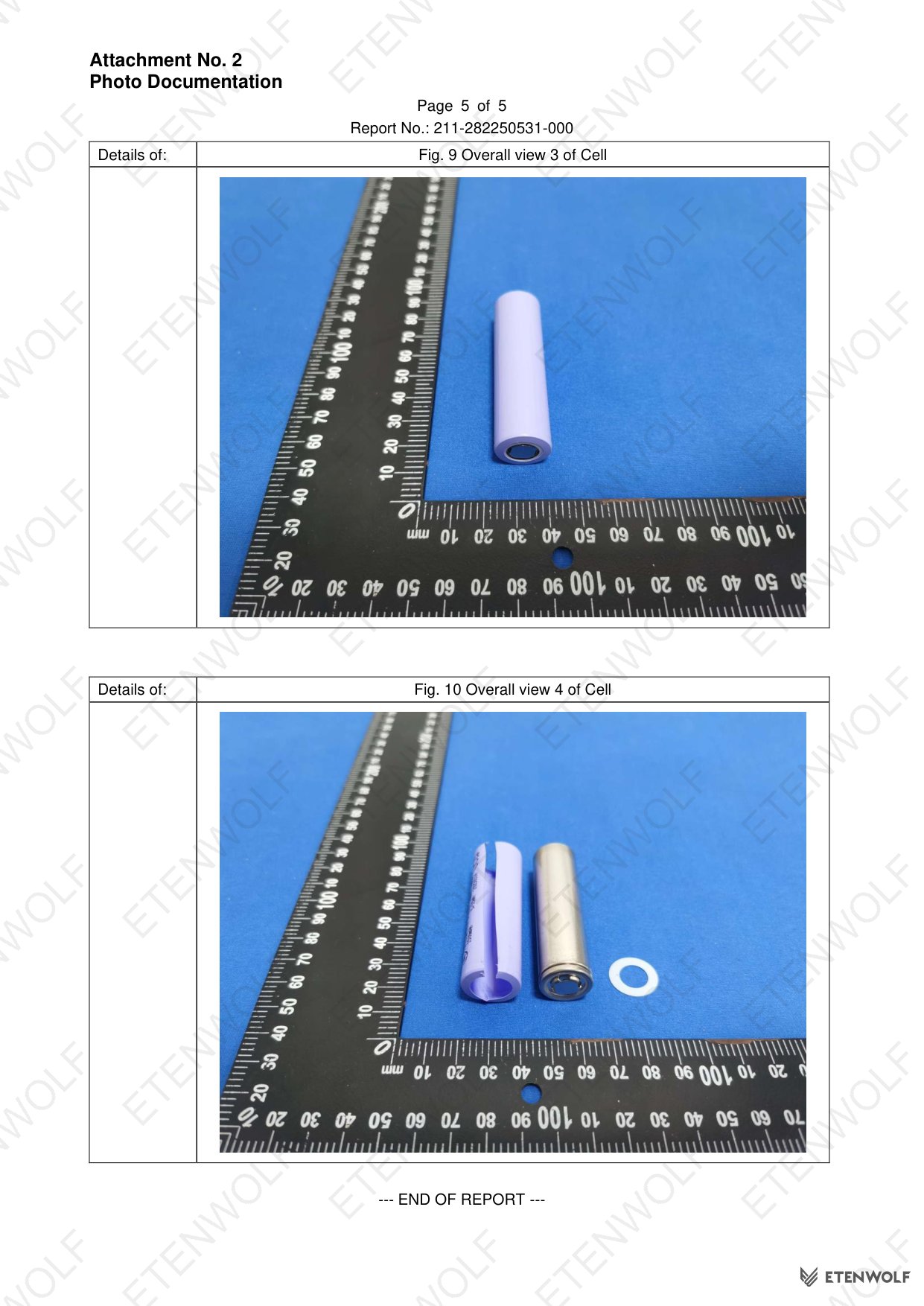
The report includes two attachments: Attachment No. 1 — 3 pages of Republic of Korea National Differences; Attachment No. 2 — 5 pages of Photo Documentation.
Standards & Compliance
The ETENWOLF P100 battery pack was evaluated against the following standards and compliance frameworks:
- IEC 62133-2:2017 — Secondary cells and batteries containing alkaline or other non-acid electrolytes: Safety requirements for portable sealed secondary lithium cells and batteries, Part 2: Lithium systems.
- IEC 62133-2:2017/AMD1:2021 — Amendment 1 to the above standard, incorporating updated safety requirements effective 2021.
- EN 62133-2:2017/A1:2021 — European harmonised version; the product fulfils these requirements as confirmed under the CB Scheme.
- Republic of Korea National Differences — The product fulfils the requirements of EN 62133-2:2017/A1:2021 as applicable to the Korean market, documented in Attachment No. 1 of the report.
- IECEE CB Scheme — Testing conducted under the international CB Scheme framework using TRF template IECEE OD-2020-F1:2021, Ed.1.4.
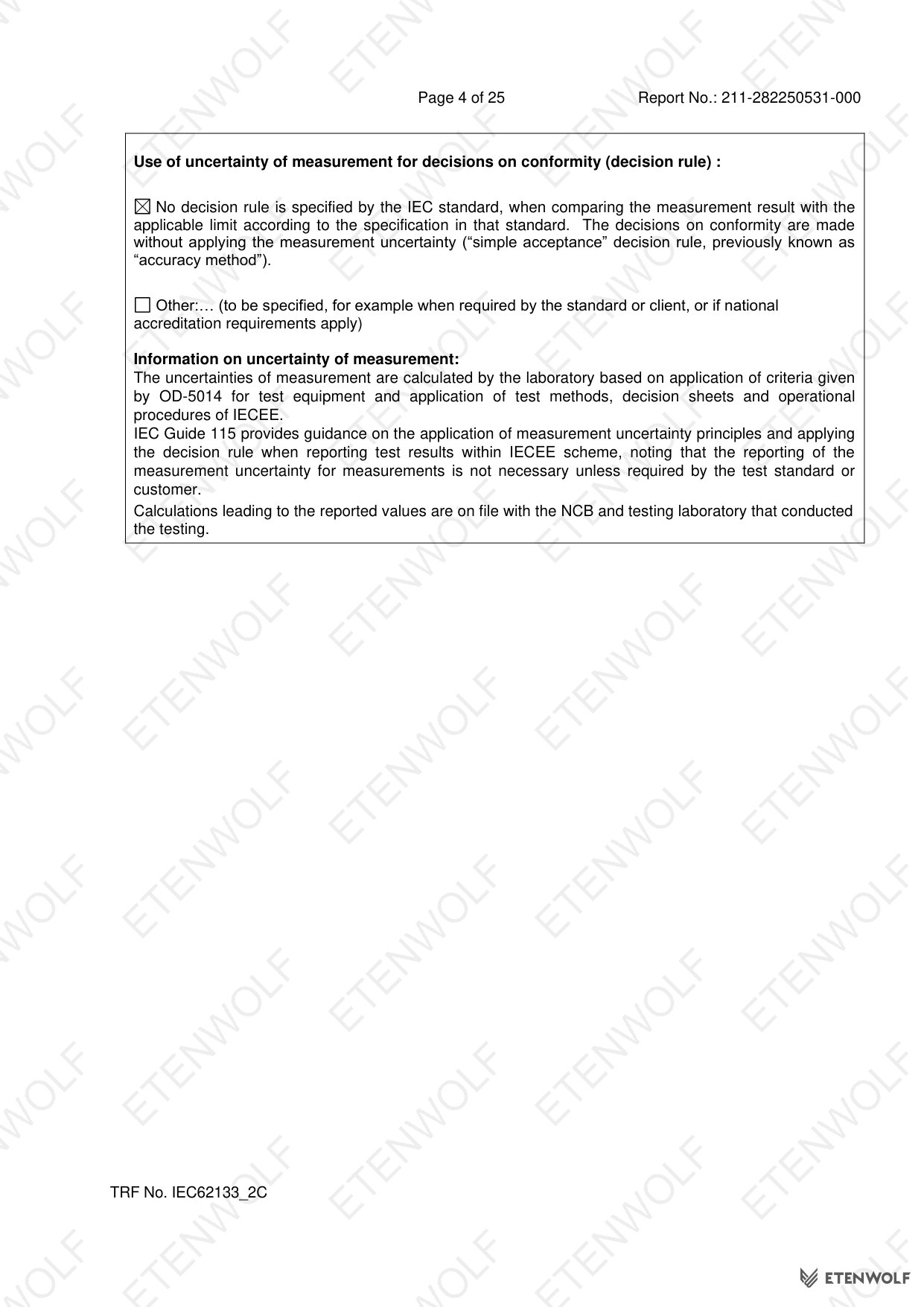
Regarding measurement uncertainty, decisions on conformity were made without applying measurement uncertainty, using the simple acceptance (accuracy method) decision rule, as no decision rule is specified by the IEC standard for comparing measurement results against applicable limits. Uncertainty calculations are based on OD-5014 criteria and are on file with the NCB and testing laboratory.
Validity & Certification Body
This CB Test Report is valid as part of the IECEE CB Scheme when appended to a CB Test Certificate issued by an authorised NCB in accordance with IECEE 02. The report is not valid as a standalone CB Test Report without the accompanying certificate and NCB signature.
| Field | Details |
|---|---|
| NCB (Issuing Body) | TÜV SÜD PSB Pte. Ltd. |
| NCB Address | 15 International Business Park, TÜV SÜD@IBP, Singapore 609937 |
| Testing Laboratory | TÜV SÜD Certification and Testing (China) Co., Ltd. Shenzhen Branch |
| Lab Address | Building A2, Jin’ao Industrial Park, No. 150, Jingfang Road, Fuhai, Bao’an District, Shenzhen, Guangdong 518103, China |
| Report Number | 211-282250531-000 |
| Date of Issue | 2025-05-06 |
| Reproducibility | Report shall not be reproduced except in full without written approval of the issuing NCB |
| Authenticity Verification | Contact TÜV SÜD PSB Pte. Ltd. (NCB responsible for this report) |
The authenticity and contents of this test report can be verified by contacting the NCB directly. Reproduction of this report in part is prohibited without written approval.
Frequently Asked Questions
- What is the CB Test Report 211-282250531-000 for?
- Report 211-282250531-000 is the CB Scheme test report for the Li-ion battery pack (model 1S1P-1500, rated 3.7 V / 1500 mAh) used in the ETENWOLF P100 inflation tool. It confirms the battery passed all required safety tests under IEC 62133-2:2017 and its 2021 amendment.
- Which safety tests did the ETENWOLF P100 battery pack pass?
- The battery pack passed 11 safety tests including external short-circuit (cell and battery), free fall, thermal abuse, crush, over-charging, vibration, mechanical shock, forced internal short-circuit, continuous charging at constant voltage, and case stress at high ambient temperature — all per IEC 62133-2:2017/AMD1:2021.
- Is this certification valid for the Korean market?
- Yes. The test report includes a Republic of Korea National Differences attachment confirming the product fulfils the requirements of EN 62133-2:2017/A1:2021 as applicable to the Korean market under the KC certification framework.
- Who conducted the testing and who issued the report?
- Testing was performed by TÜV SÜD Certification and Testing (China) Co., Ltd. Shenzhen Branch. The report was issued under the responsibility of the NCB TÜV SÜD PSB Pte. Ltd. (Singapore). The project was handled by Red Chen and reviewed by West Li.
Related Documents
For a complete compliance picture of the ETENWOLF P100, the following related certification and test documents are typically required or recommended alongside this CB Test Report:
- CB Test Certificate — Issued by TÜV SÜD PSB Pte. Ltd. (NCB) based on this report; required for the CB Test Report to be valid under IECEE 02.
- UN 38.3 Transport Test Report — Mandatory for lithium battery air and ground shipping compliance per UN 38.3 regulations.
- CE Declaration of Conformity — Required for sale in the European Economic Area, referencing the applicable EU Battery Regulation and Low Voltage Directive.
- KC Certification — Republic of Korea market approval based on the national differences addressed in Attachment No. 1 of this report.
- RoHS Compliance Report — Confirms the battery pack meets RoHS restrictions on hazardous substances in electrical and electronic equipment.
- REACH SVHC Declaration — Substance of Very High Concern declaration under REACH regulation for materials used in the battery pack.
Document Pages