Document Overview
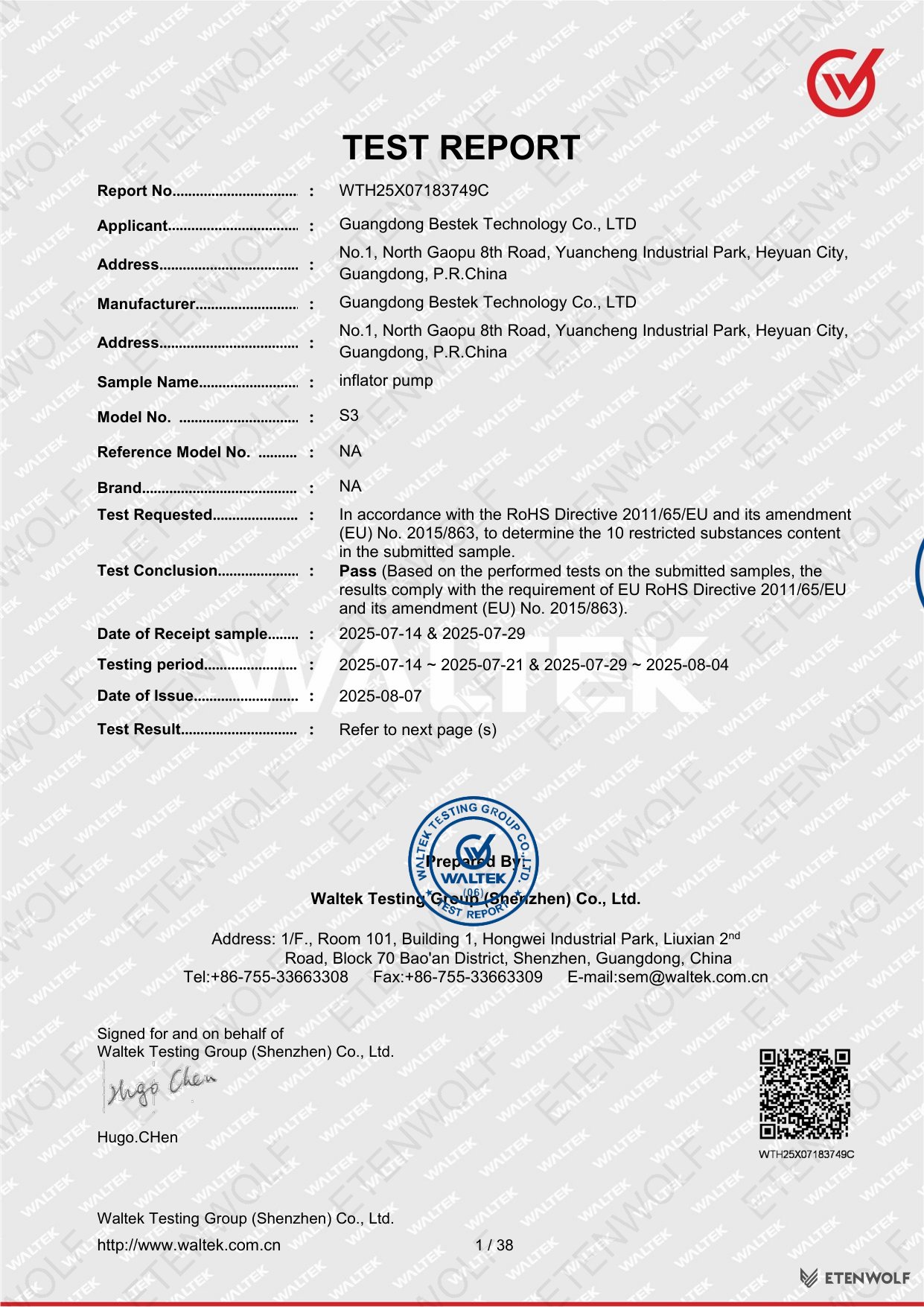
Document Overview This page presents the official RoHS test report issued for the ETENWOLF S3 cordless tire inflator. The report was prepared by Waltek Testing Group (Shenzhen) Co., Ltd., an accredited third-party testing laboratory, and bears Report No. WTH25X07183749C. The test was conducted to determine…
- Document type
- Certification Report
- Prepared by
- Michelle Torres
- Published
- Last reviewed
- Topics
- European Union: CE / RoHS / REACH / WEEE
Document Overview
This page presents the official RoHS test report issued for the ETENWOLF S3 cordless tire inflator. The report was prepared by Waltek Testing Group (Shenzhen) Co., Ltd., an accredited third-party testing laboratory, and bears Report No. WTH25X07183749C.
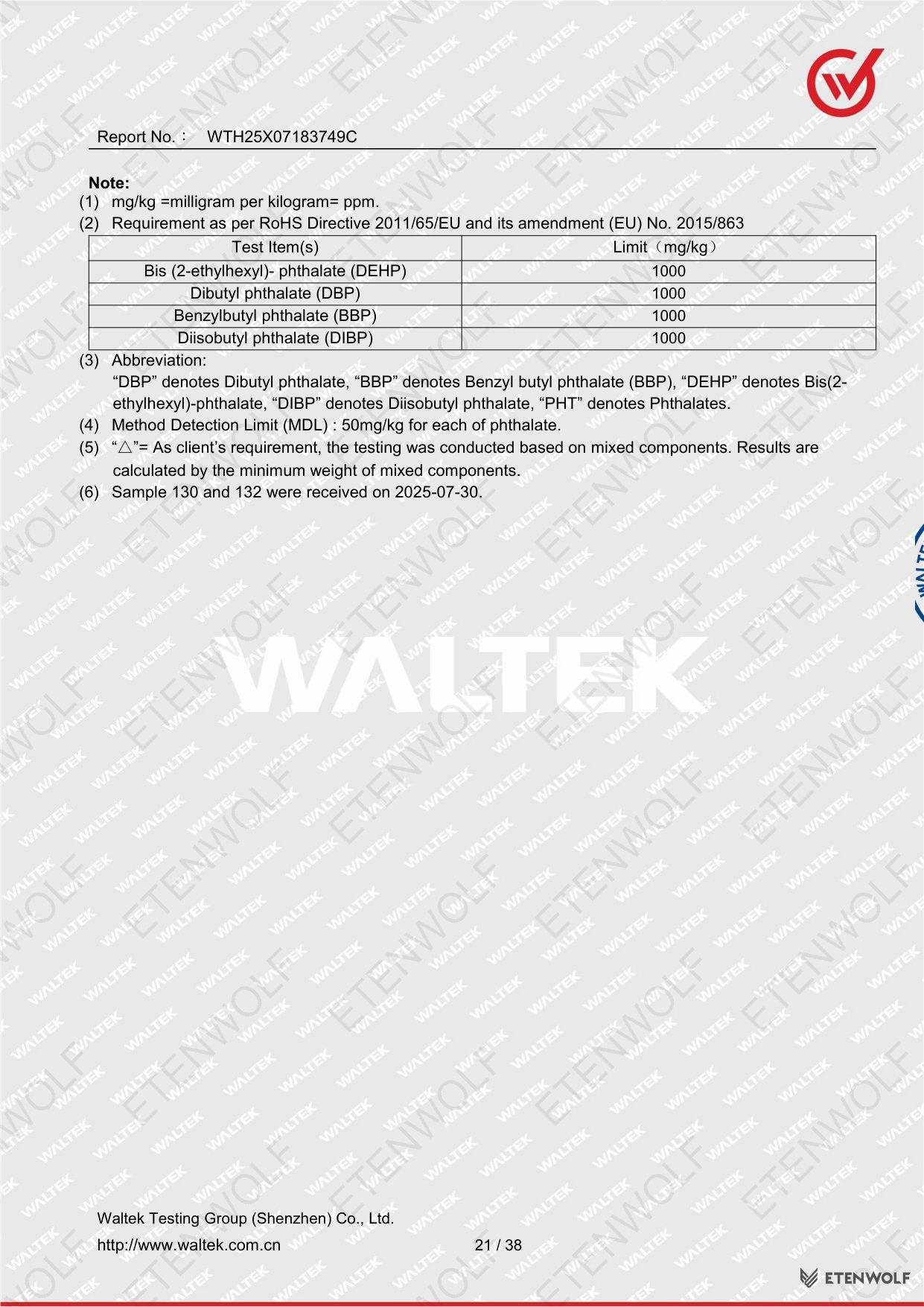
The test was conducted to determine the content of 10 restricted substances in the submitted product sample, in accordance with EU RoHS Directive 2011/65/EU and its amendment (EU) No. 2015/863.
| Field | Detail |
|---|---|
| Document Type | RoHS Test Report |
| Report Number | WTH25X07183749C |
| Issuing Laboratory | Waltek Testing Group (Shenzhen) Co., Ltd. |
| Date of Issue | 2025-08-07 |
| Test Conclusion | Pass |
| Applicable Directive | EU RoHS Directive 2011/65/EU and amendment (EU) No. 2015/863 |
Product Information
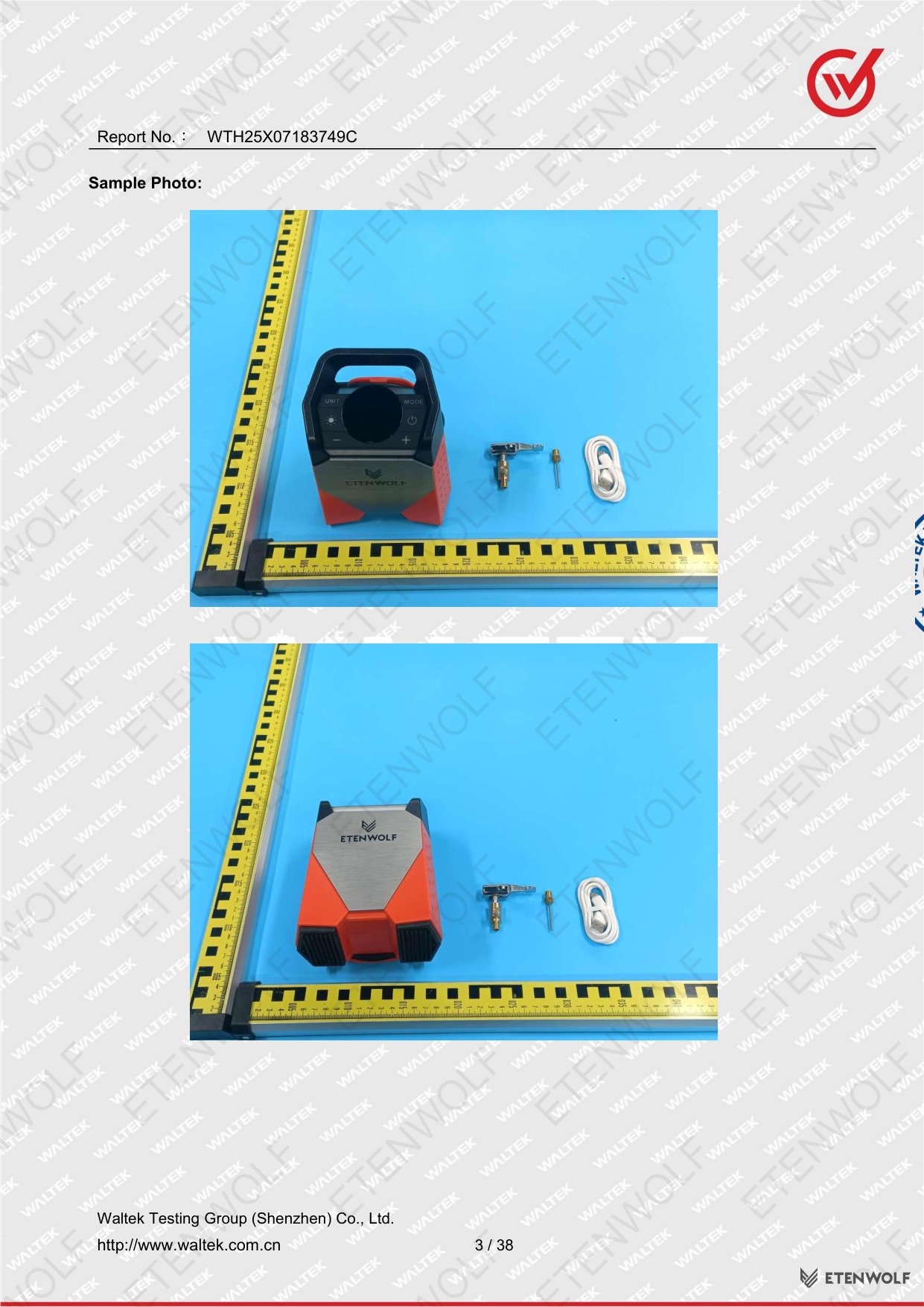
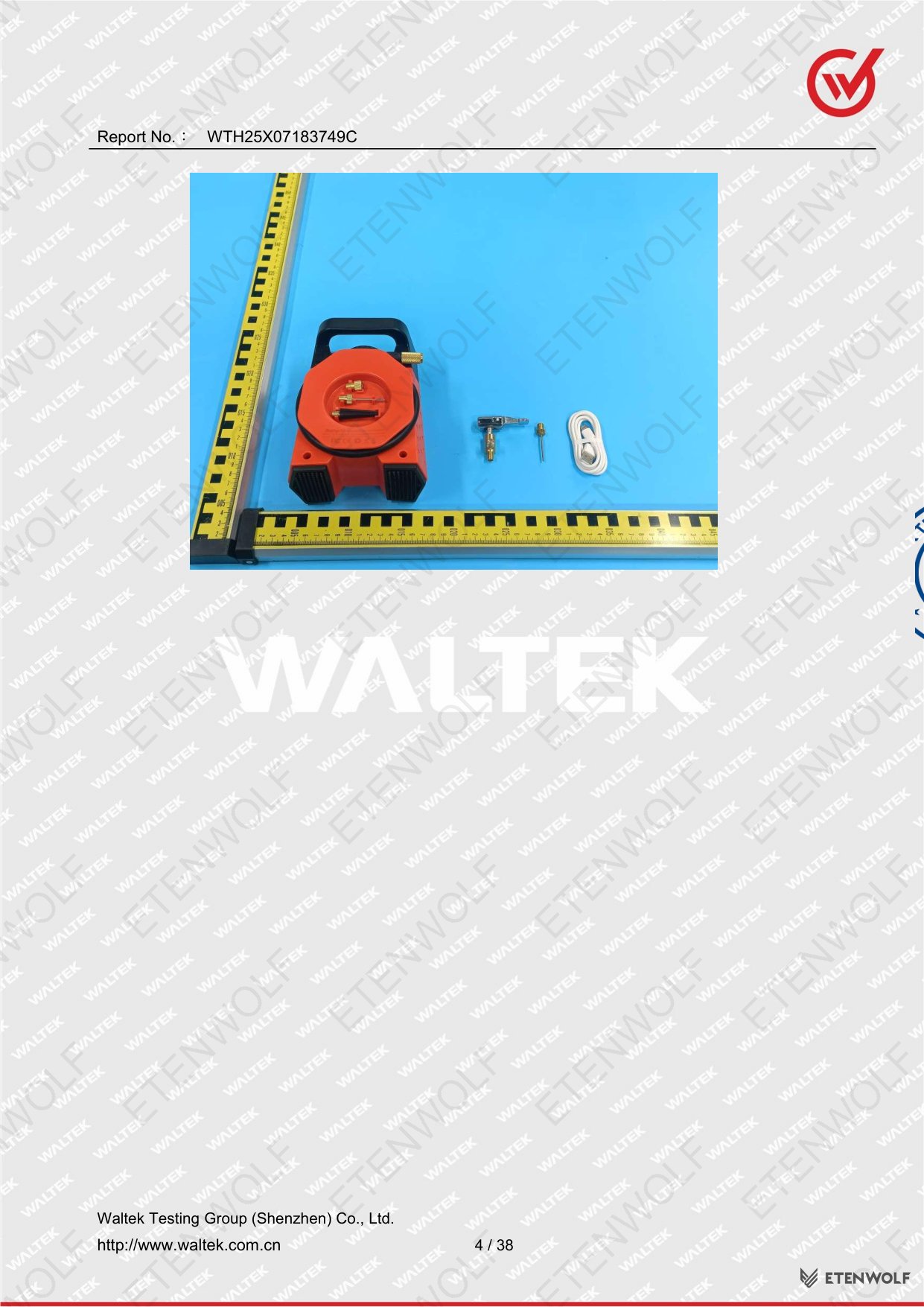
The tested product is the ETENWOLF S3 cordless tire inflator, a portable inflation tool designed for automotive and recreational use. The applicant and manufacturer are both identified as Guangdong Bestek Technology Co., Ltd., located in Heyuan City, Guangdong, China.
| Field | Detail |
|---|---|
| Sample Name | Inflator Pump |
| Model Number | S3 |
| Reference Model No. | NA |
| Brand | NA (marketed under ETENWOLF) |
| Applicant | Guangdong Bestek Technology Co., Ltd. |
| Manufacturer | Guangdong Bestek Technology Co., Ltd. |
| Applicant / Manufacturer Address | No.1, North Gaopu 8th Road, Yuancheng Industrial Park, Heyuan City, Guangdong, P.R. China |
| Date of Sample Receipt | 2025-07-14 and 2025-07-29 |
| Testing Period | 2025-07-14 to 2025-07-21 and 2025-07-29 to 2025-08-04 |
Key Details
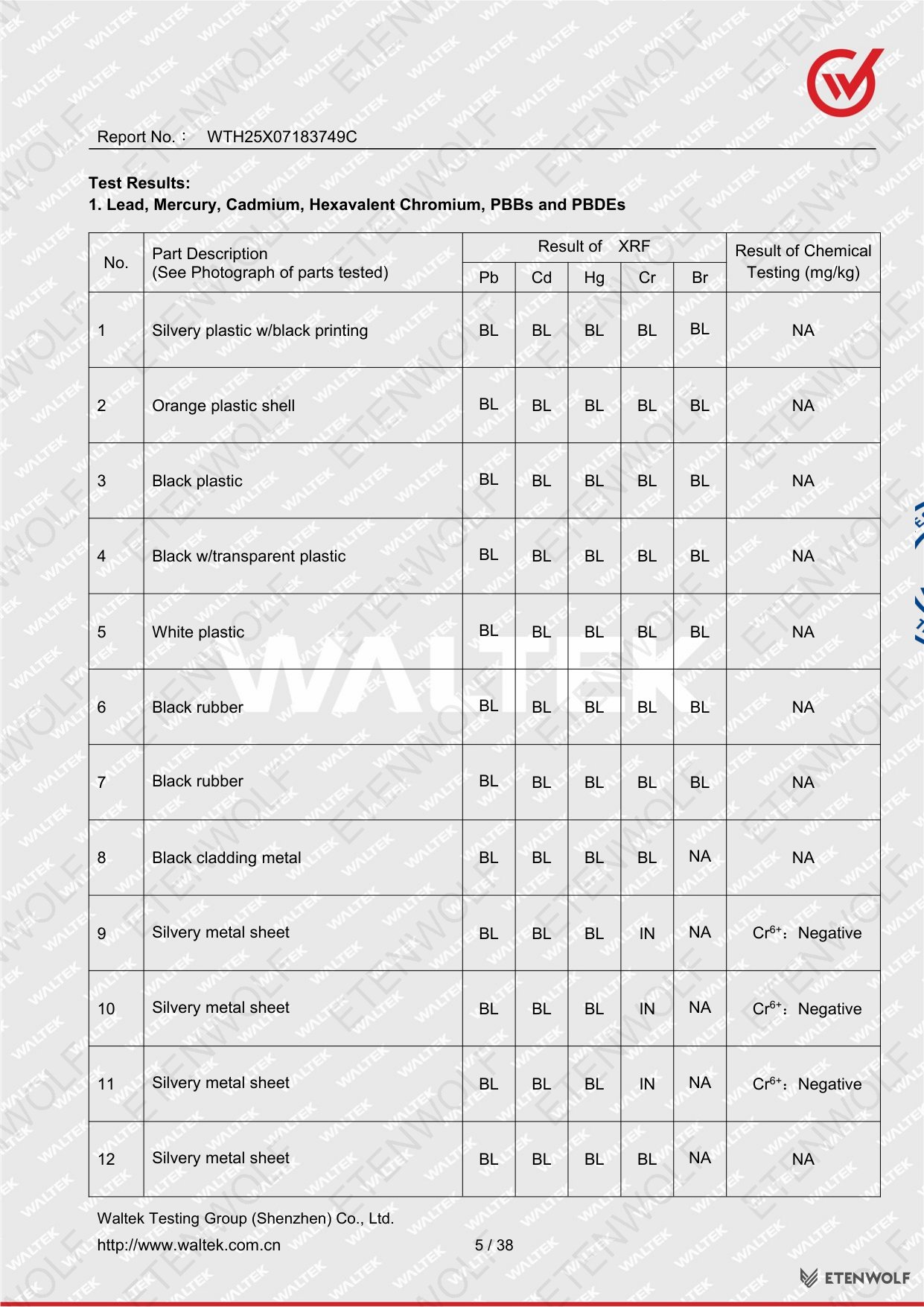
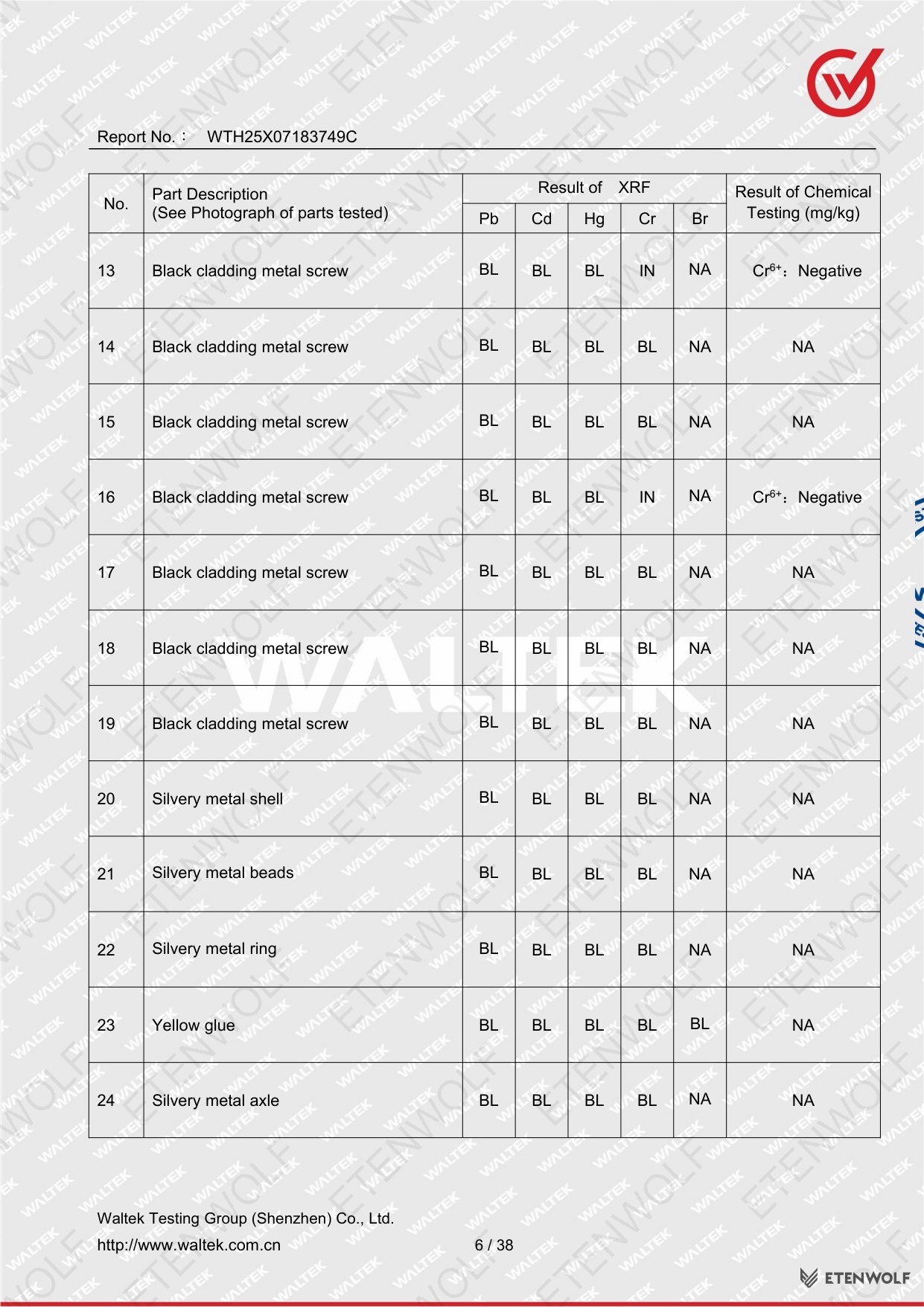
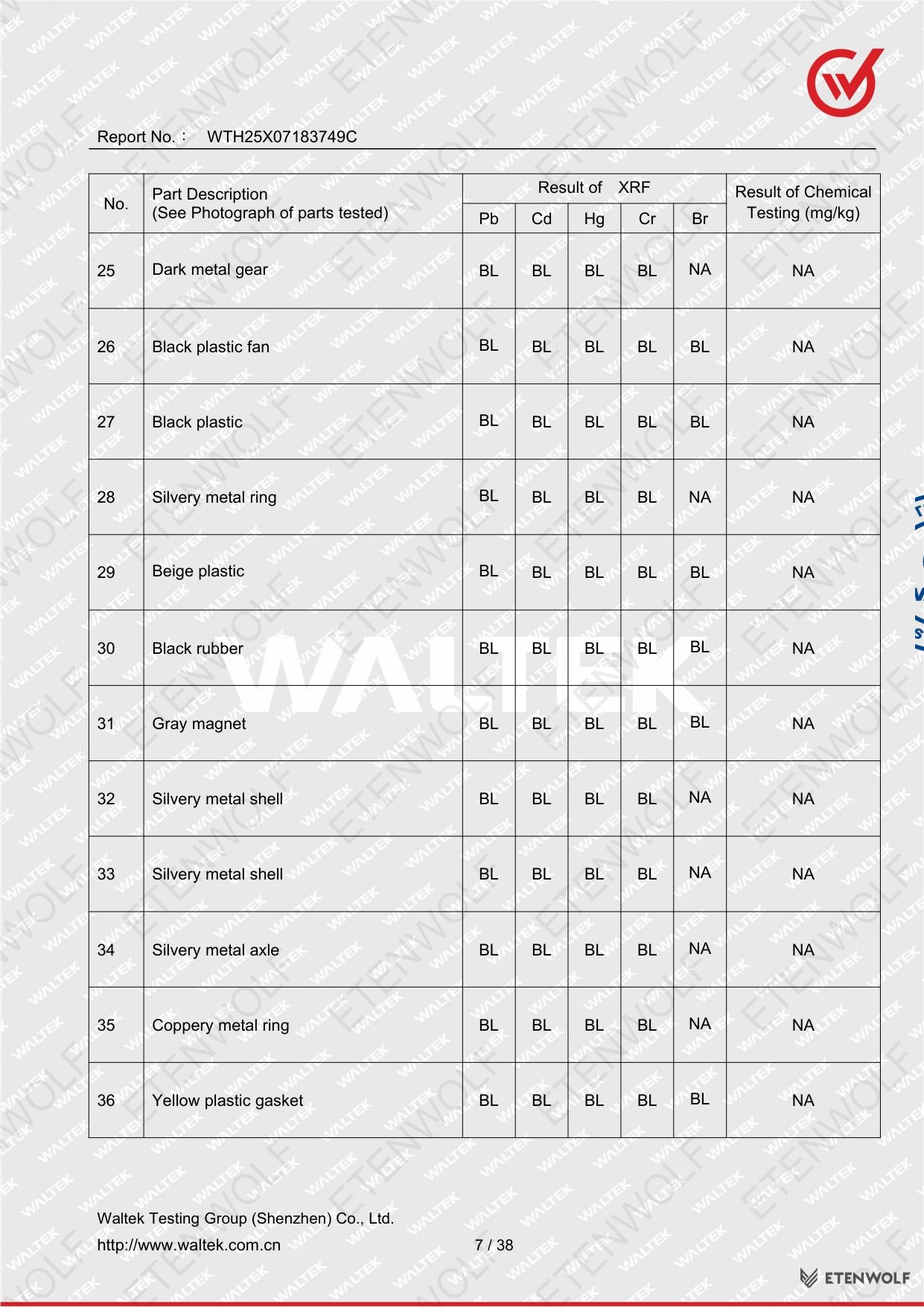
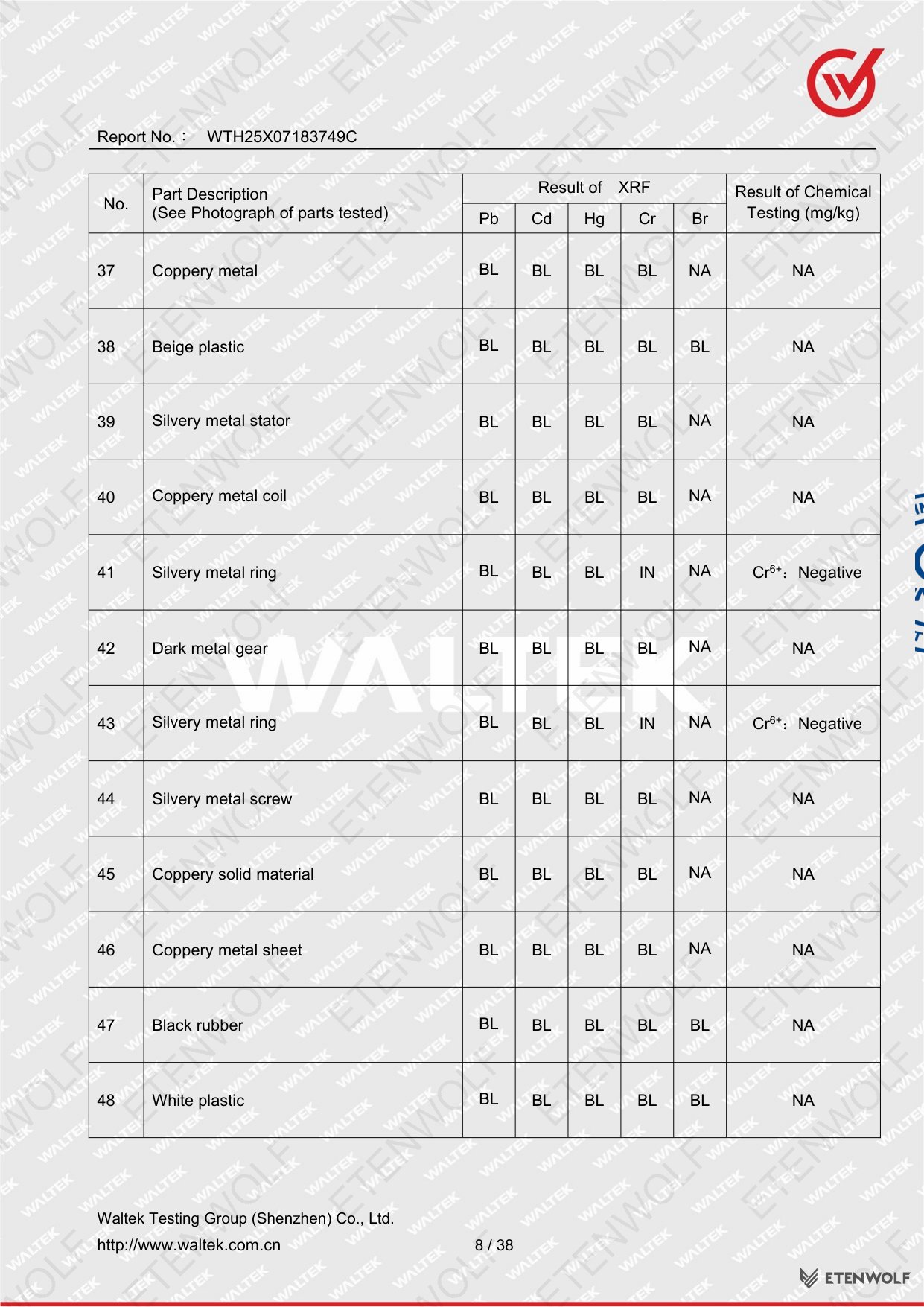
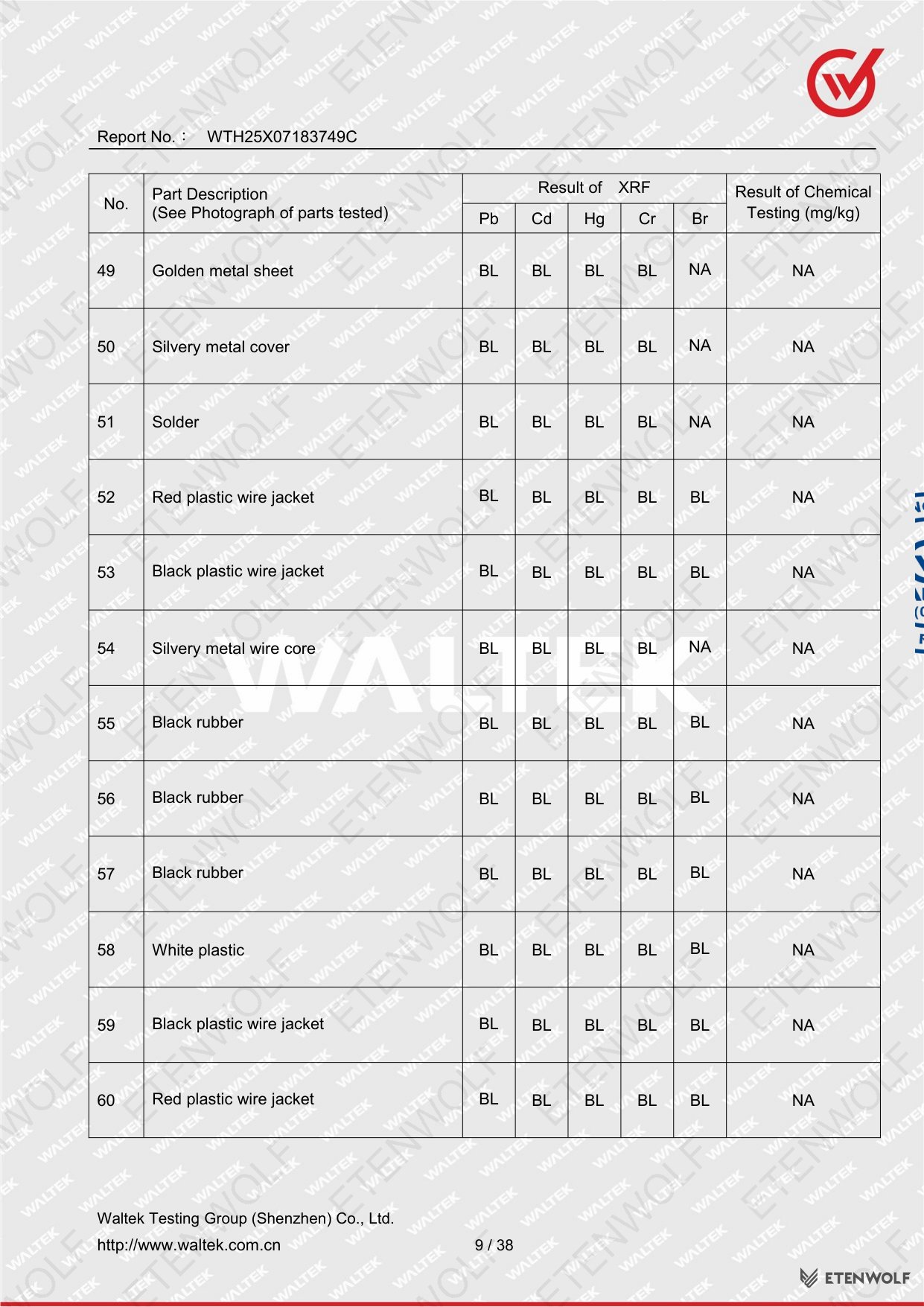
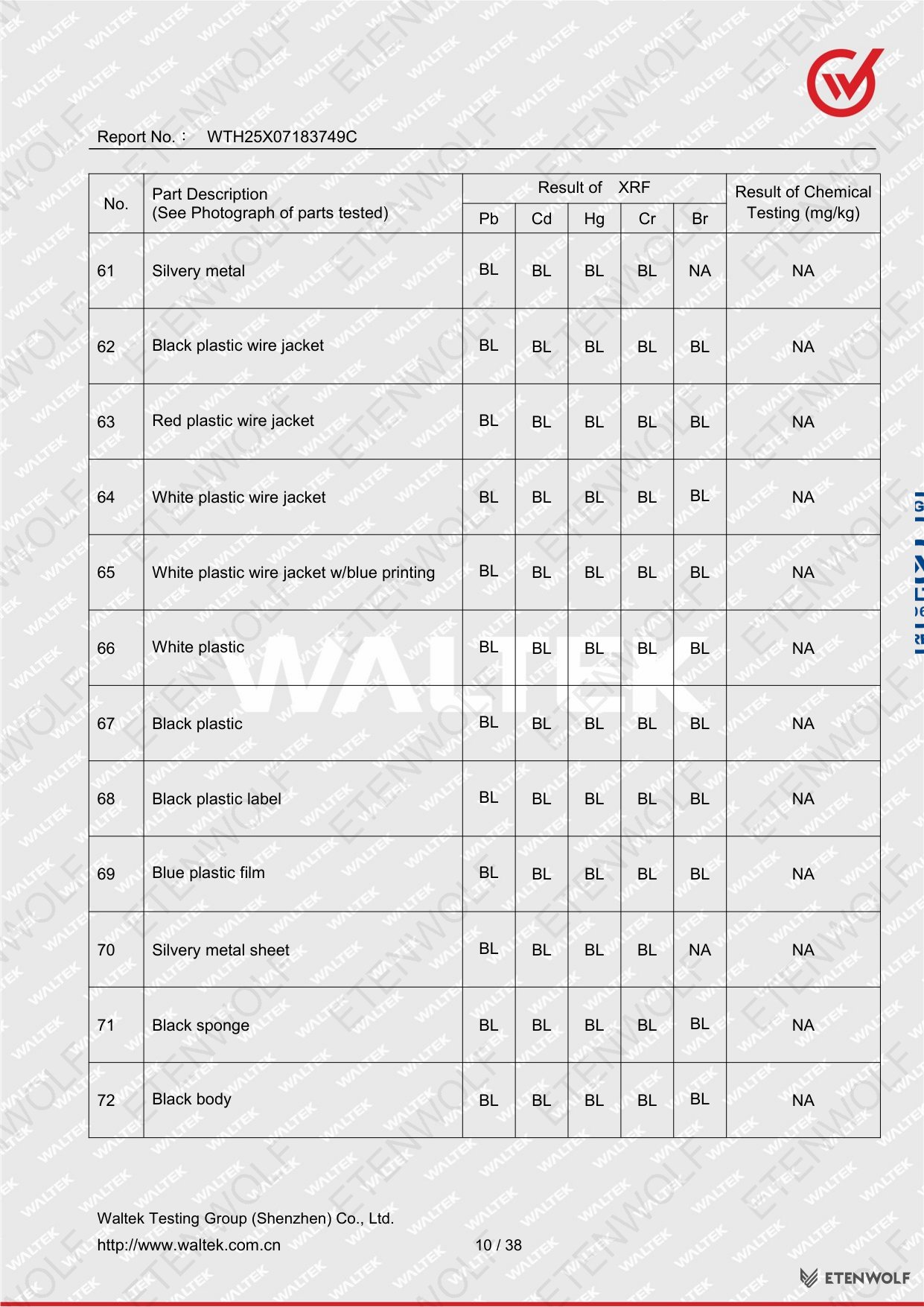
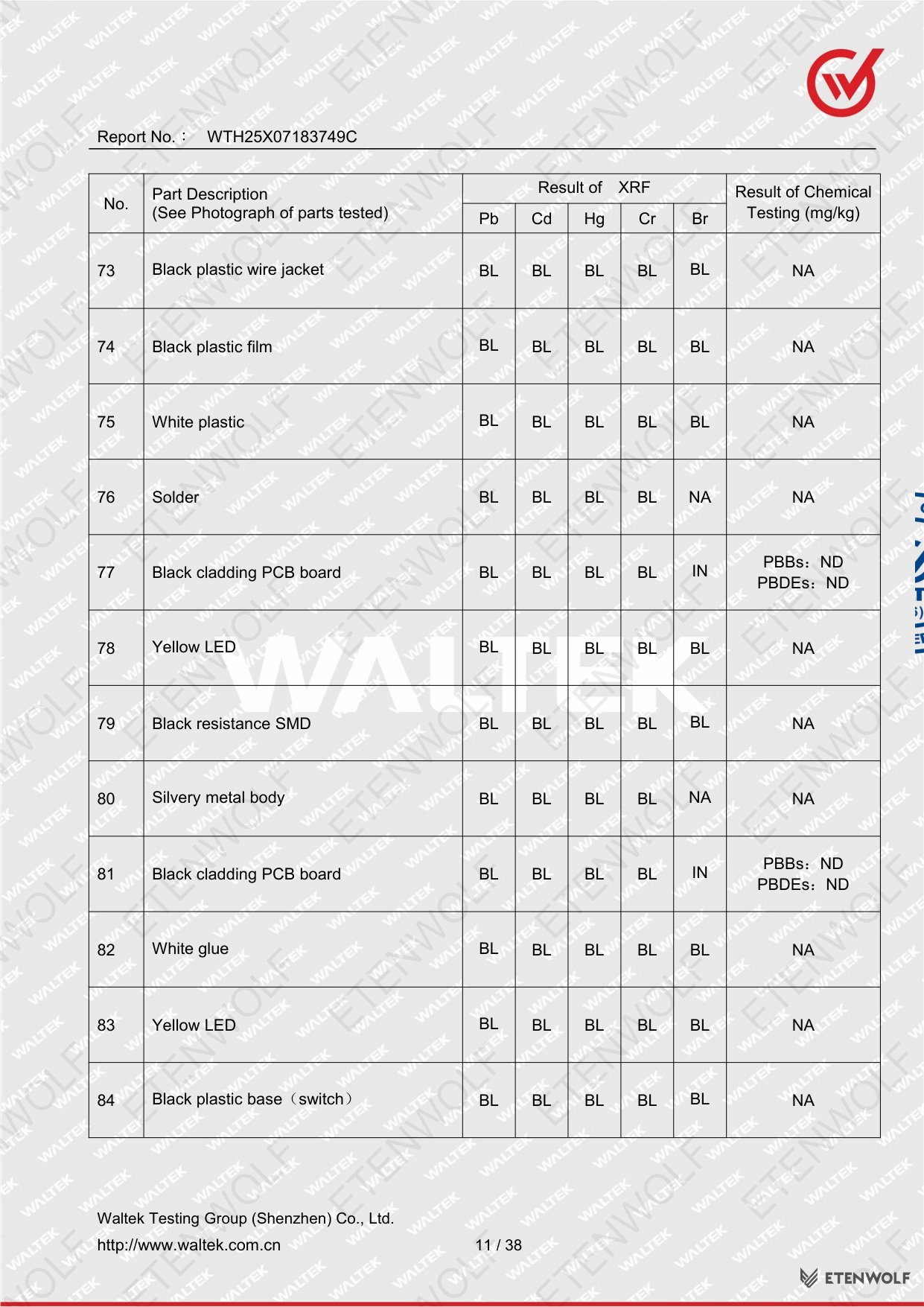
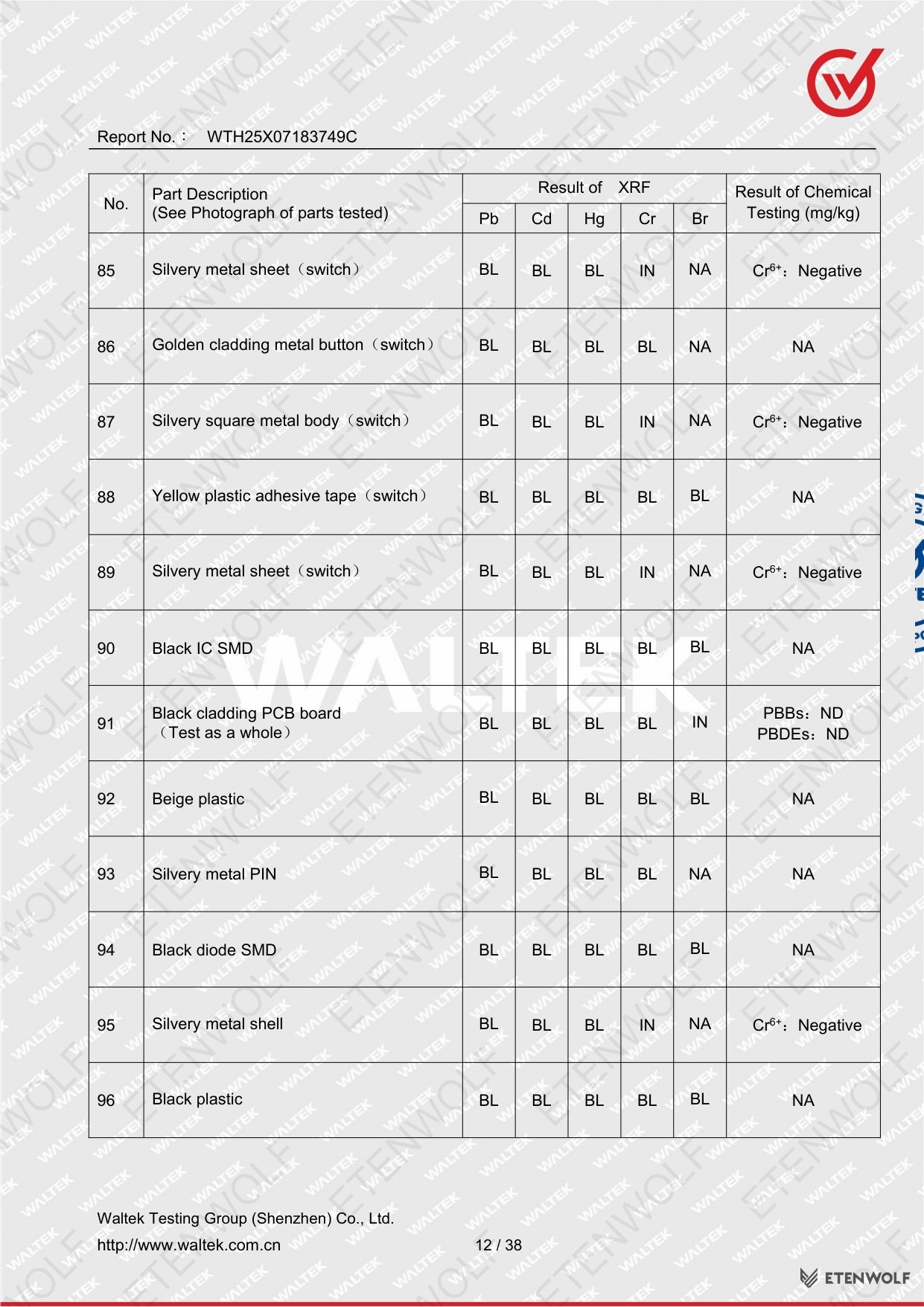
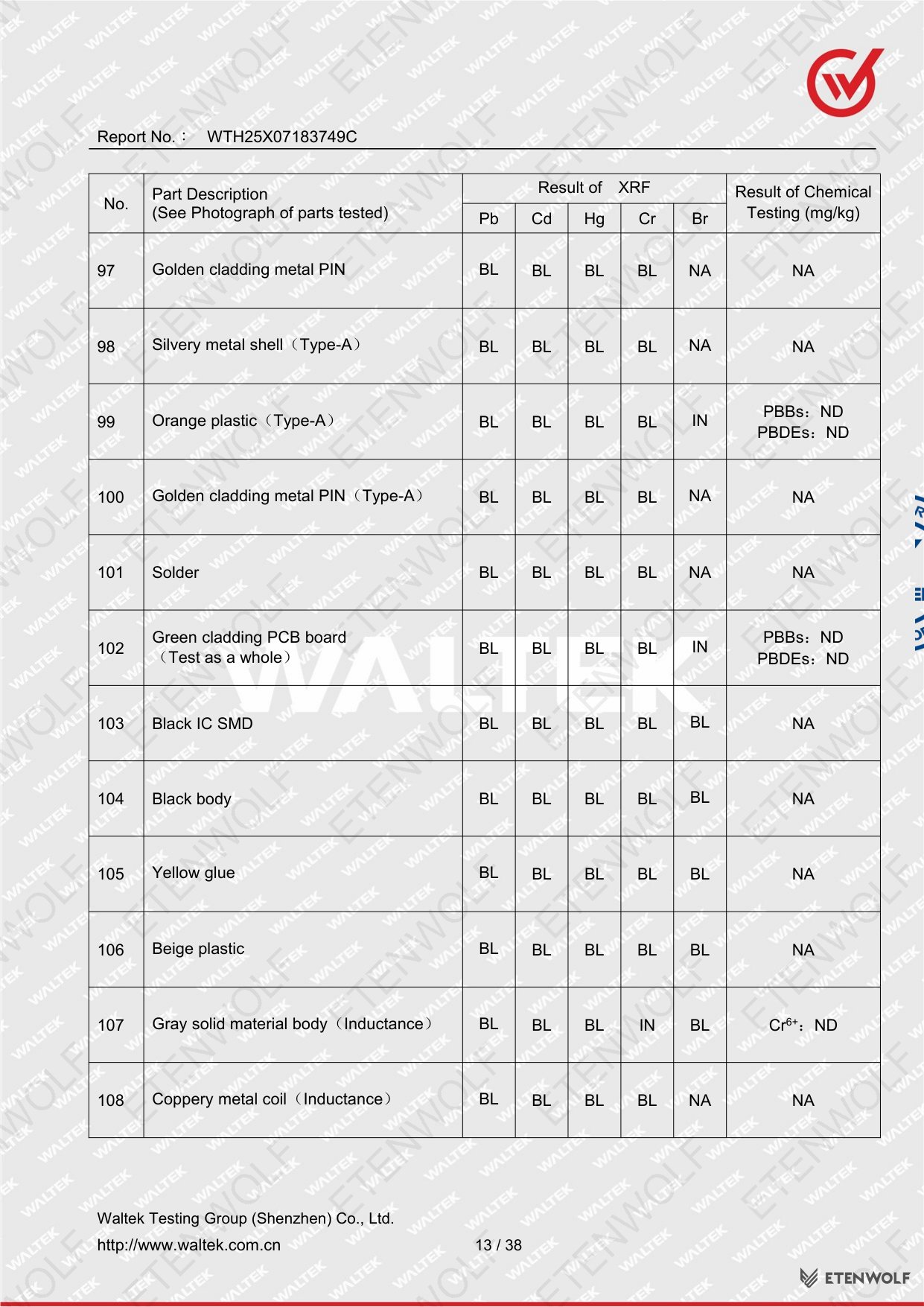
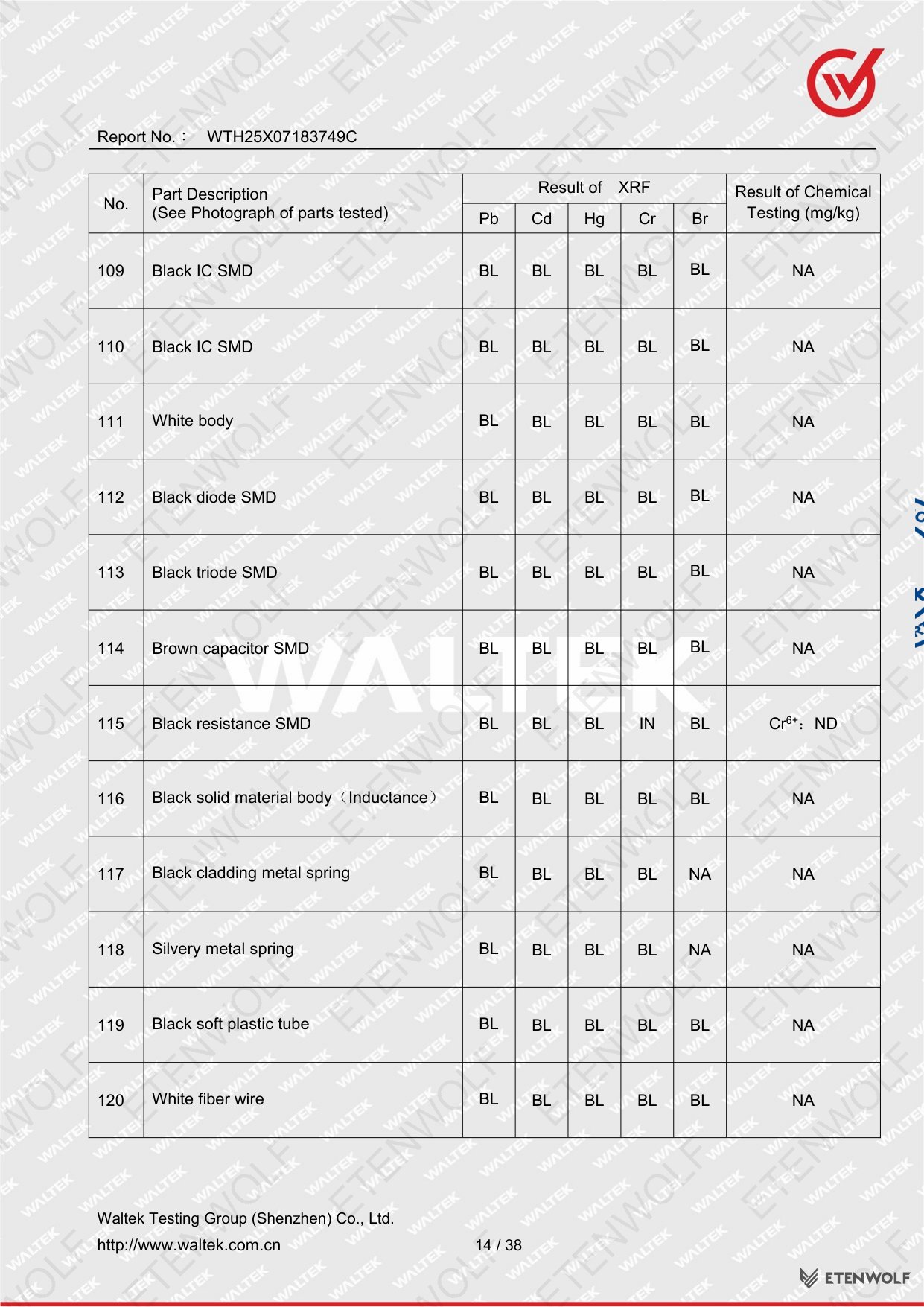
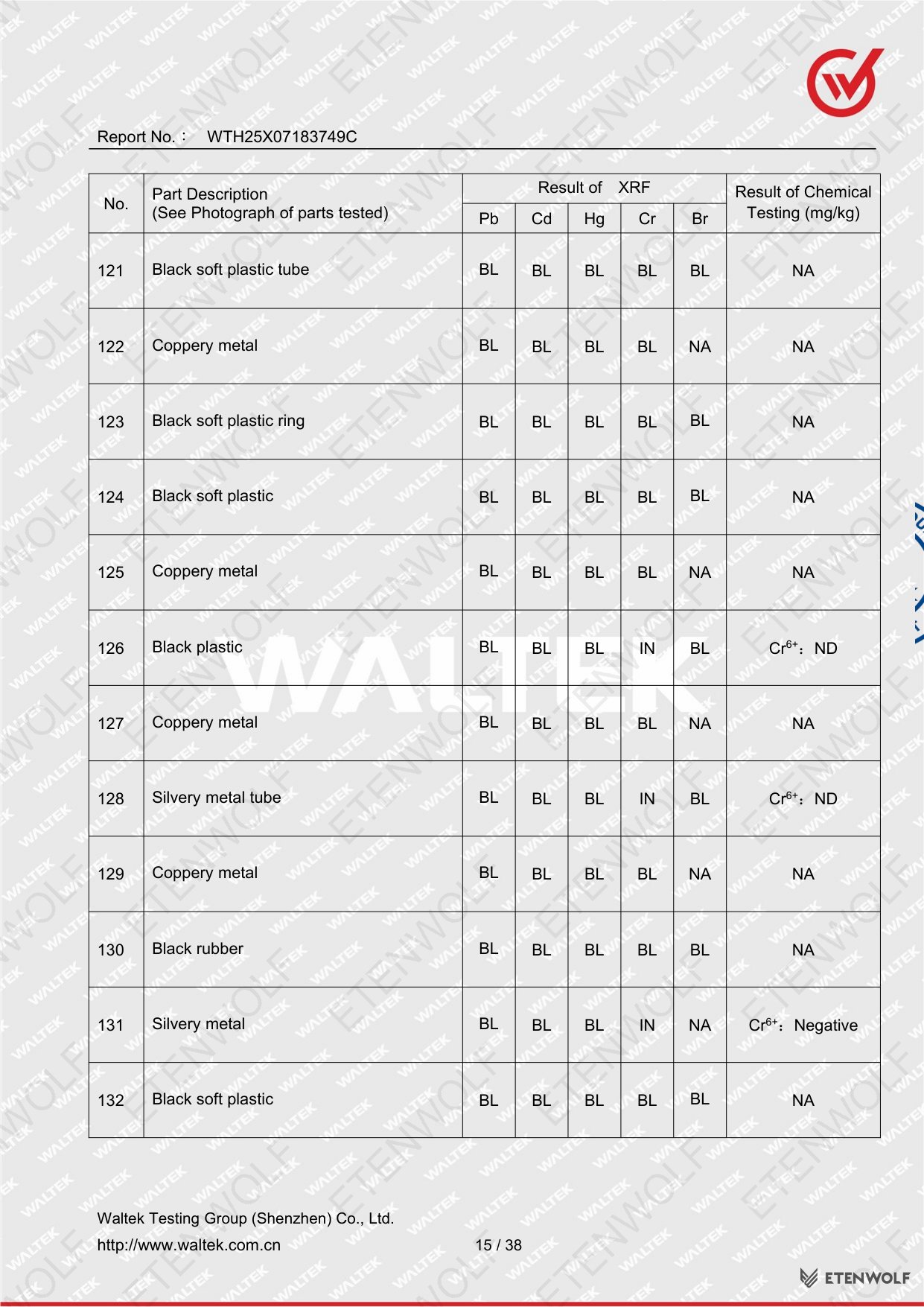
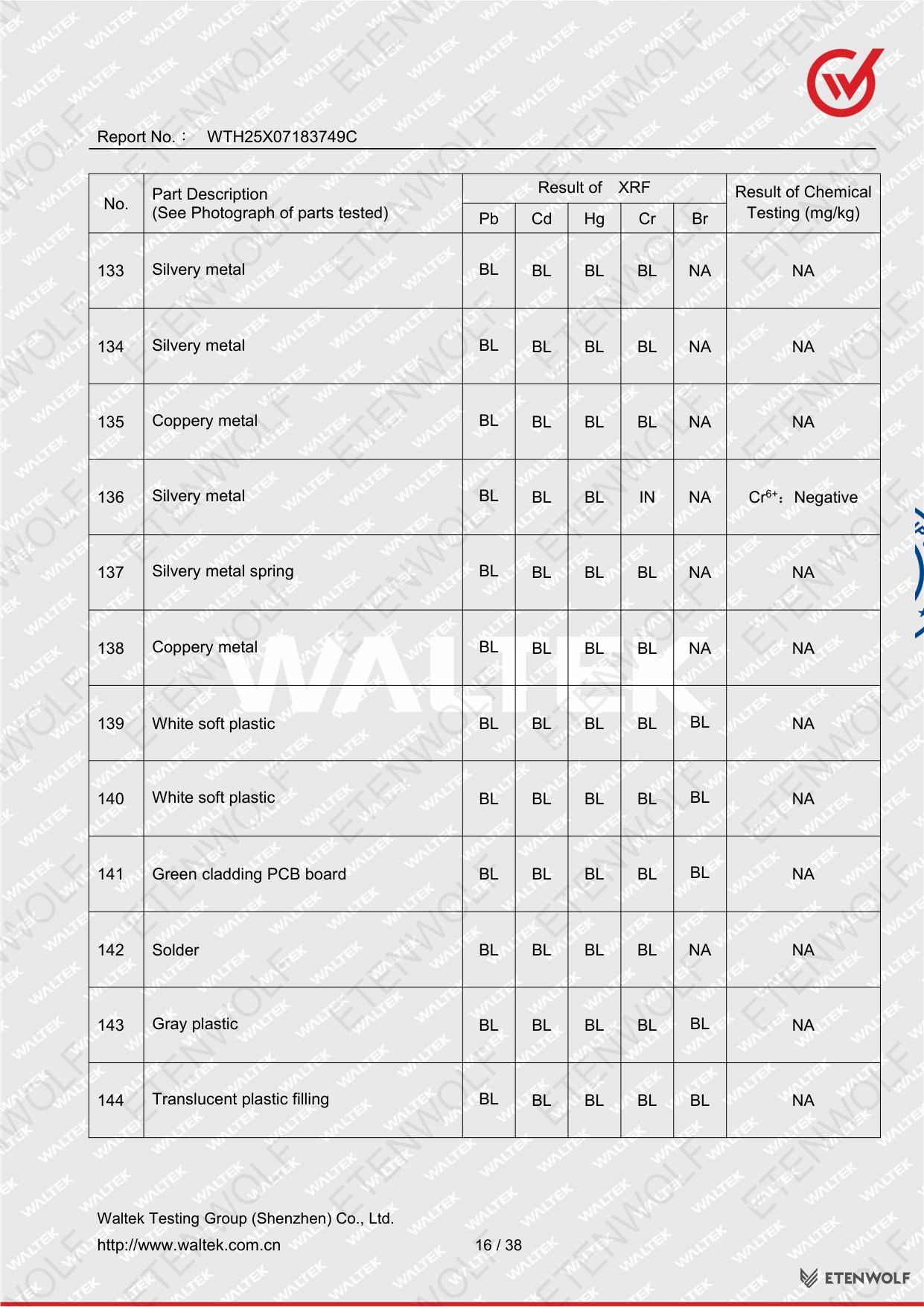
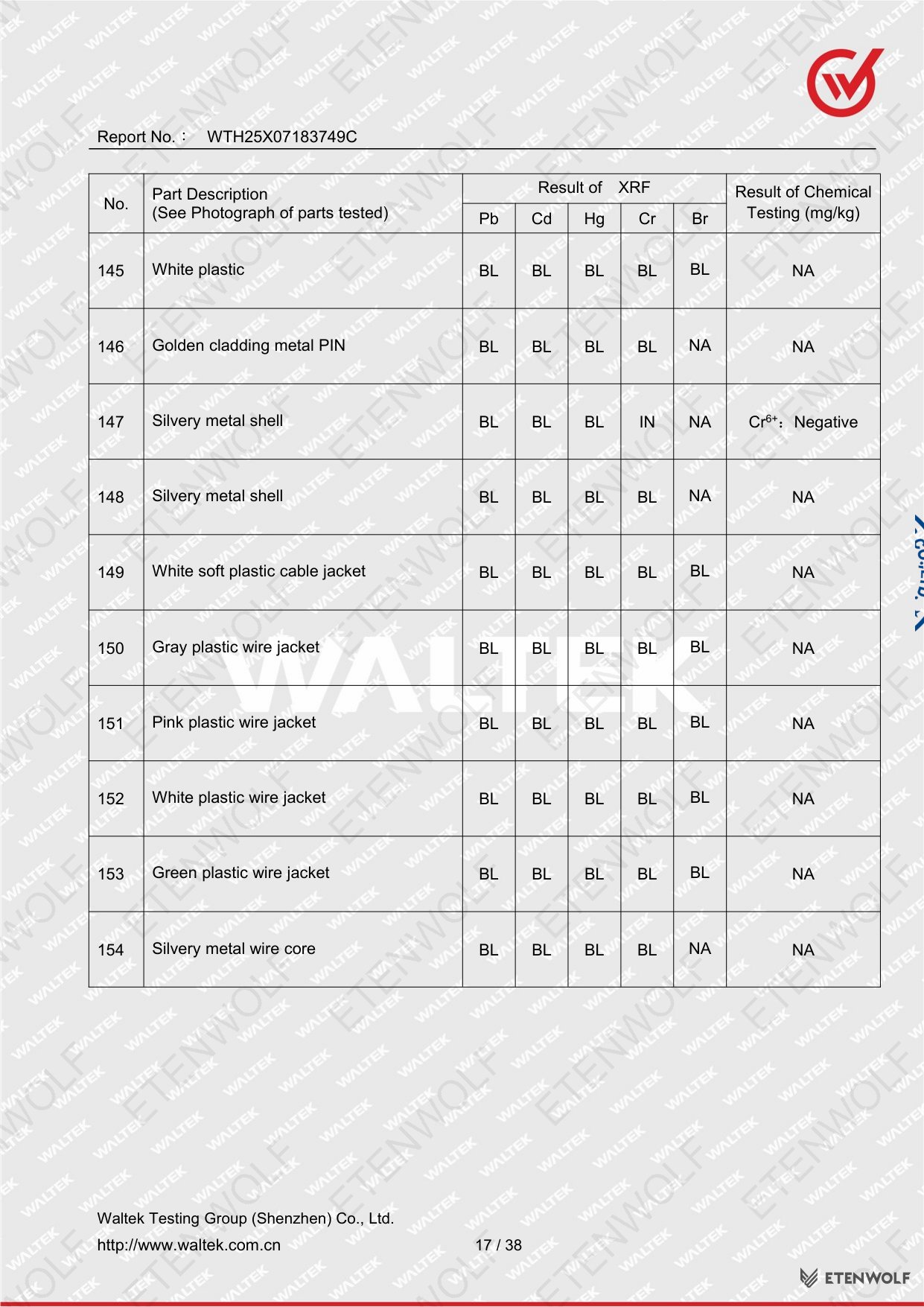
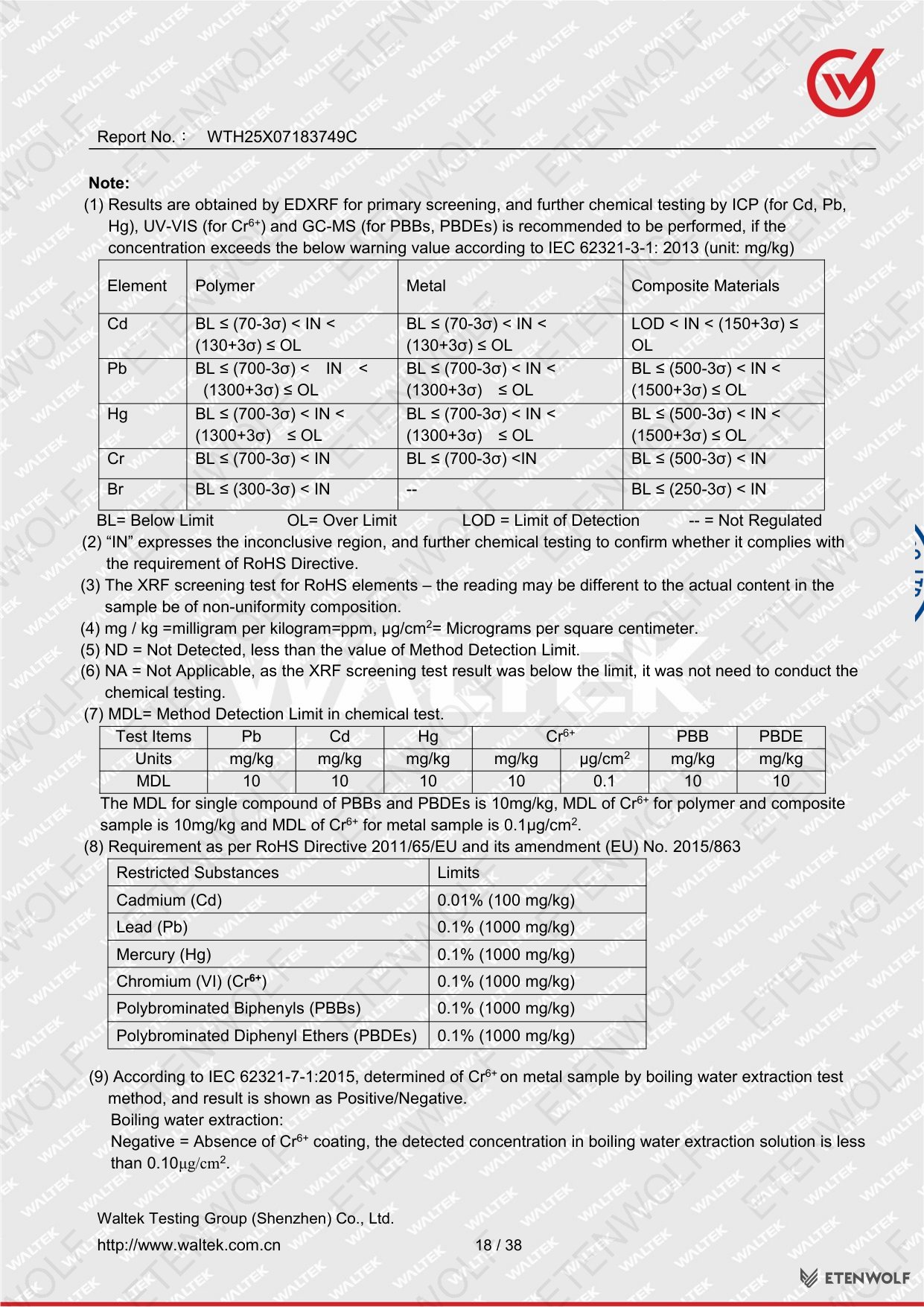
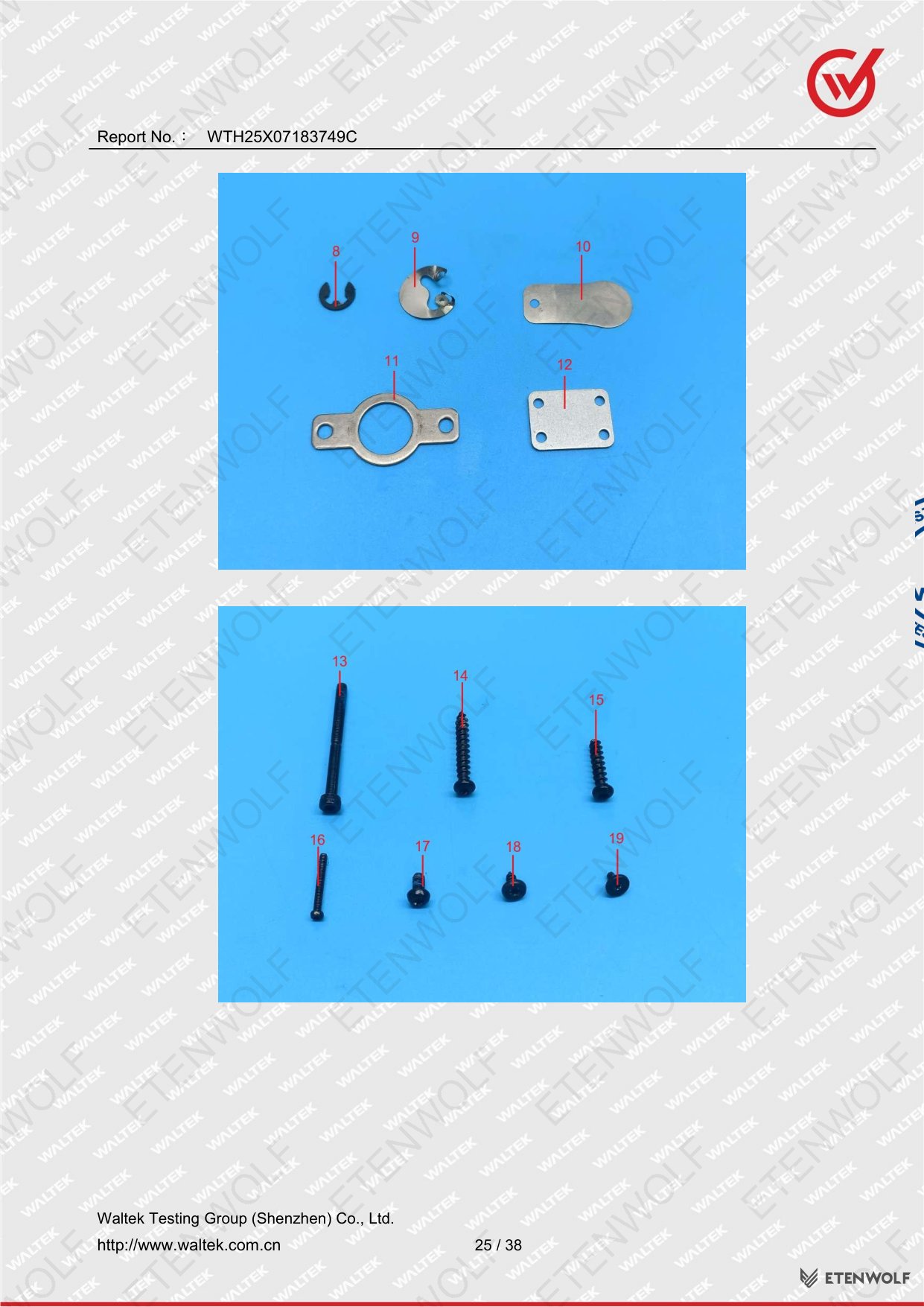
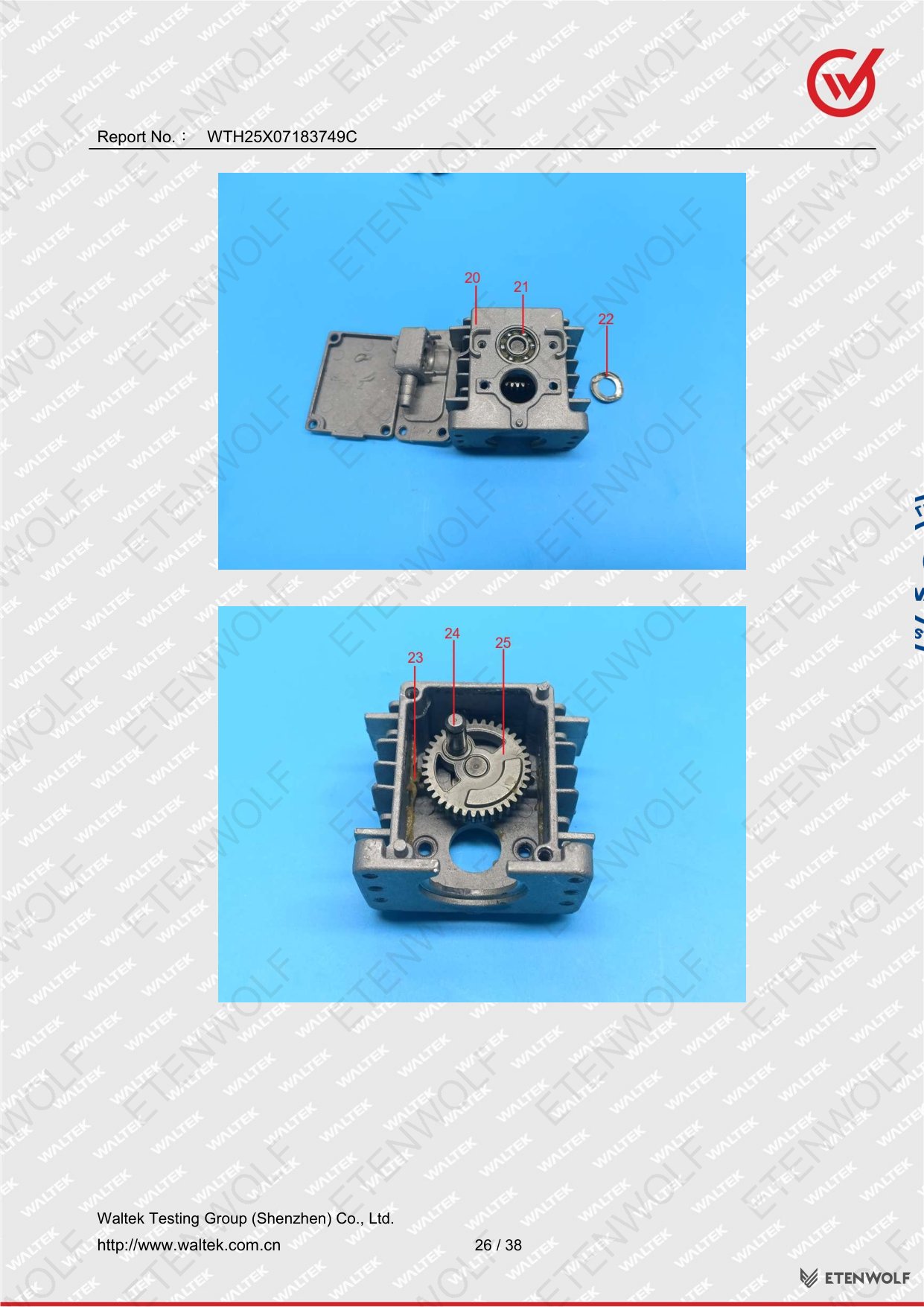
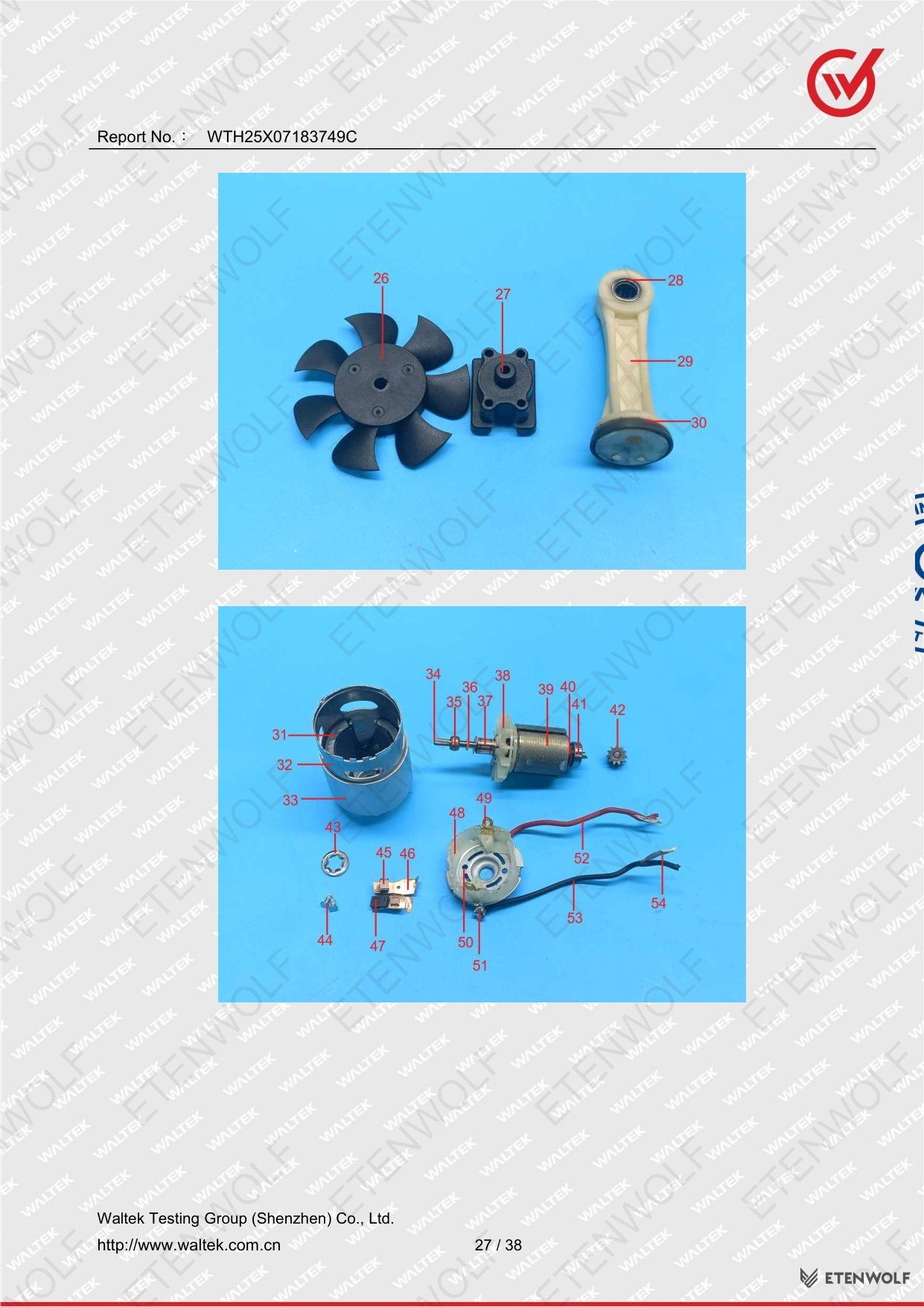
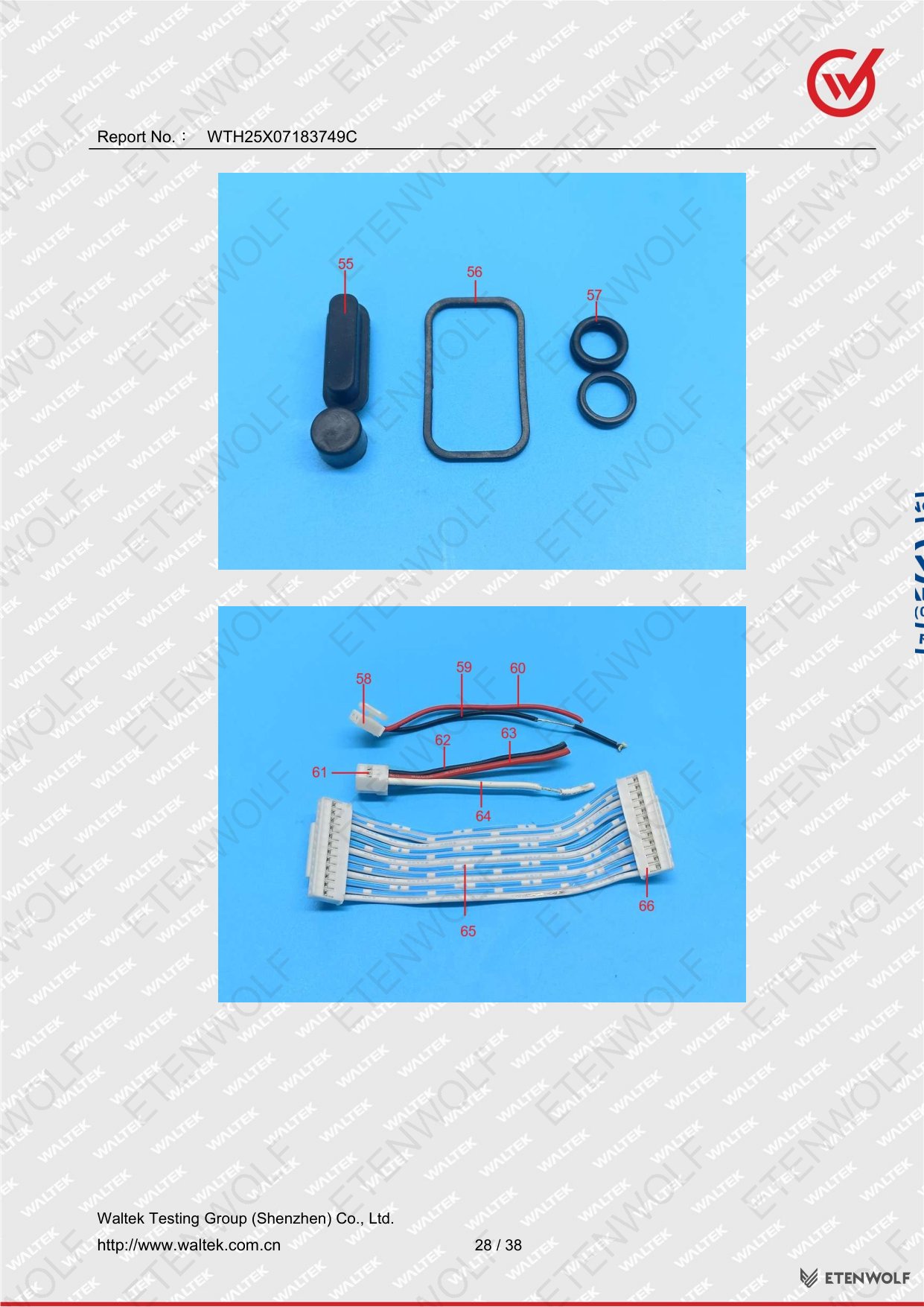
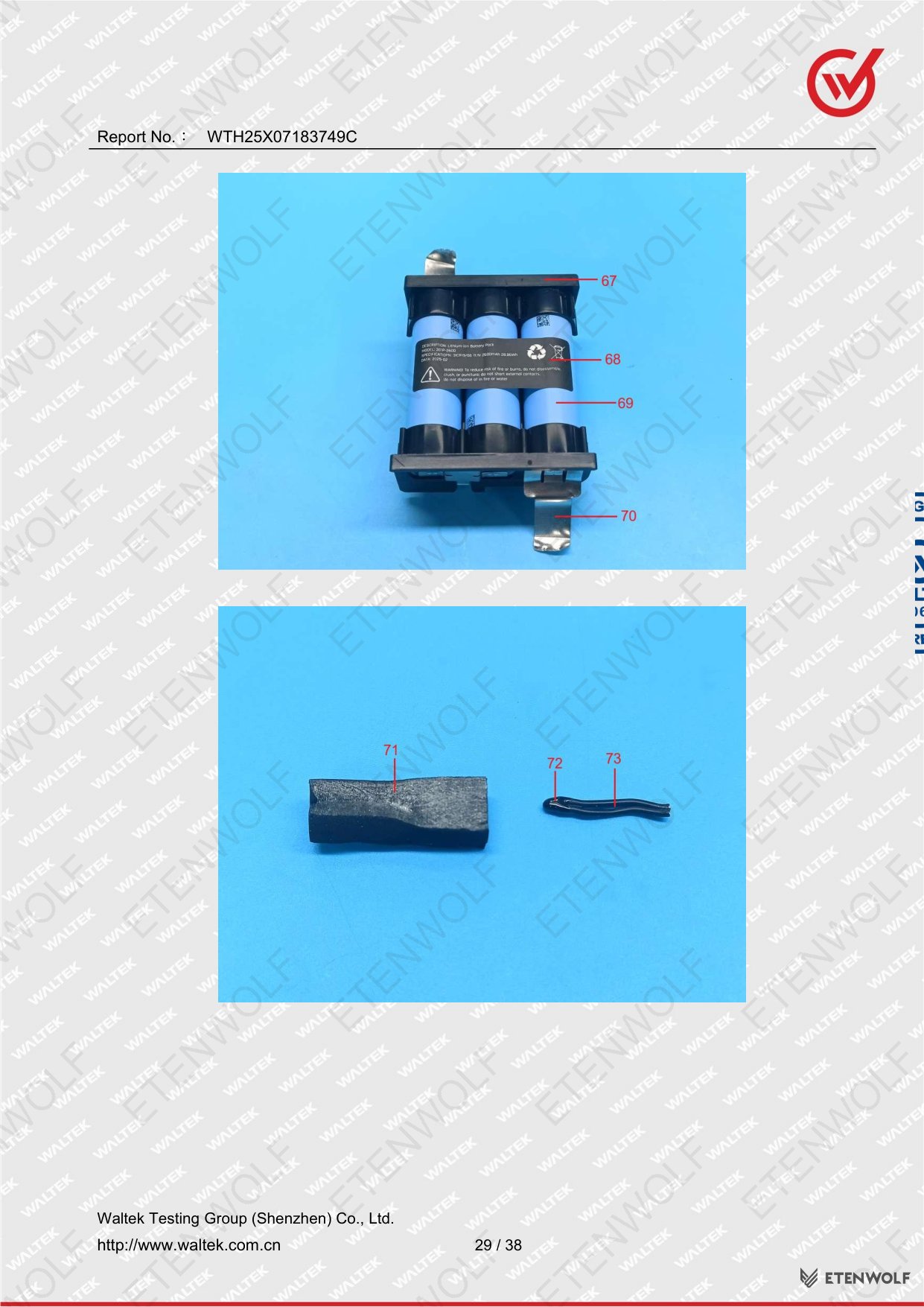
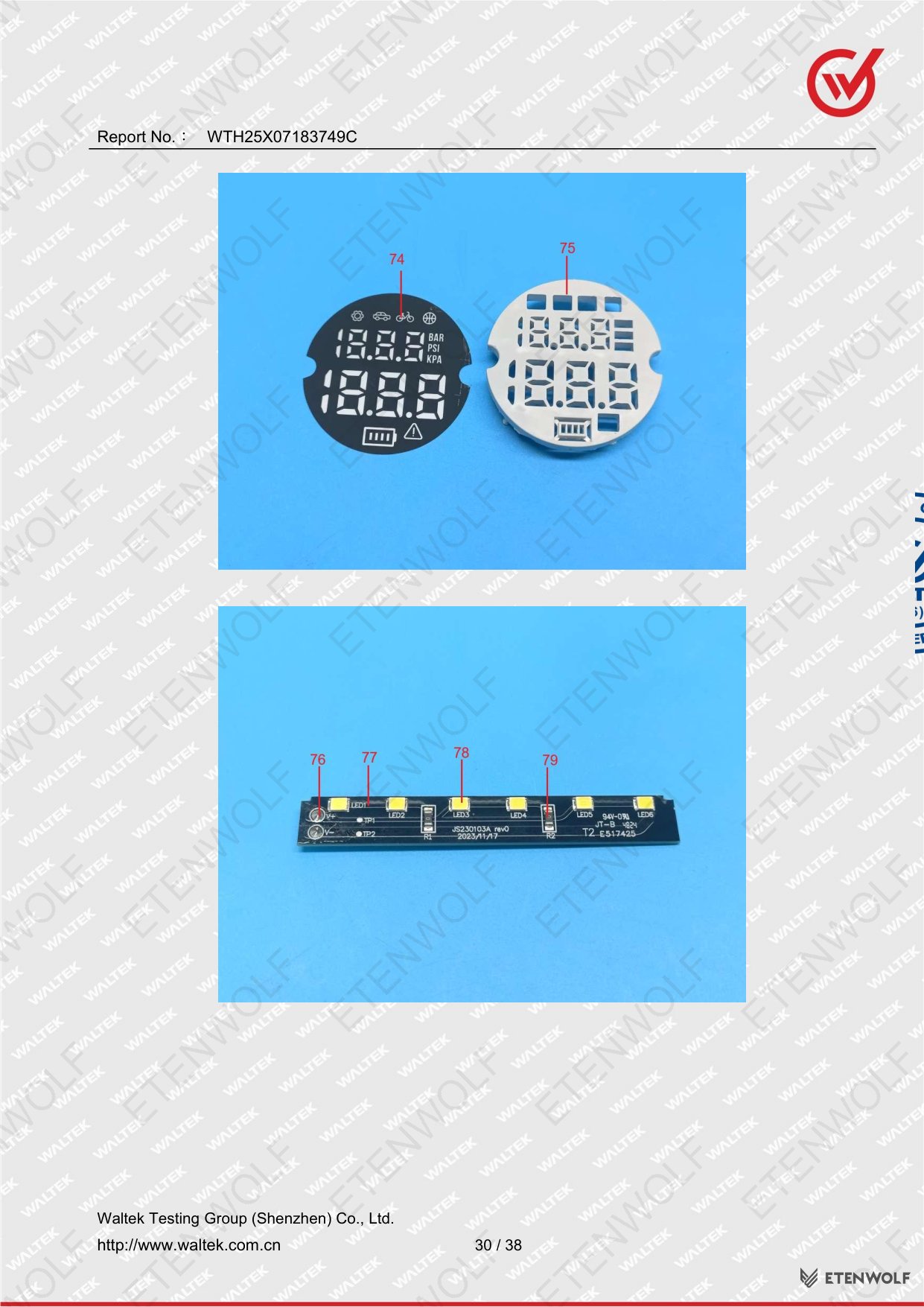
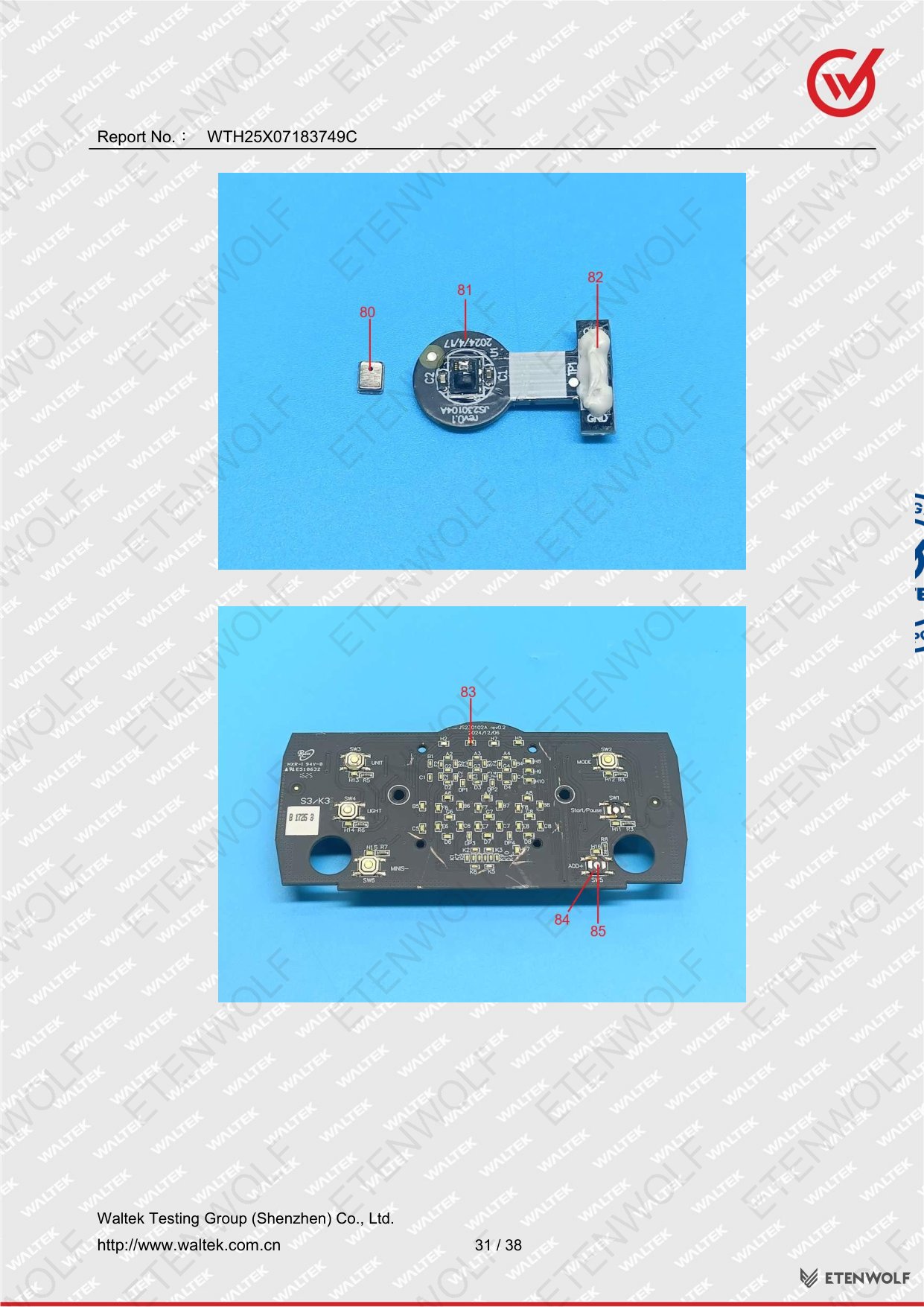
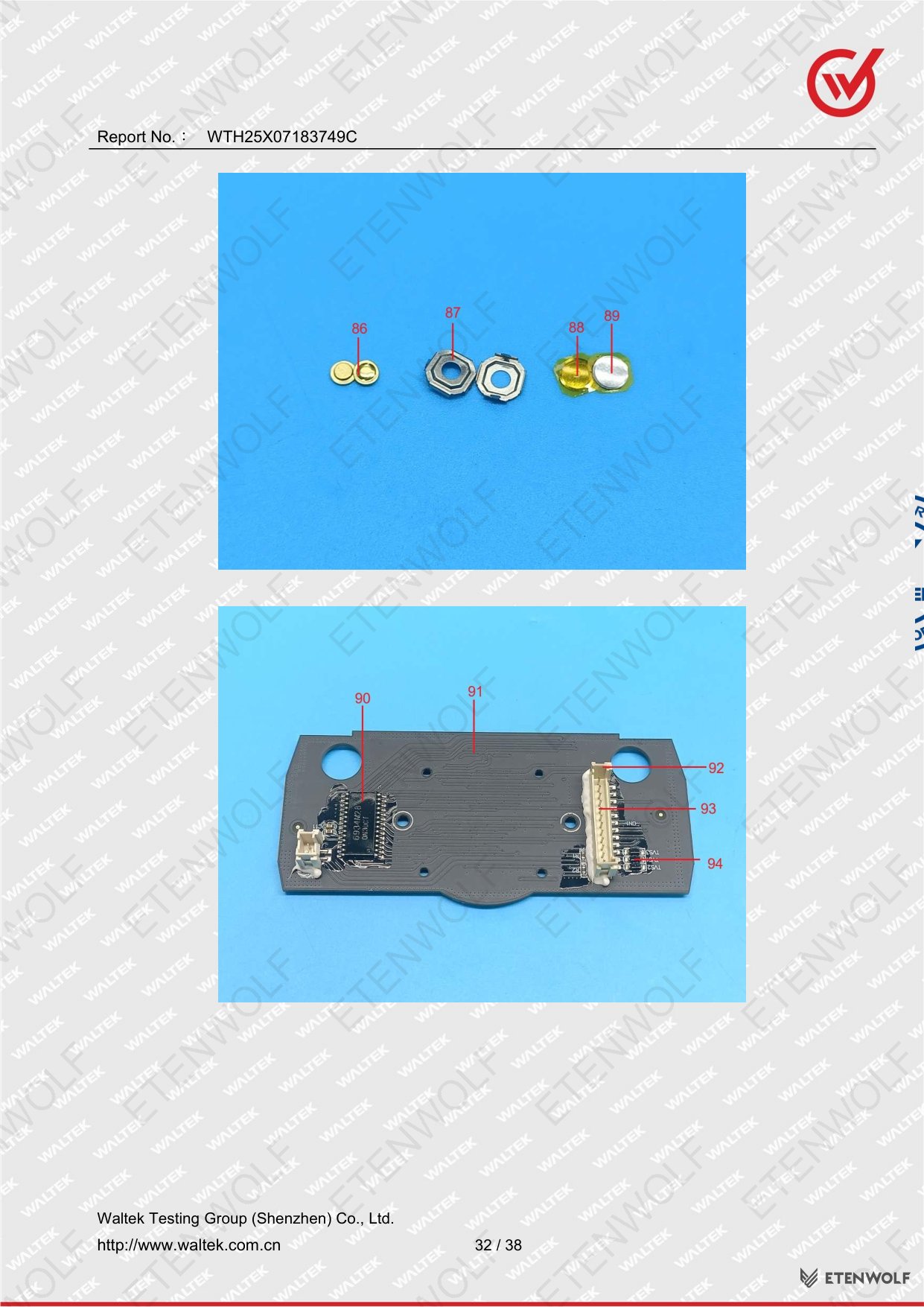
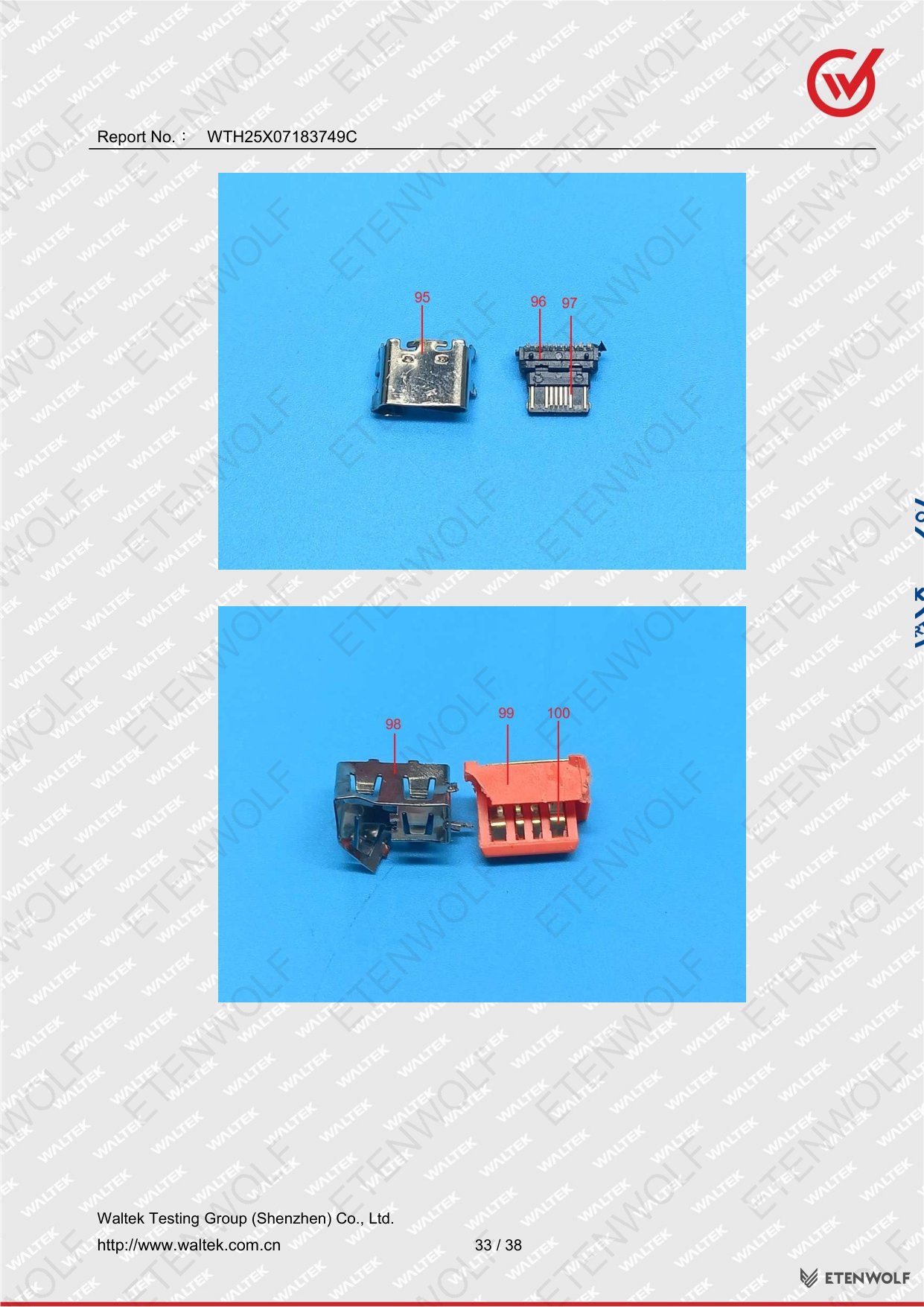
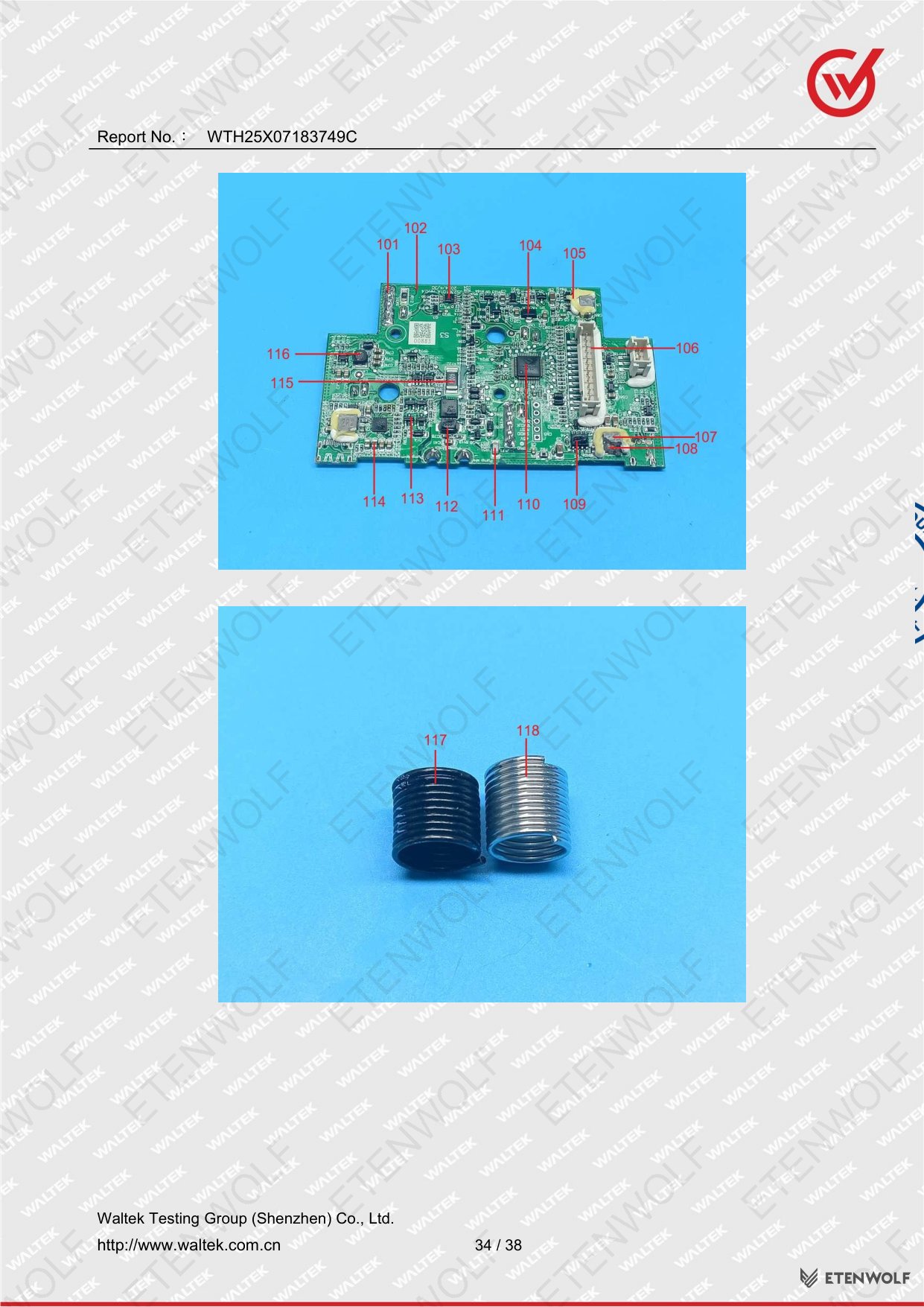
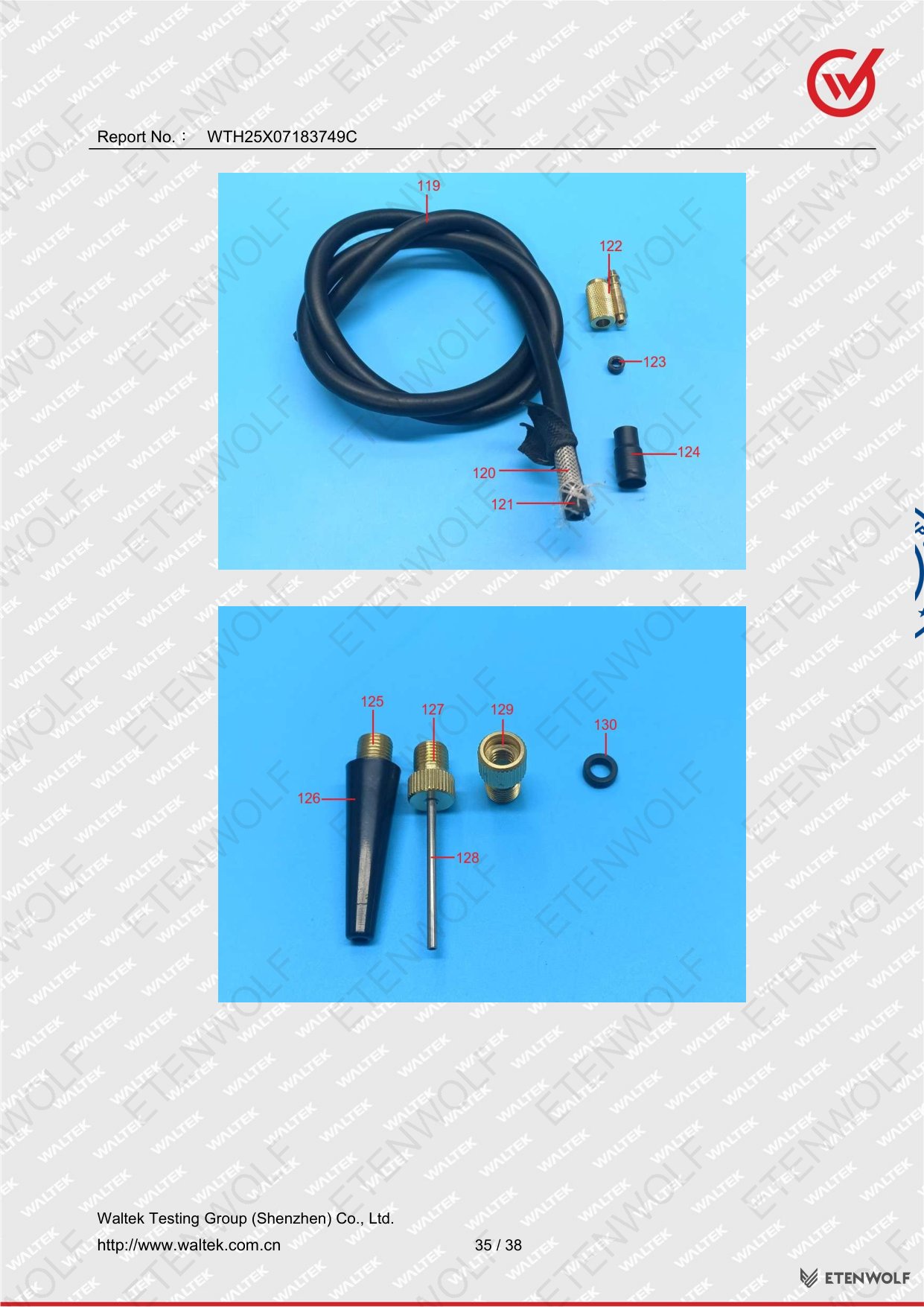
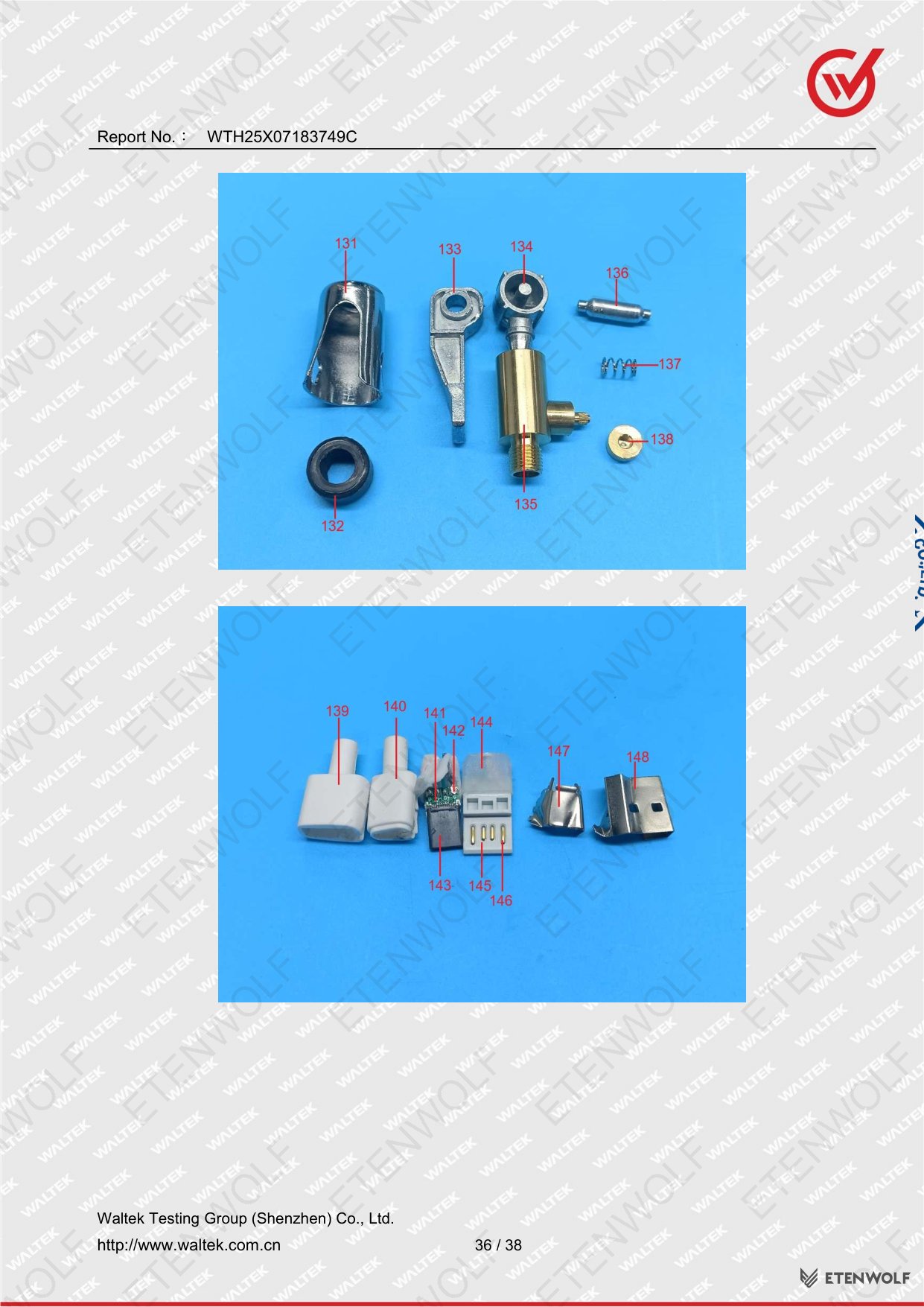
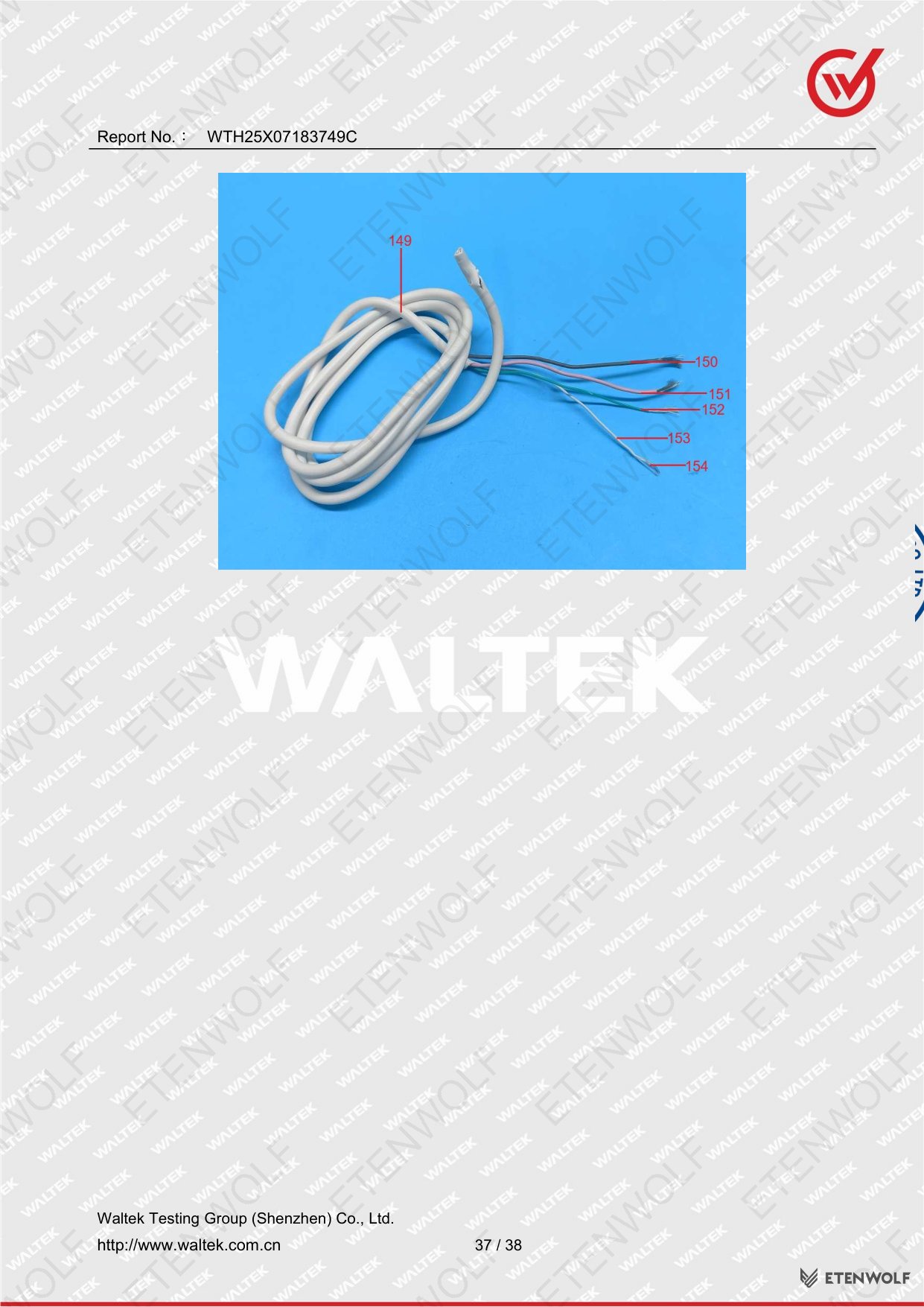
The laboratory disassembled the ETENWOLF S3 into 84 or more individual component parts. Each part was first screened by X-ray fluorescence spectrometry (XRF). Parts where XRF indicated a potentially elevated level of a restricted element were then subject to confirmatory chemical analysis. The table below summarises a representative selection of tested components and their results. BL = Below detection limit by XRF; IN = Inconclusive by XRF (confirmatory chemical test performed); ND = Not Detected; NA = Not Applicable for that substance/method.
| Part No. | Part Description | XRF Screen | Chemical Result / Note |
|---|---|---|---|
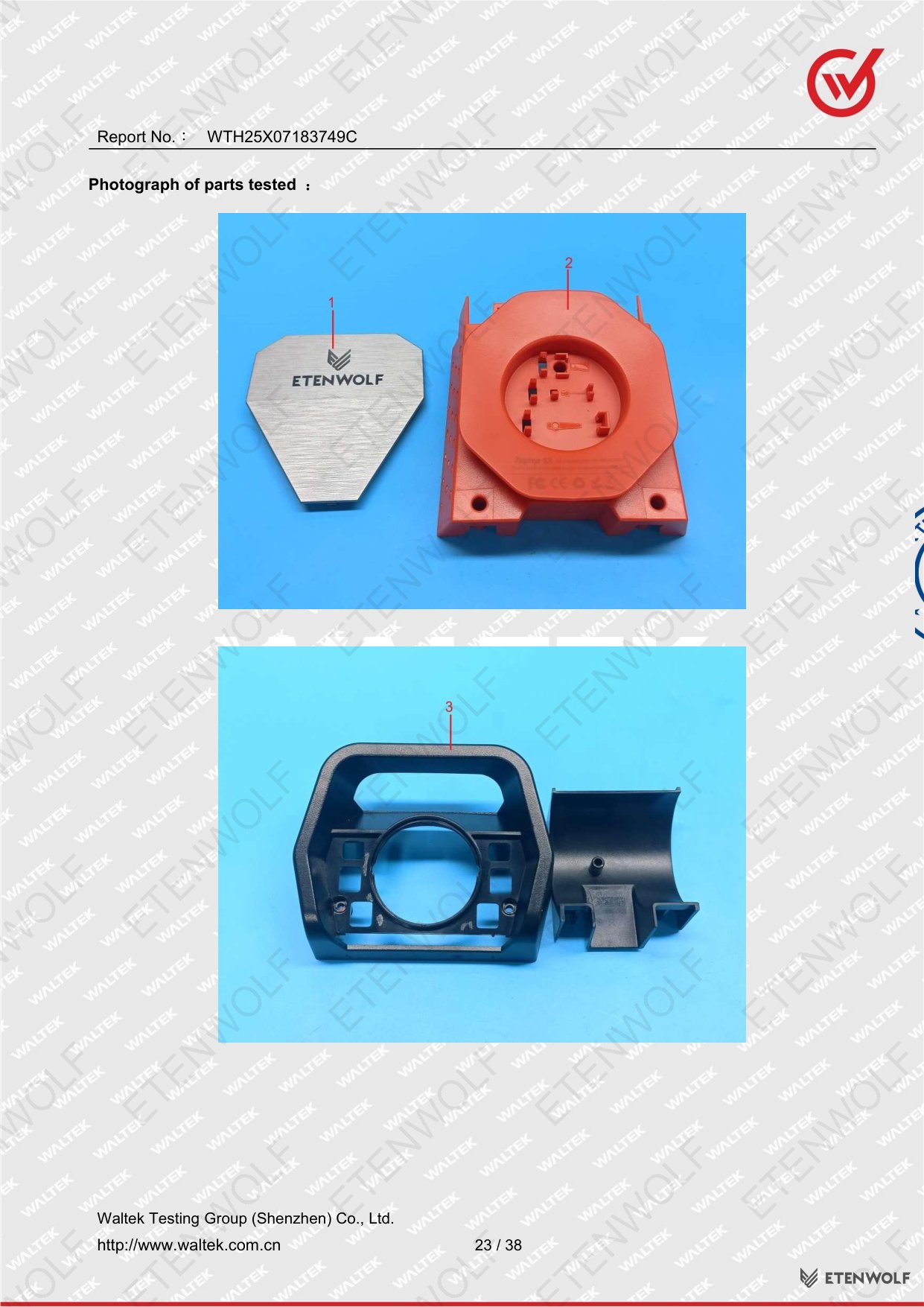
| 1 | Silvery plastic w/black printing | BL for Pb, Cd, Hg, Cr, Br | No chemical test required |
| 2 | Orange plastic shell | BL for Pb, Cd, Hg, Cr, Br | No chemical test required |
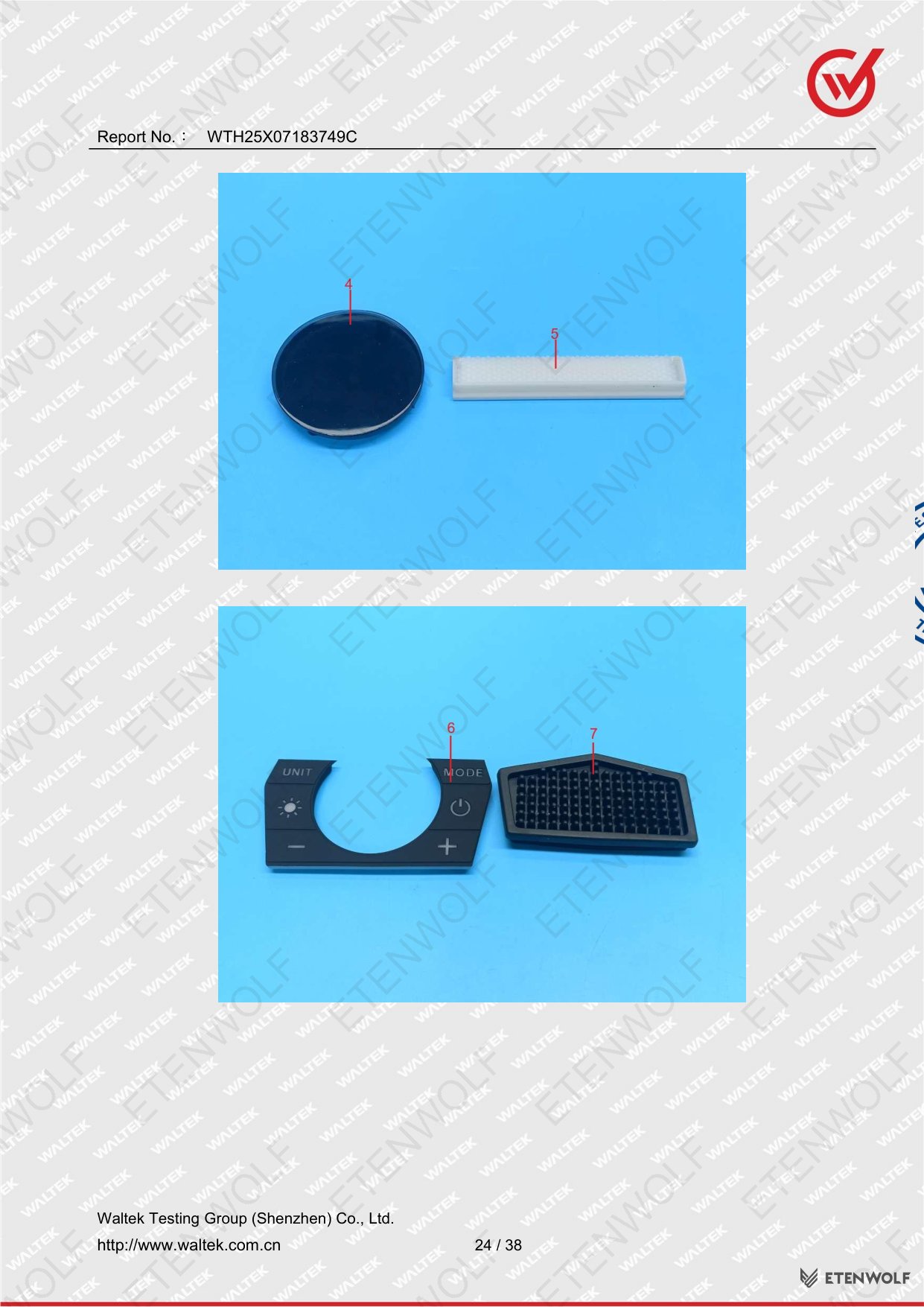
| 6–7 | Black rubber (×2) | BL for Pb, Cd, Hg, Cr, Br | No chemical test required |
| 9–11 | Silvery metal sheets (×3) | Cr: Inconclusive (IN) | Cr6+: Negative |
| 13 | Black cladding metal screw | Cr: Inconclusive (IN) | Cr6+: Negative |
| 16 | Black cladding metal screw | Cr: Inconclusive (IN) | Cr6+: Negative |
| 41 | Silvery metal ring | Cr: Inconclusive (IN) | Cr6+: Negative |
| 43 | Silvery metal ring | Cr: Inconclusive (IN) | Cr6+: Negative |
| 51 | Solder | BL for Pb, Cd, Hg, Cr | No chemical test required |
| 76 | Solder | BL for Pb, Cd, Hg, Cr | No chemical test required |
| 77 | Black cladding PCB board | Br: Inconclusive (IN) | PBBs: ND; PBDEs: ND |
| 81 | Black cladding PCB board | Br: Inconclusive (IN) | PBBs: ND; PBDEs: ND |
All 10 restricted substances were confirmed to be within the limits set by the RoHS Directive across all tested parts. Notably, all metal components that triggered an inconclusive XRF result for total chromium were confirmed negative for hexavalent chromium (Cr6+) by UV-Vis chemical analysis, and all PCB boards flagged for bromine were confirmed free of PBBs and PBDEs by GC-MS analysis.
Standards & Compliance
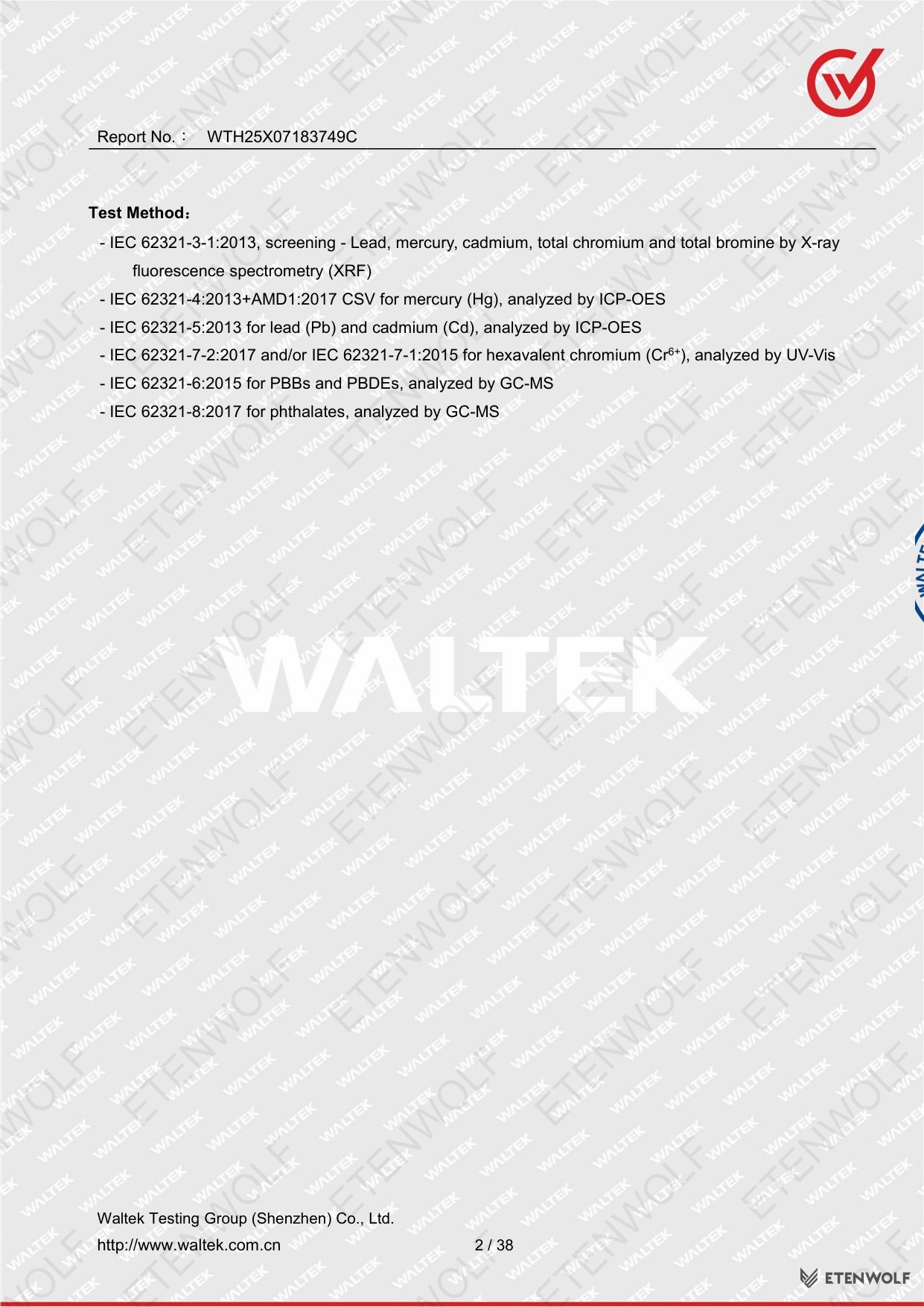
The testing programme for the ETENWOLF S3 followed a suite of internationally recognised IEC test methods for each restricted substance group. The methods applied are listed below.
| Standard | Scope | Analytical Technique |
|---|---|---|
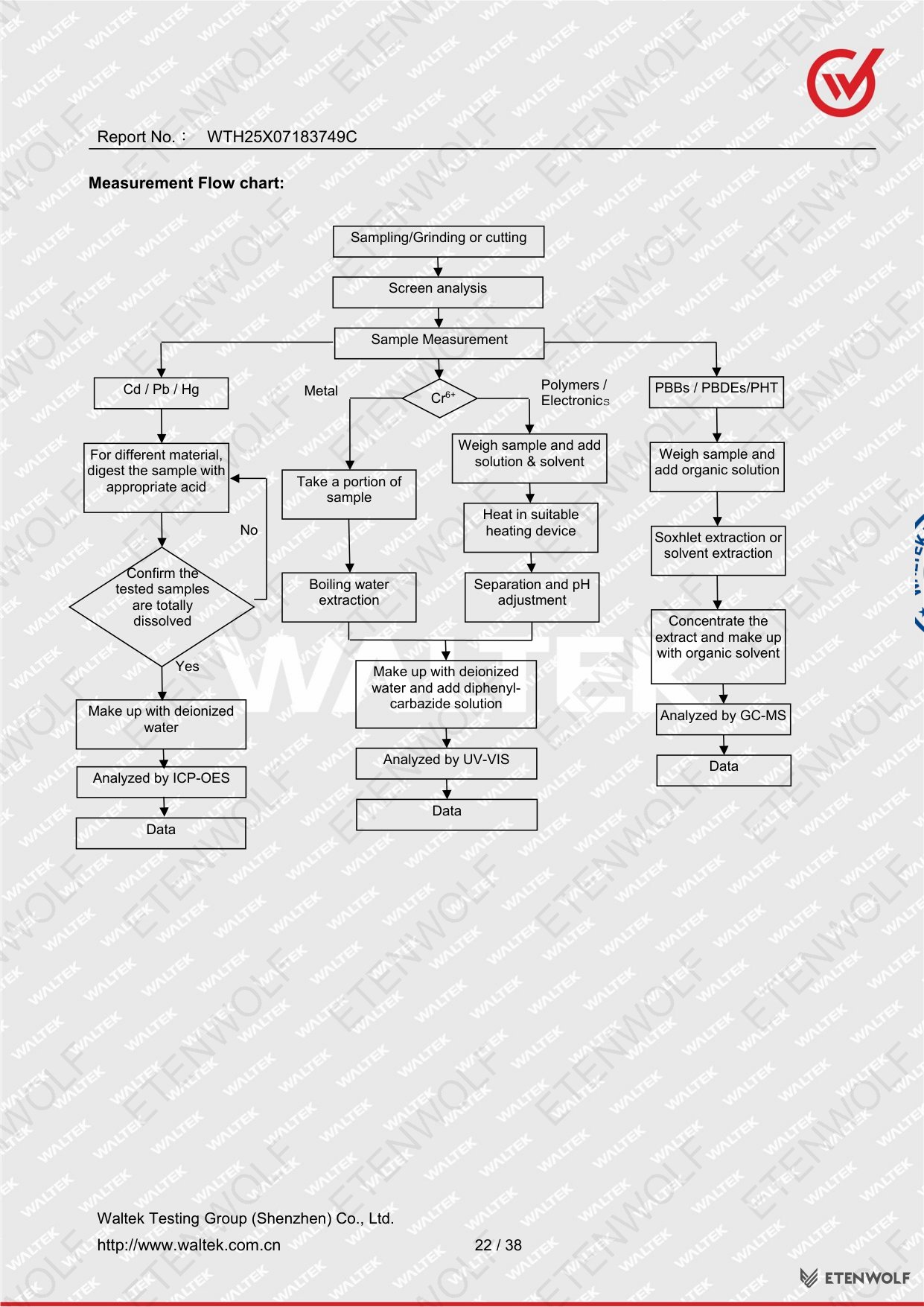
| IEC 62321-3-1:2013 | Screening – Pb, Hg, Cd, total Cr, total Br | X-ray Fluorescence Spectrometry (XRF) |
| IEC 62321-4:2013+AMD1:2017 CSV | Mercury (Hg) | ICP-OES |
| IEC 62321-5:2013 | Lead (Pb) and Cadmium (Cd) | ICP-OES |
| IEC 62321-7-2:2017 and/or IEC 62321-7-1:2015 | Hexavalent Chromium (Cr6+) | UV-Vis Spectrophotometry |
| IEC 62321-6:2015 | Polybrominated Biphenyls (PBBs) and Polybrominated Diphenyl Ethers (PBDEs) | GC-MS |
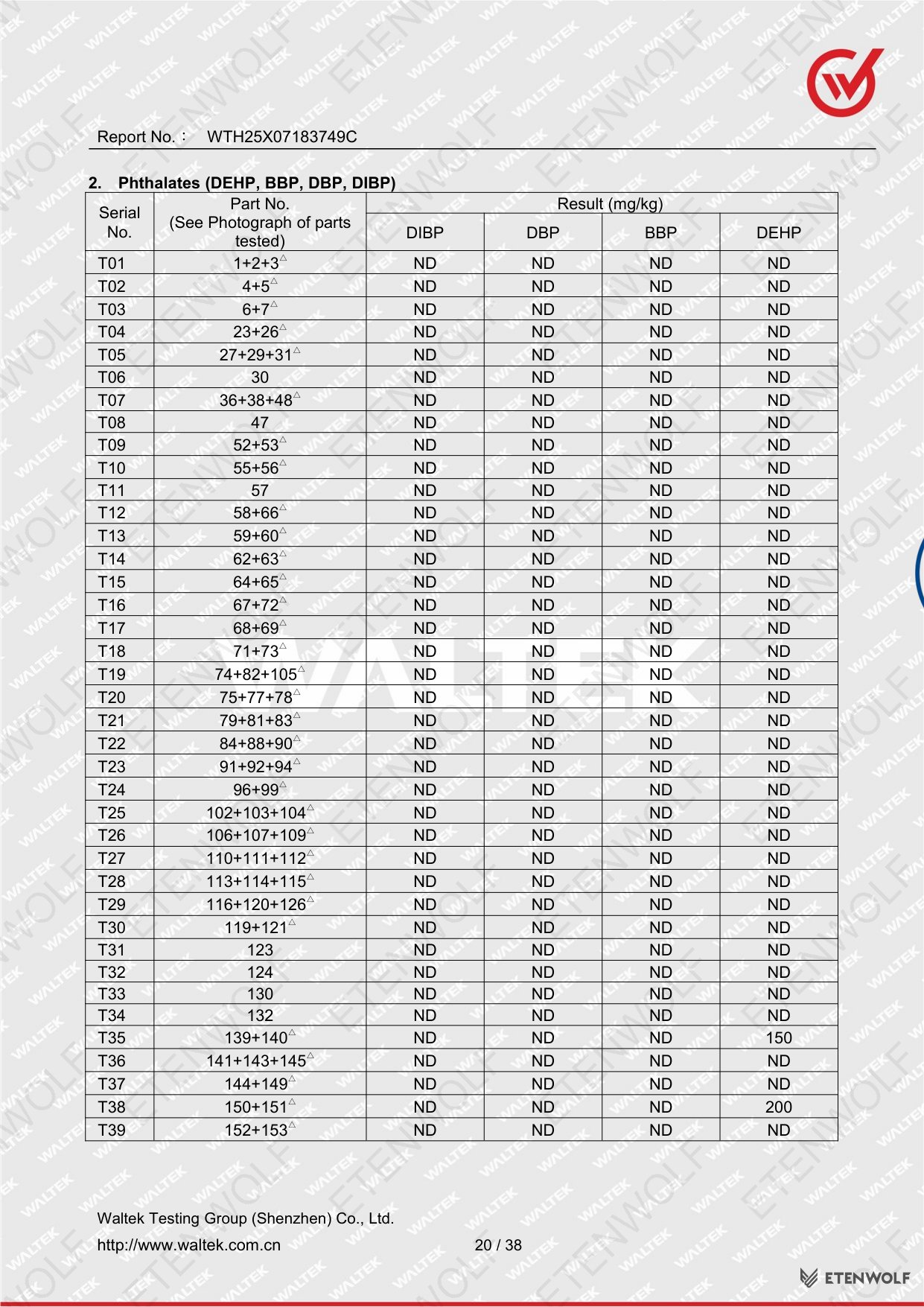
| IEC 62321-8:2017 | Phthalates (DEHP, BBP, DBP, DIBP) | GC-MS |
The governing regulatory framework is the EU RoHS Directive 2011/65/EU, as amended by (EU) No. 2015/863, which restricts 10 hazardous substances in electrical and electronic equipment placed on the European market.
Validity & Certification Body
The test report was issued on 2025-08-07 by Waltek Testing Group (Shenzhen) Co., Ltd. RoHS test reports of this type document compliance at the time of testing based on the submitted samples. The report remains valid as long as the product design, materials, and supply chain remain unchanged. Any modification to components or materials would necessitate re-testing.
| Field | Detail |
|---|---|
| Report Number | WTH25X07183749C |
| Date of Issue | 2025-08-07 |
| Issued By | Waltek Testing Group (Shenzhen) Co., Ltd. |
| Laboratory Address | 1/F., Room 101, Building 1, Hongwei Industrial Park, Liuxian 2nd Road, Block 70, Bao’an District, Shenzhen, Guangdong, China |
| Laboratory Website | http://www.waltek.com.cn |
| Telephone | +86-755-33663308 |
| Fax | +86-755-33663309 |
| [email protected] | |
| Signed By | Hugo Chen, on behalf of Waltek Testing Group (Shenzhen) Co., Ltd. |
Frequently Asked Questions
- What does RoHS compliance mean for the ETENWOLF S3?
-
RoHS stands for Restriction of Hazardous Substances. RoHS compliance means the ETENWOLF S3 has been independently tested and confirmed to contain less than the maximum permitted concentrations of 10 hazardous substances — including lead, mercury, cadmium, hexavalent chromium, PBBs, PBDEs, and four phthalates — as required by EU Directive 2011/65/EU and its amendment (EU) No. 2015/863.
- Which laboratory tested the ETENWOLF S3 for RoHS?
-
The testing was carried out by Waltek Testing Group (Shenzhen) Co., Ltd., an accredited third-party laboratory based in Shenzhen, China. The report number is WTH25X07183749C, issued on 2025-08-07.
- Why were some metal parts sent for chemical analysis after the XRF screen?
-
XRF is a rapid screening method but can return an inconclusive (IN) result when total chromium is detected in a metal surface coating, since XRF cannot distinguish between non-toxic trivalent chromium and restricted hexavalent chromium (Cr6+). Similarly, elevated total bromine in PCB boards triggers confirmatory GC-MS analysis for PBBs and PBDEs. In every such case for the ETENWOLF S3, chemical analysis confirmed the restricted forms were absent.
- Does this RoHS report cover phthalates?
-
Yes. The four phthalates added to the RoHS restricted list by amendment (EU) No. 2015/863 — DEHP, BBP, DBP, and DIBP — were tested using IEC 62321-8:2017 with GC-MS analysis. The ETENWOLF S3 passed all phthalate requirements.
Related Documents
The following additional certification and compliance documents are relevant for the ETENWOLF S3 cordless tire inflator and would typically accompany a complete compliance file for the European and global market:
- CE Declaration of Conformity — Required for the European market, covering applicable CE directives such as the Low Voltage Directive (LVD) and Electromagnetic Compatibility (EMC) Directive.
- UN 38.3 Battery Transport Test Report — Required for shipping lithium-ion battery products by air, sea, or road under UN 38.3 regulations.
- FCC Declaration of Conformity / Test Report — Required for the US market, covering radio frequency emissions under FCC Part 15.
- KC Certification — Required for the South Korean market under KC safety and EMC regulations.
- REACH SVHC Compliance Declaration — Confirms the product does not contain Substances of Very High Concern above threshold levels under the REACH regulation (EC) No. 1907/2006.
- IEC 62133 Battery Safety Test Report — Covers safety requirements for the portable sealed secondary lithium cells and batteries used in the inflator.
Document Pages