Document Overview
Document Overview This page presents the Material Safety Data Sheet (MSDS) issued under reference number WTH25D11289146B001 for a lithium-ion battery pack associated with the ETENWOLF C2PRO inflation tool. The document was prepared by Waltek Testing Group Co., Ltd., an accredited third-party testing laboratory based in…
- Document type
- Certification Report
- Prepared by
- Michelle Torres
- Published
- Last reviewed
- Topics
- International Transportation: CB / MSDS / UN38.3
Document Overview
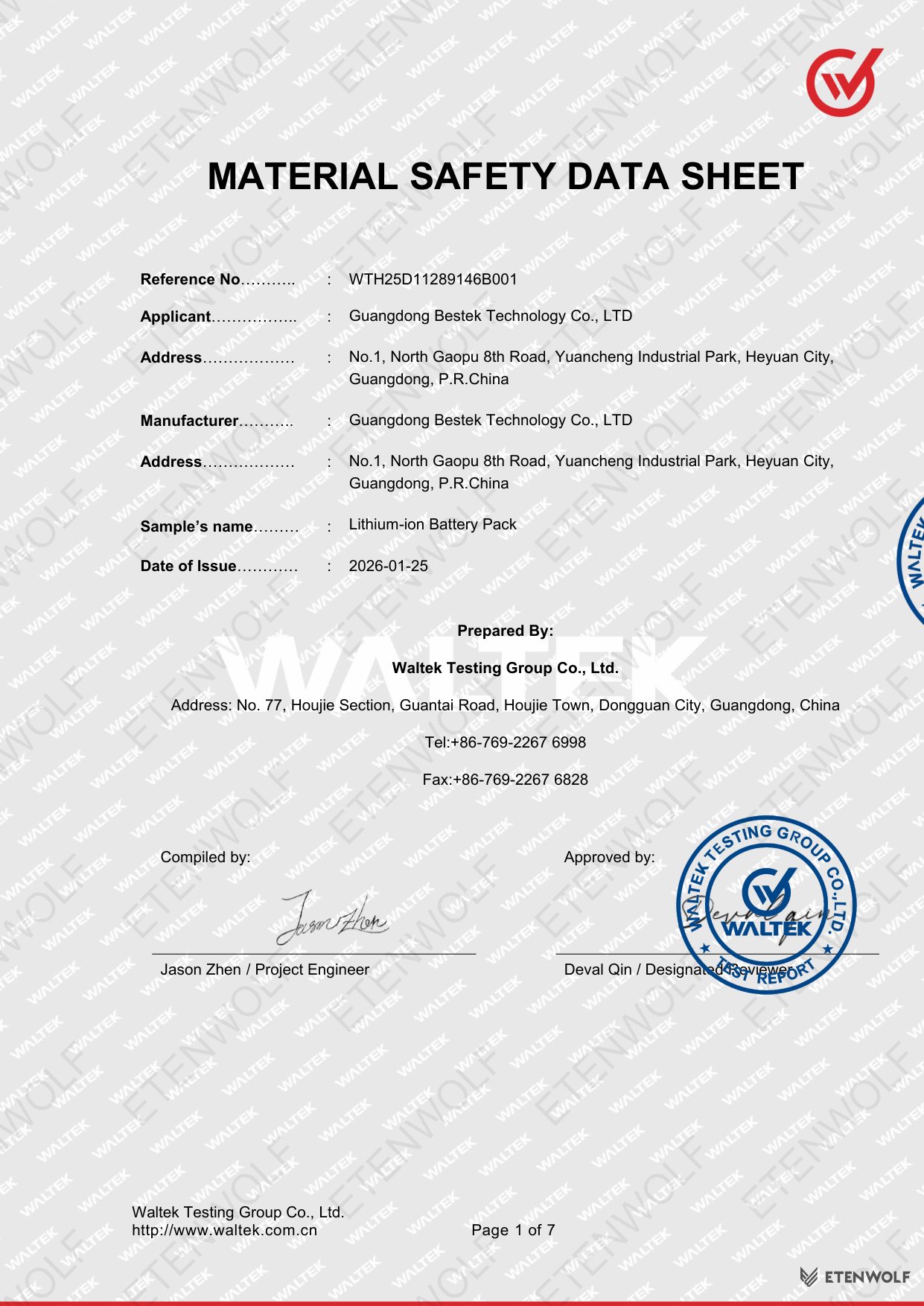
This page presents the Material Safety Data Sheet (MSDS) issued under reference number WTH25D11289146B001 for a lithium-ion battery pack associated with the ETENWOLF C2PRO inflation tool. The document was prepared by Waltek Testing Group Co., Ltd., an accredited third-party testing laboratory based in Dongguan City, Guangdong, China, and issued on 2026-01-25. The MSDS covers chemical composition, hazard identification, first aid measures, fire-fighting procedures, handling and storage guidelines, and exposure controls for the battery pack, in compliance with UN38.3 transport safety requirements for lithium batteries. The applicant and manufacturer is Guangdong Bestek Technology Co., Ltd., located at No. 1, North Gaopu 8th Road, Yuancheng Industrial Park, Heyuan City, Guangdong, P.R. China.
Section 1 – Chemical Product and Company Identification
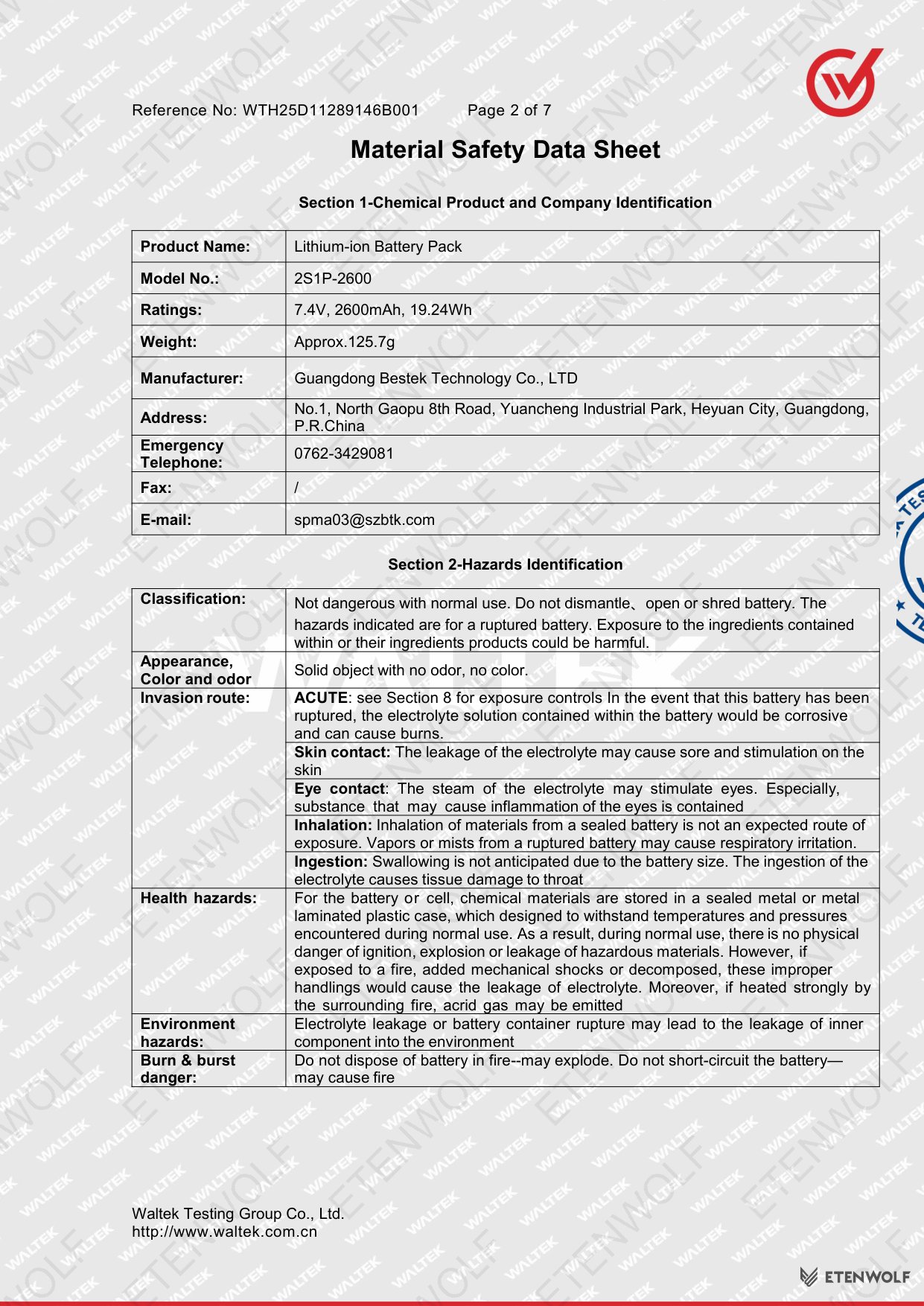
The battery pack covered by this MSDS is installed in the ETENWOLF C2PRO cordless inflation tool. Key specifications are listed in the table below.
| Parameter | Value |
|---|---|
| Product Name | Lithium-ion Battery Pack |
| Model Number | 2S1P-2600 |
| Nominal Voltage | 7.4 V |
| Capacity | 2600 mAh |
| Energy | 19.24 Wh |
| Approximate Weight | 125.7 g |
| Configuration | 2 cells in series, 1 cell in parallel (2S1P) |
| Manufacturer | Guangdong Bestek Technology Co., Ltd. |
| Emergency Telephone | 0762-3429081 |
| Contact Email | [email protected] |
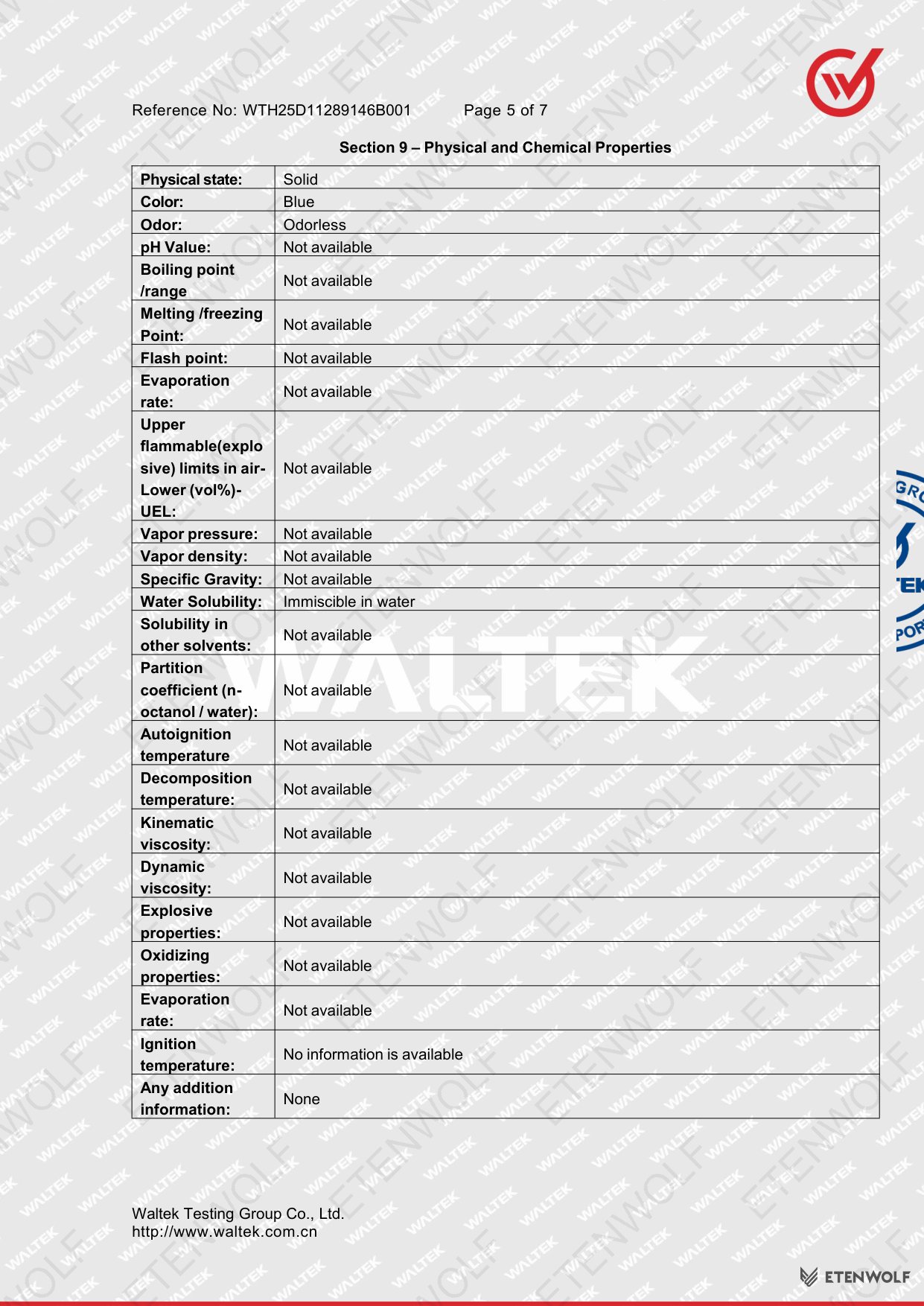
Under normal operating conditions the battery pack is a solid object with no odor and no characteristic color. It is not classified as dangerous goods during standard use, provided all handling and storage instructions are followed.
Key Details
Hazards Identification (Section 2)
The battery pack is not classified as dangerous under normal use conditions. Chemical materials are sealed inside a metal or metal-laminated plastic casing engineered to withstand temperatures and pressures encountered during standard operation. Risk arises only if the battery is ruptured, overheated, short-circuited, or exposed to fire.
- Skin contact: Electrolyte leakage may cause soreness and skin irritation.
- Eye contact: Electrolyte vapors may cause eye irritation or inflammation.
- Inhalation: Vapors or mists from a ruptured battery may cause respiratory irritation.
- Ingestion: Accidental ingestion of electrolyte can cause tissue damage to the throat.
- Environmental: Electrolyte leakage or container rupture may release inner components into the environment.
- Fire / Explosion: Do not dispose of the battery in fire — it may explode. Do not short-circuit — risk of fire.
Chemical Composition (Section 3)
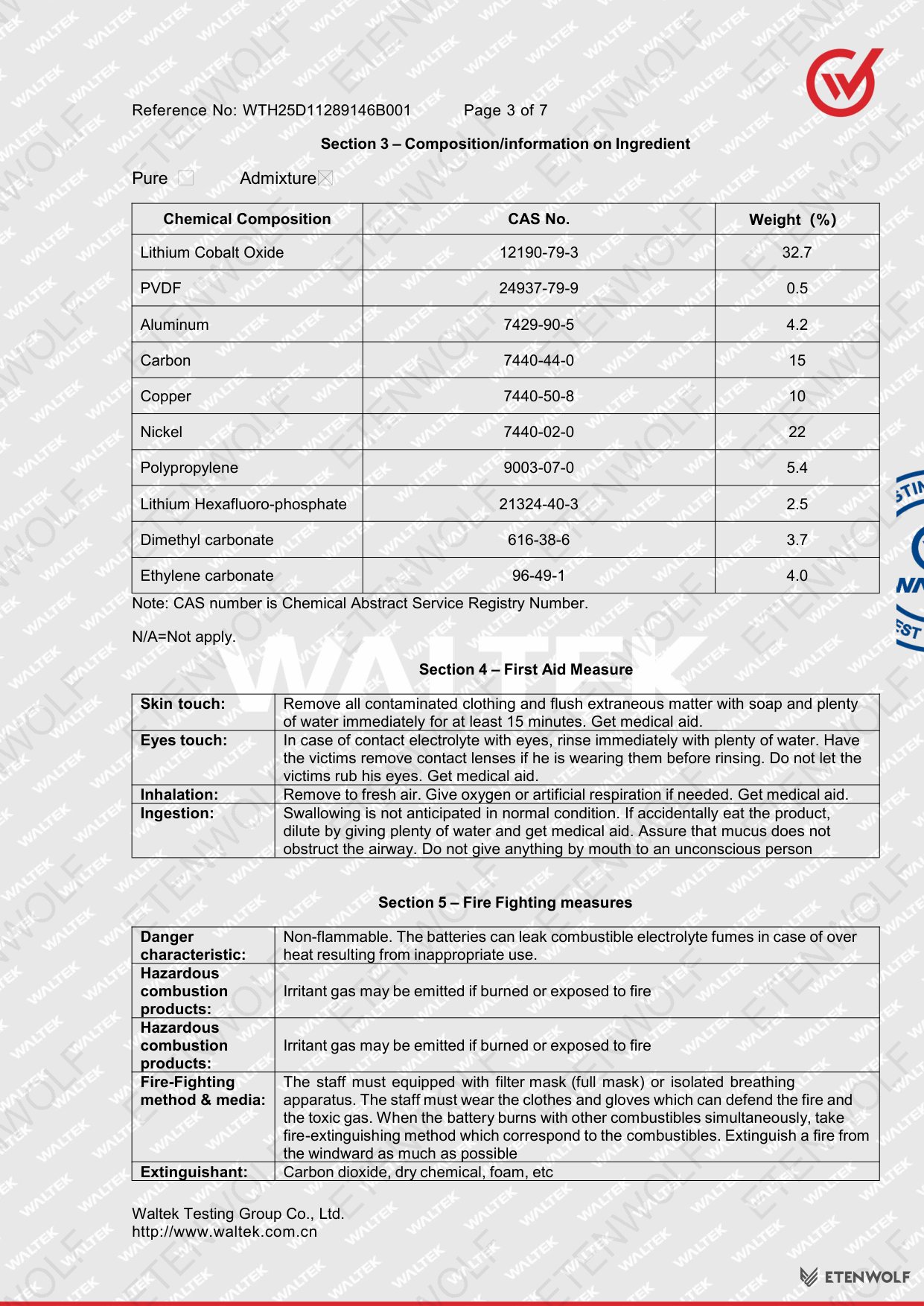
The battery pack is an admixture. The following table lists all identified ingredients with their CAS Registry Numbers and approximate weight percentages.
| Chemical Name | CAS No. | Weight (%) |
|---|---|---|
| Lithium Cobalt Oxide | 12190-79-3 | 32.7 |
| Nickel | 7440-02-0 | 22 |
| Carbon | 7440-44-0 | 15 |
| Copper | 7440-50-8 | 10 |
| Aluminum | 7429-90-5 | 4.2 |
| Ethylene Carbonate | 96-49-1 | 4.0 |
| Dimethyl Carbonate | 616-38-6 | 3.7 |
| Lithium Hexafluorophosphate | 21324-40-3 | 2.5 |
| Polypropylene | 9003-07-0 | 5.4 |
| PVDF (Polyvinylidene Fluoride) | 24937-79-9 | 0.5 |
First Aid Measures (Section 4)
- Skin: Remove contaminated clothing; flush with soap and plenty of water for at least 15 minutes. Seek medical aid.
- Eyes: Rinse immediately with plenty of water; remove contact lenses before rinsing; do not rub eyes. Seek medical aid.
- Inhalation: Move to fresh air; administer oxygen or artificial respiration if needed. Seek medical aid.
- Ingestion: Dilute by drinking plenty of water; ensure airway is clear; seek medical aid immediately. Do not give anything by mouth to an unconscious person.
Fire-Fighting Measures (Section 5)
The battery pack is non-flammable under normal conditions. If overheated through improper use, combustible electrolyte fumes may be released. Recommended extinguishing agents include carbon dioxide, dry chemical, and foam. Firefighters must wear full-face filter masks or self-contained breathing apparatus, along with fire- and chemical-resistant clothing and gloves. Extinguish fire from the upwind direction wherever possible.
Accidental Release Measures (Section 6)
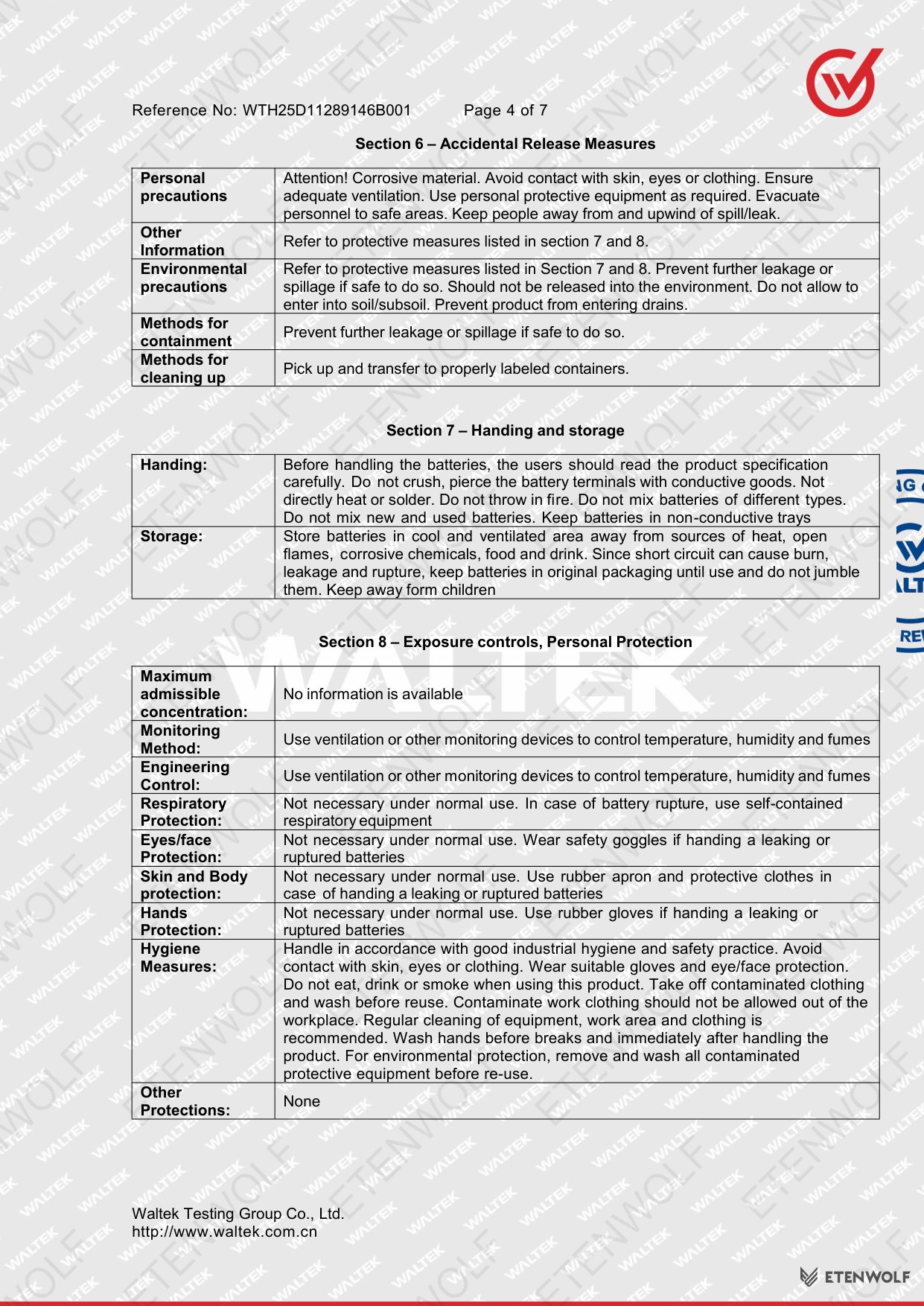
- Personal precautions: Attention! Corrosive material. Avoid contact with skin, eyes or clothing. Ensure adequate ventilation. Use personal protective equipment as required. Evacuate personnel to safe areas. Keep people away from and upwind of spill/leak.
- Other information: Refer to protective measures listed in section 7 and 8.
- Environmental precautions: Refer to protective measures listed in Section 7 and 8. Prevent further leakage or spillage if safe to do so. Should not be released into the environment. Do not allow to enter into soil/subsoil. Prevent product from entering drains.
- Containment: Prevent further leakage or spillage if safe to do so.
- Cleaning: Pick up and transfer to properly labeled containers.
Handling and Storage (Section 7)
- Read the product specification before handling.
- Do not crush, pierce, directly heat, or solder the battery.
- Do not throw into fire or mix batteries of different types or states (new vs. used).
- Keep batteries in non-conductive trays and in original packaging until use.
- Store in a cool, well-ventilated area away from heat sources, open flames, corrosive chemicals, food, and drink.
- Keep away from children.
Standards & Compliance
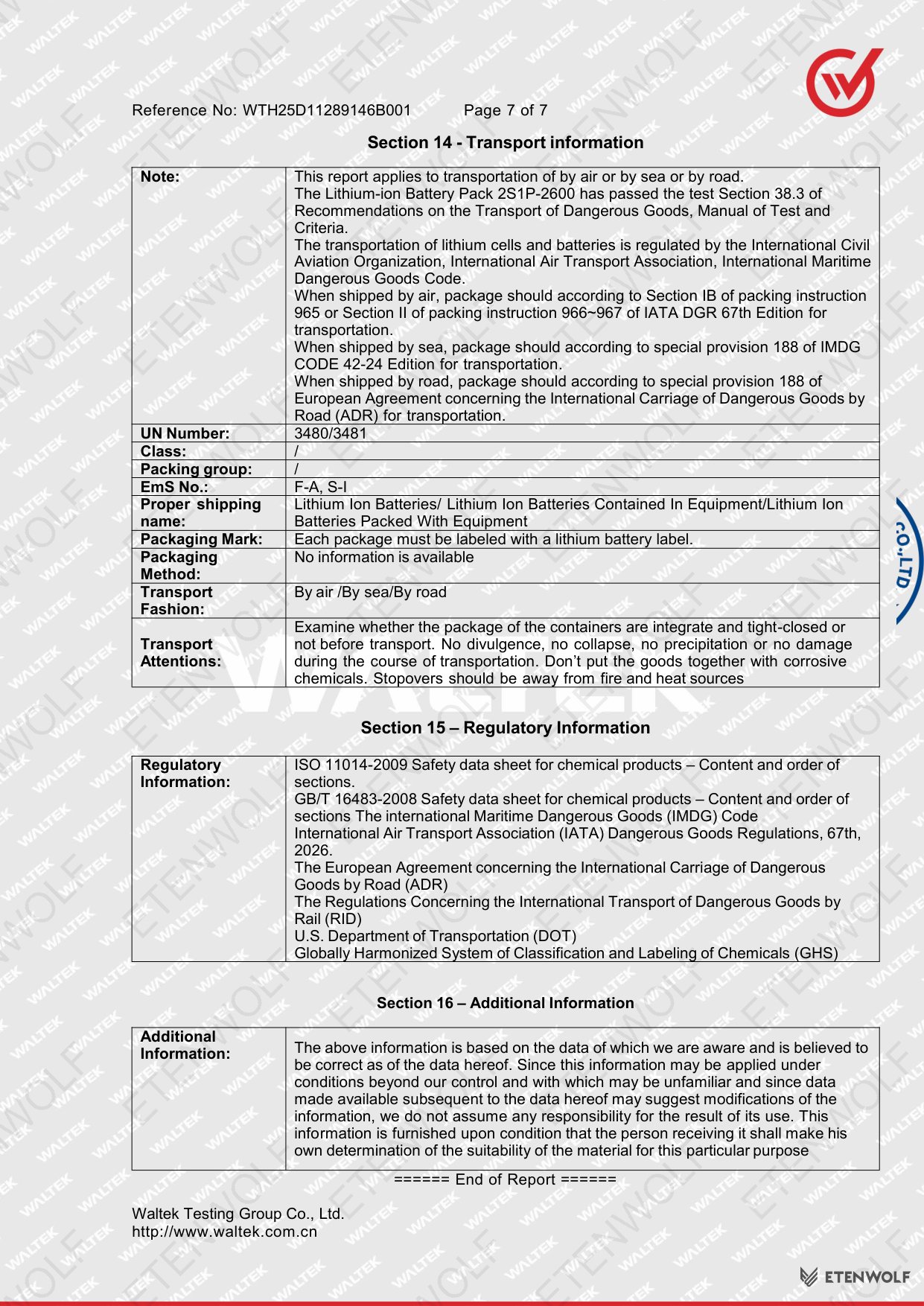
This Material Safety Data Sheet is prepared in support of UN38.3 — the United Nations Manual of Tests and Criteria, Part III, Section 38.3, which governs the transport testing of lithium metal and lithium-ion batteries. Compliance with UN38.3 is mandatory for the safe air, sea, and ground transport of lithium-based battery products worldwide.
| Standard / Regulation | Scope |
|---|---|
| UN38.3 | Transport testing requirements for lithium batteries |
| MSDS / SDS Format | Material Safety Data Sheet per international GHS guidelines |
The MSDS documents chemical hazards, exposure controls, and emergency response procedures to satisfy regulatory requirements for safe handling and transport of the lithium-ion battery pack used in the ETENWOLF C2PRO.
Validity & Certification Body
The Material Safety Data Sheet bearing reference number WTH25D11289146B001 was issued on 2026-01-25. The issuing laboratory is:
| Field | Details |
|---|---|
| Laboratory Name | Waltek Testing Group Co., Ltd. |
| Website | http://www.waltek.com.cn |
| Address | No. 77, Houjie Section, Guantai Road, Houjie Town, Dongguan City, Guangdong, China |
| Telephone | +86-769-2267 6998 |
| Fax | +86-769-2267 6828 |
| Compiled By | Jason Zhen, Project Engineer |
| Approved By | Deval Qin, Designated Reviewer |
| Reference Number | WTH25D11289146B001 |
| Date of Issue | 2026-01-25 |
| Document Length | 7 pages |
No explicit expiry date is stated in the extracted document. MSDS documents are typically reviewed and reissued when formulation, regulations, or safety data change. Users should confirm with the issuing laboratory whether a more recent revision exists before relying on this document for regulatory submissions.
Frequently Asked Questions
- What is the battery specification inside the ETENWOLF C2PRO?
- The ETENWOLF C2PRO uses a lithium-ion battery pack with model number 2S1P-2600, rated at 7.4 V, 2600 mAh, and 19.24 Wh. The pack weighs approximately 125.7 g and is manufactured by Guangdong Bestek Technology Co., Ltd.
- Is the lithium-ion battery pack in the C2PRO dangerous during normal use?
- No. Under normal operating conditions the battery pack is not classified as a dangerous article. Hazards only arise if the battery is ruptured, short-circuited, exposed to fire, or handled improperly. Always follow the handling and storage guidelines in the MSDS.
- What should I do if the battery pack leaks or ruptures?
- Avoid skin and eye contact with any released electrolyte. If skin contact occurs, flush with soap and water for at least 15 minutes. If electrolyte contacts eyes, rinse immediately with plenty of water and seek medical attention. Move to fresh air if vapors are inhaled. Contact emergency services and refer to the full first aid section of the MSDS (reference WTH25D11289146B001).
- Which testing laboratory issued the UN38.3 MSDS for the C2PRO battery?
- The MSDS was prepared and issued by Waltek Testing Group Co., Ltd., located in Dongguan City, Guangdong, China (website: http://www.waltek.com.cn). The document reference number is WTH25D11289146B001, issued on 2026-01-25.
Related Documents
The following certification and compliance documents are typically required alongside a UN38.3 MSDS for a lithium-ion battery-powered inflation tool such as the ETENWOLF C2PRO. Confirm availability with ETENWOLF or the authorized distributor.
- UN38.3 Test Report — Full transport safety test results for the lithium-ion battery pack (altitude simulation, thermal test, vibration, shock, external short circuit, impact, overcharge, and forced discharge).
- CE Declaration of Conformity — Required for sale in the European Economic Area; covers applicable CE directives including the Battery Directive and Low Voltage Directive.
- FCC Declaration of Conformity — Required for the US market; covers electromagnetic compatibility per FCC Part 15.
- RoHS Compliance Certificate — Confirms restriction of hazardous substances per RoHS Directive 2011/65/EU.
- REACH SVHC Declaration — Confirms compliance with REACH regulation (EC) No 1907/2006 regarding substances of very high concern.
- KC Certification — Required for the South Korean market under the KC safety scheme.
- IEC 62133 Battery Safety Test Report — Covers safety requirements for portable sealed secondary lithium cells per IEC standard 62133.
Document Pages