Document Overview
Document Overview This page presents the official CPSIA test report issued in support of the Children’s Product Certificate (CPC) for the ETENWOLF L1 Mini Torch. The document also covers the addition of a lanyard (挂绳) and stickers (贴纸) as newly tested components under the same…
- Document type
- Certification Report
- Prepared by
- Michelle Torres
- Published
- Last reviewed
- Topics
- Lighting Gear
Document Overview
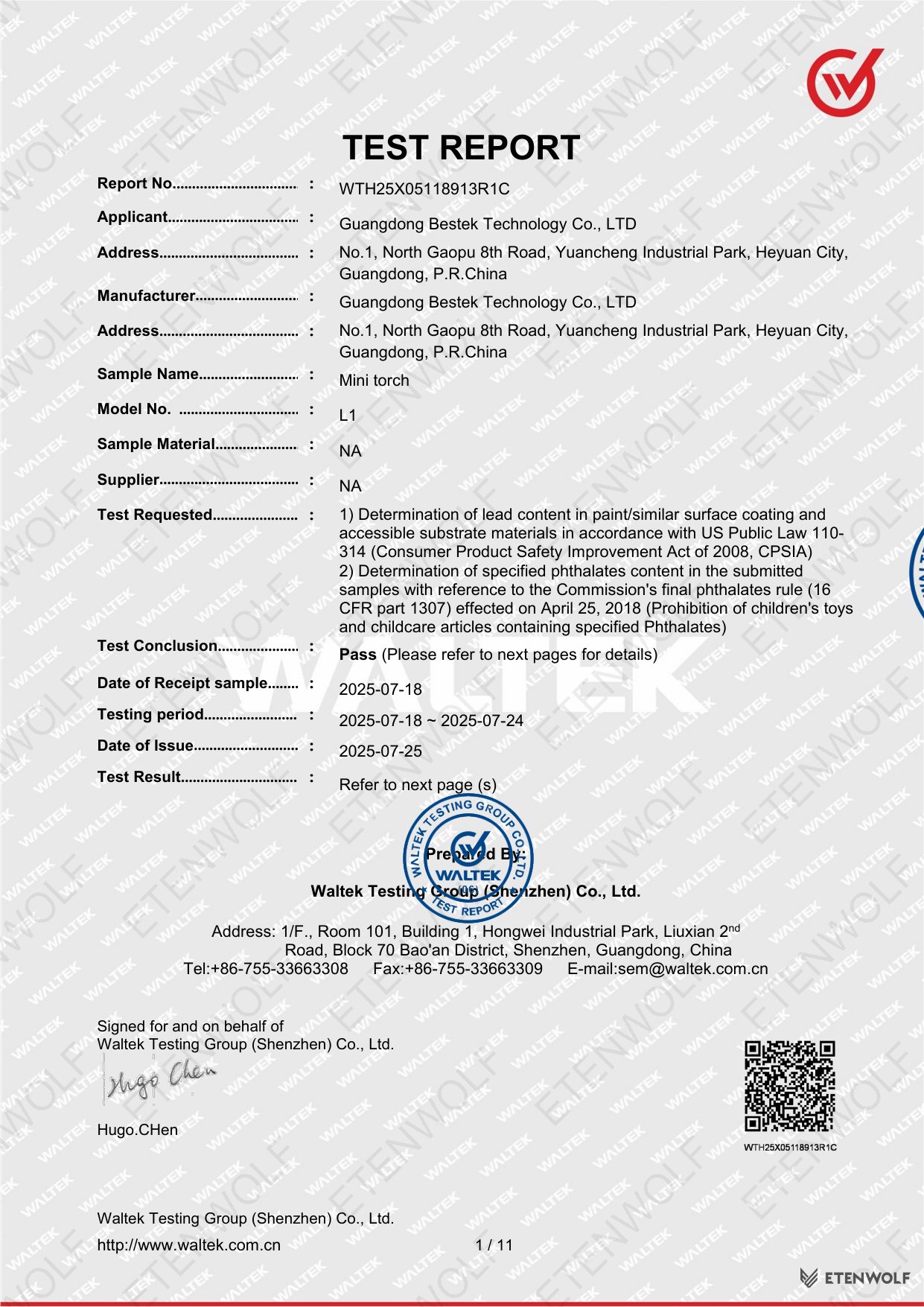
This page presents the official CPSIA test report issued in support of the Children’s Product Certificate (CPC) for the ETENWOLF L1 Mini Torch. The document also covers the addition of a lanyard (挂绳) and stickers (贴纸) as newly tested components under the same CPC certification scope.
| Field | Detail |
|---|---|
| Document Type | CPSIA Test Report (CPC Certification) |
| Report Number | WTH25X05118913R1C |
| Issuing Body | Waltek Testing Group (Shenzhen) Co., Ltd. |
| Date of Issue | 2025-07-25 |
| Testing Period | 2025-07-18 to 2025-07-24 |
| Date of Sample Receipt | 2025-07-18 |
| Overall Conclusion | Pass |
The report was prepared and signed on behalf of Waltek Testing Group (Shenzhen) Co., Ltd. by Hugo Chen. It covers two mandatory CPSIA test requirements: total lead content in accessible substrate materials and specified phthalates content in children’s products and childcare articles.
Product Information
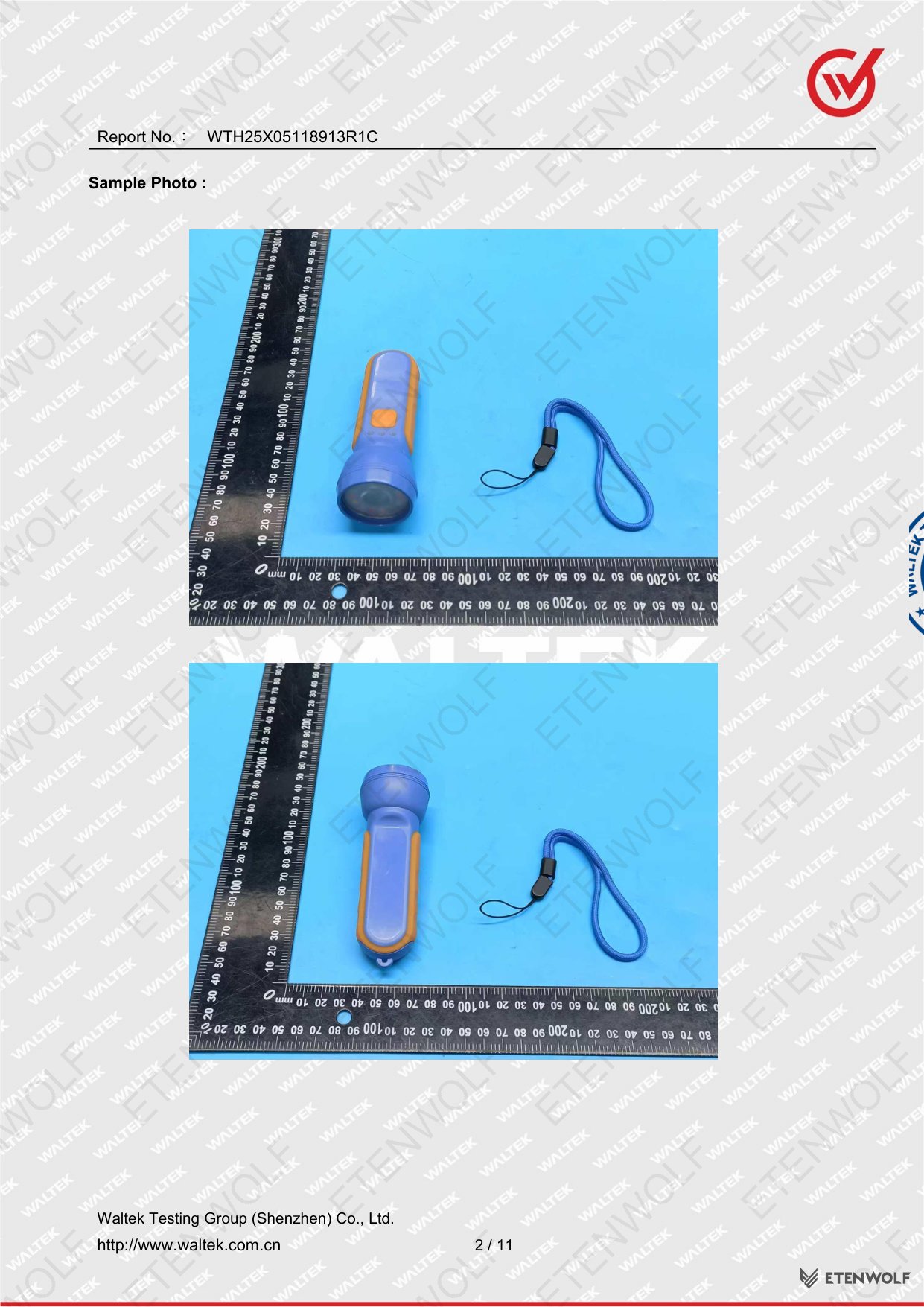
The tested product is the ETENWOLF L1 Mini Torch, a compact flashlight/torch designed for consumer use. The CPC scope for this revised report (revision suffix R1C) extends the original certification to include a lanyard and stickers that are now attached to or packaged with the product.
| Field | Detail |
|---|---|
| Sample Name | Mini Torch |
| Model Number | L1 |
| Applicant | Guangdong Bestek Technology Co., LTD |
| Applicant Address | No.1, North Gaopu 8th Road, Yuancheng Industrial Park, Heyuan City, Guangdong, P.R.China |
| Manufacturer | Guangdong Bestek Technology Co., LTD |
| Manufacturer Address | No.1, North Gaopu 8th Road, Yuancheng Industrial Park, Heyuan City, Guangdong, P.R.China |
| Sample Material | Not Applicable (NA) |
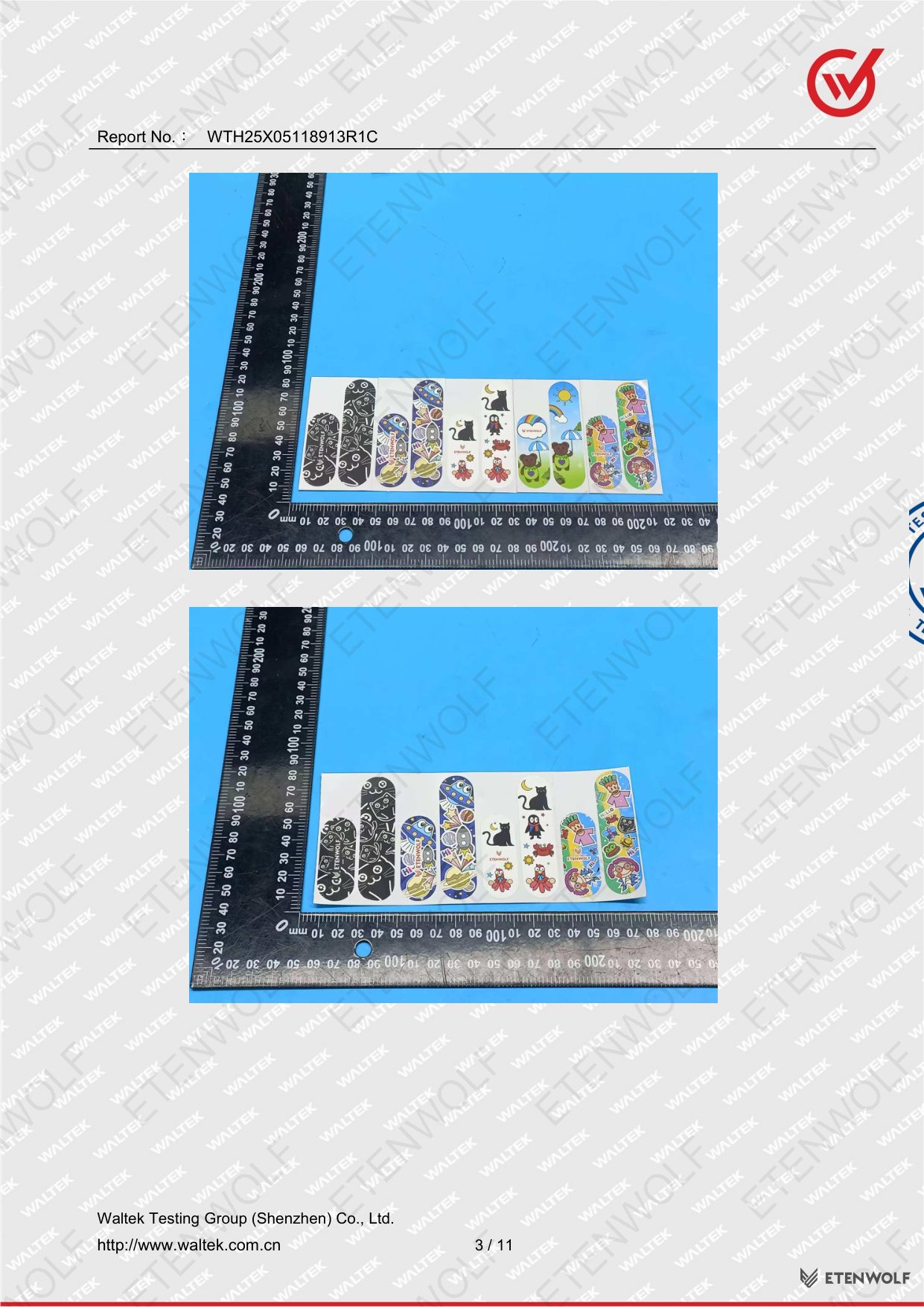
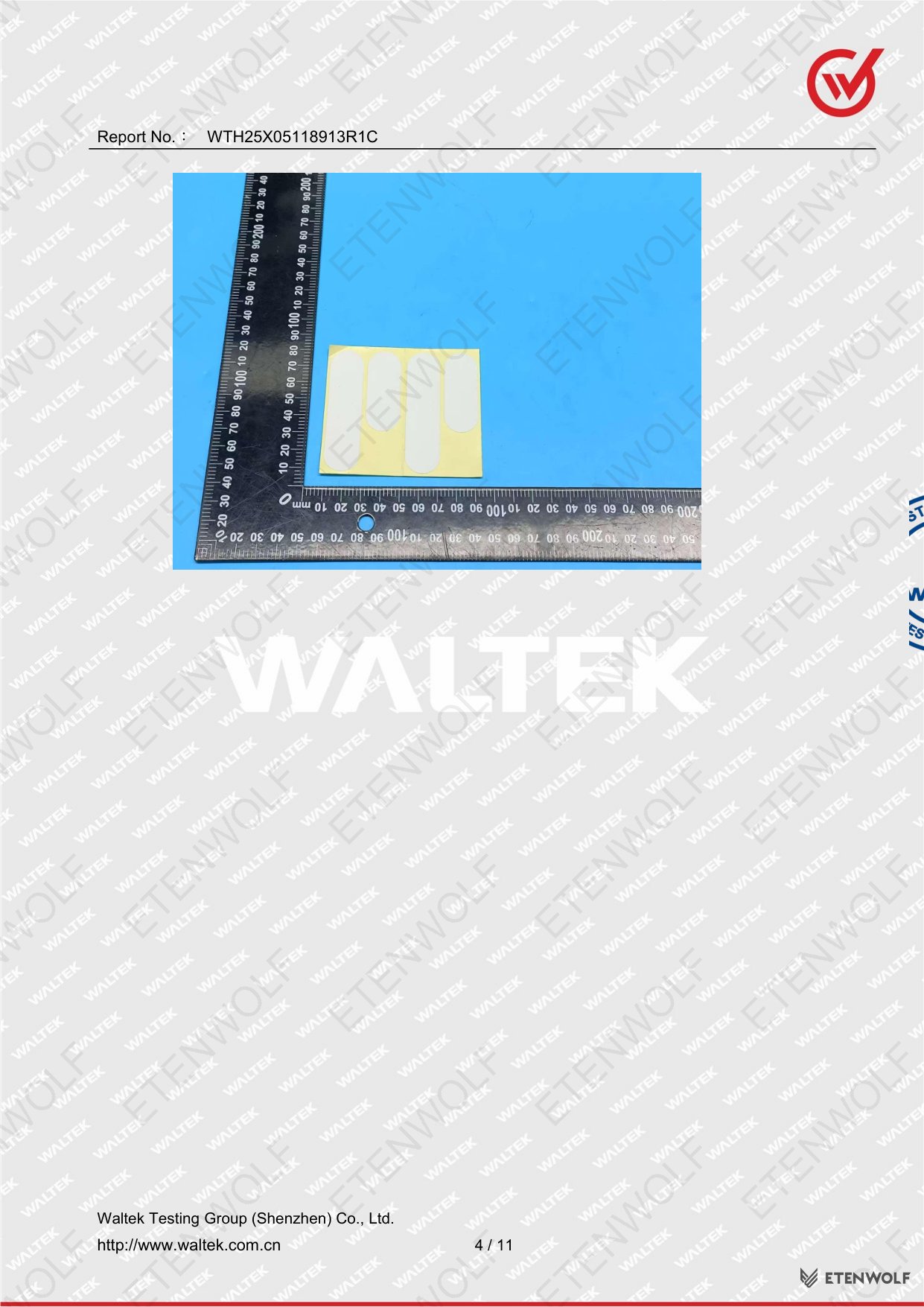
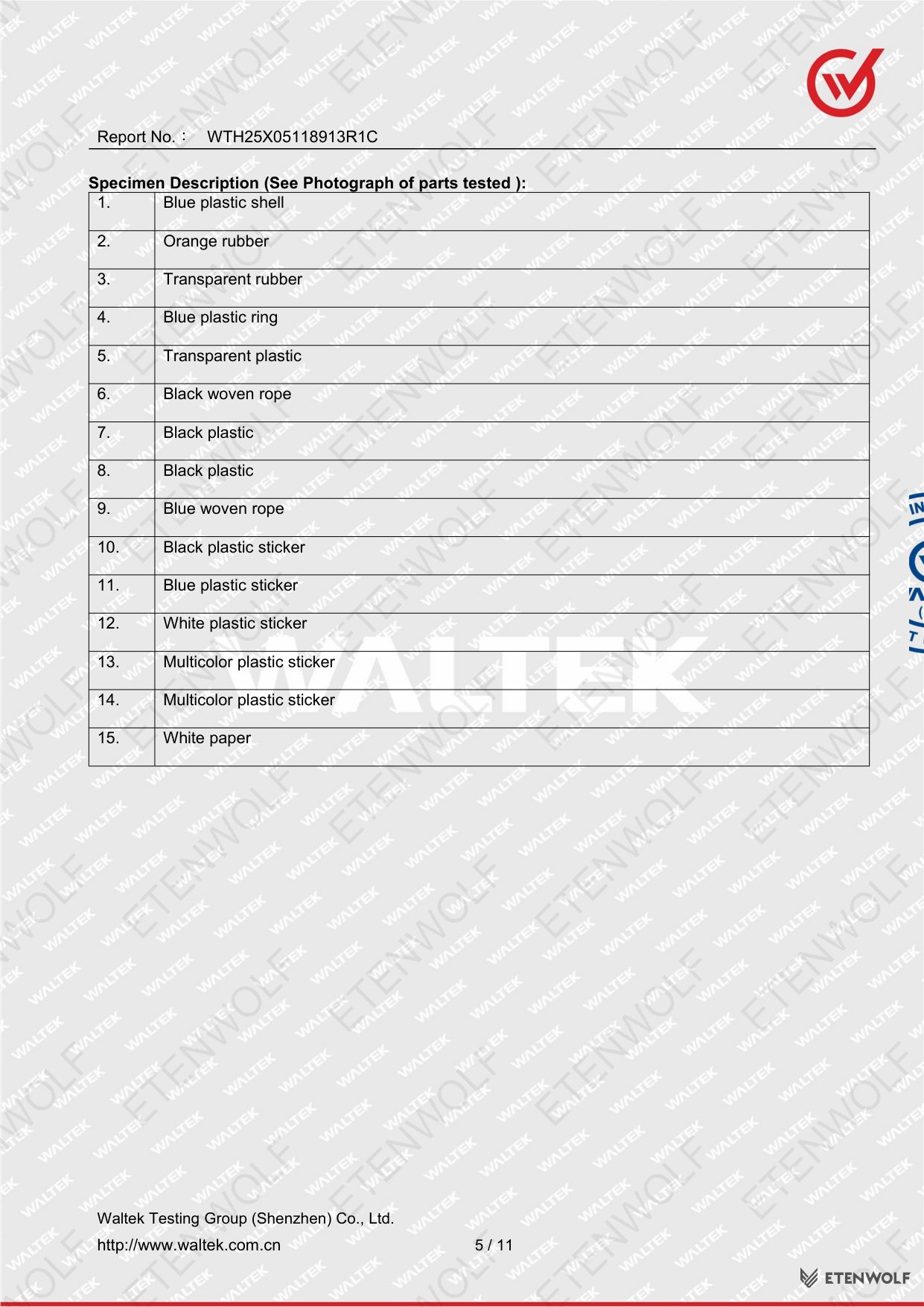
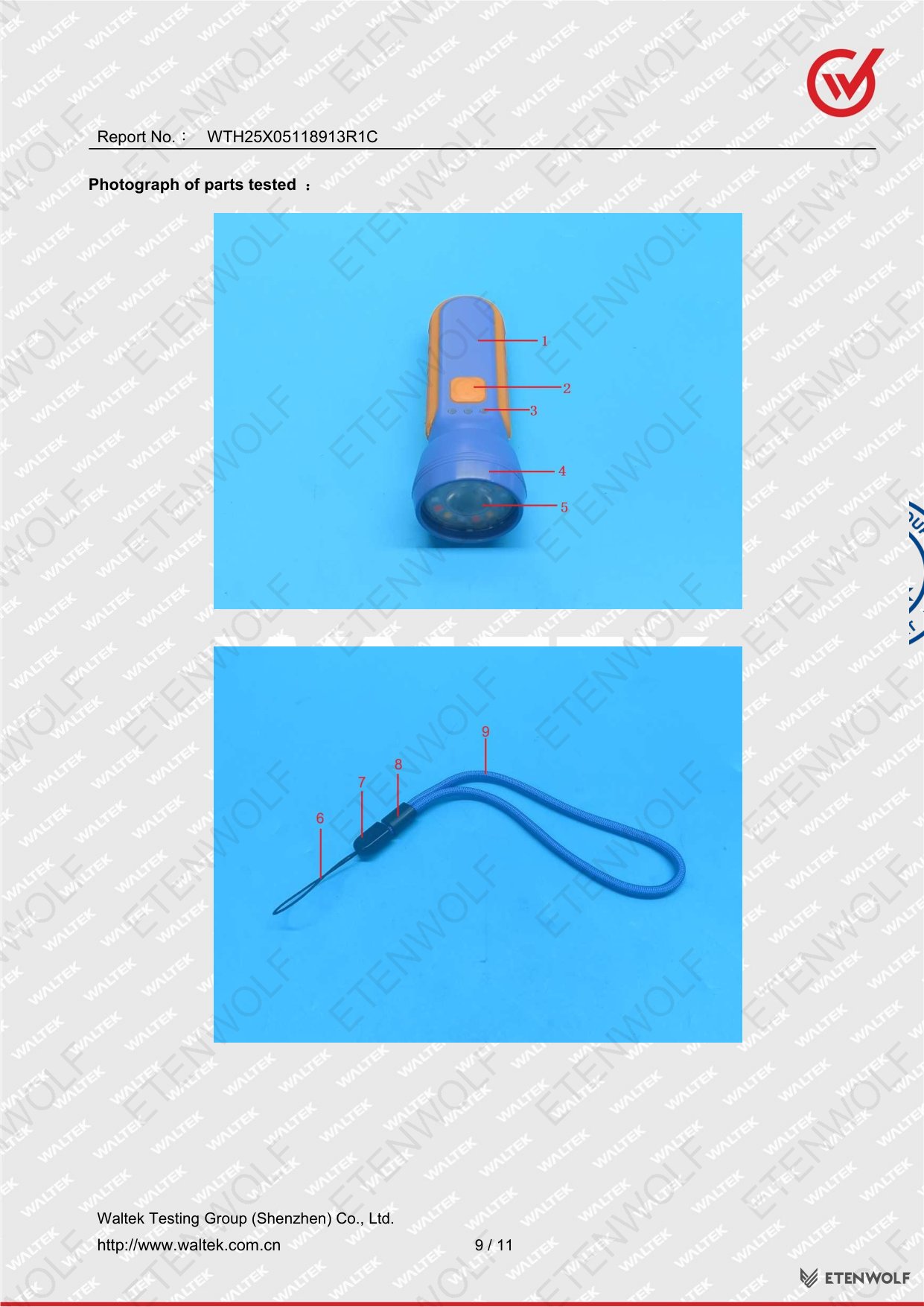
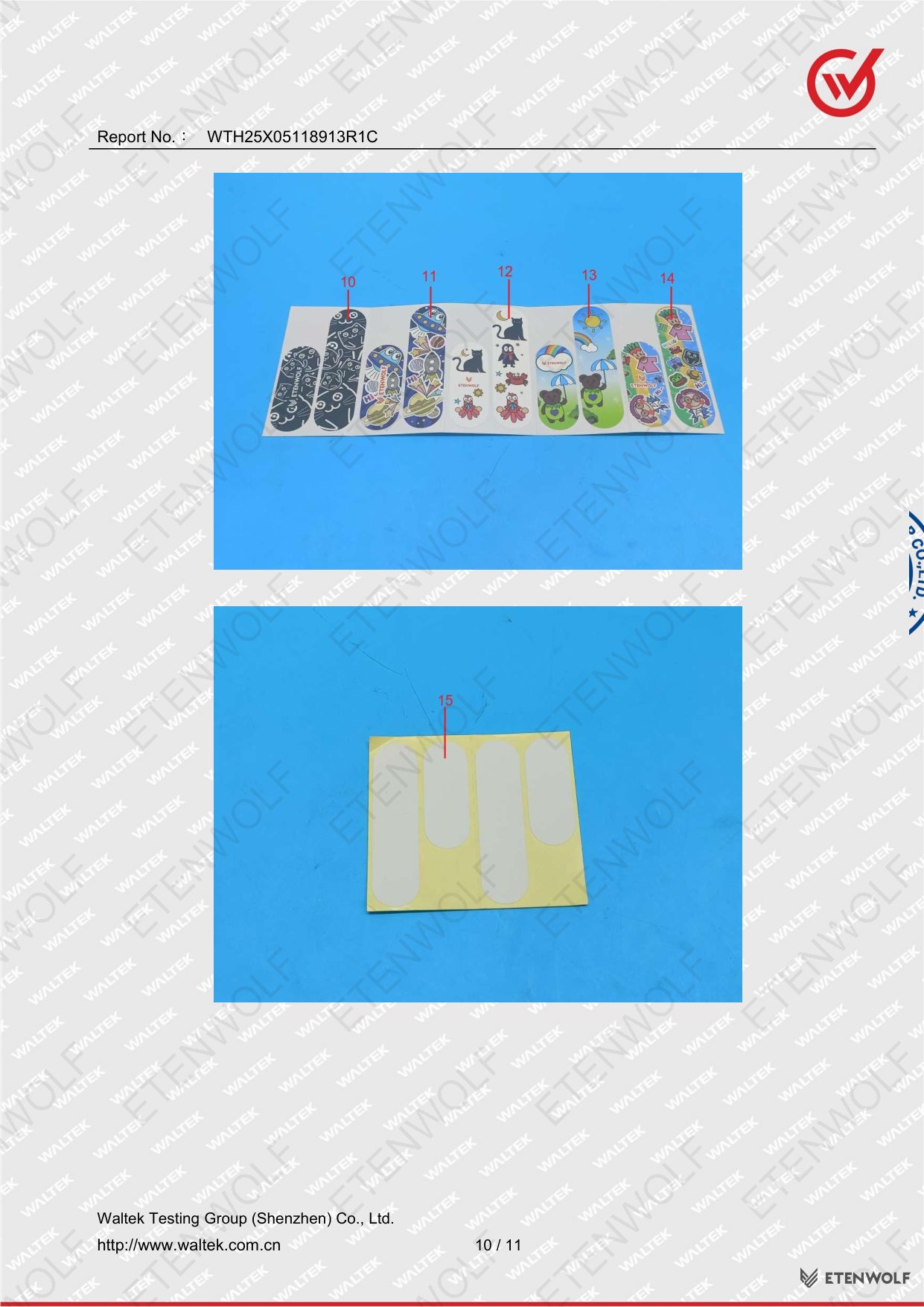
The specimen comprised 15 individually identified parts, including the main housing, rubber components, plastic rings, woven ropes (lanyard), plastic stickers, and paper sticker — reflecting the expanded CPC scope that adds lanyard and sticker accessories to the previously certified product.
Key Details
Testing was performed on 15 distinct specimen parts. Results for specimens 1–6 were carried forward from the preceding report WTH25X05118913C, while specimens 7–15 (covering the newly added lanyard and sticker components) were freshly tested under this revised report.
Specimen Parts Tested
| No. | Description |
|---|---|
| 1 | Blue plastic shell |
| 2 | Orange rubber |
| 3 | Transparent rubber |
| 4 | Blue plastic ring |
| 5 | Transparent plastic |
| 6 | Black woven rope |
| 7 | Black plastic |
| 8 | Black plastic |
| 9 | Blue woven rope |
| 10 | Black plastic sticker |
| 11 | Blue plastic sticker |
| 12 | White plastic sticker |
| 13 | Multicolor plastic sticker |
| 14 | Multicolor plastic sticker |
| 15 | White paper |
Total Lead Content Results
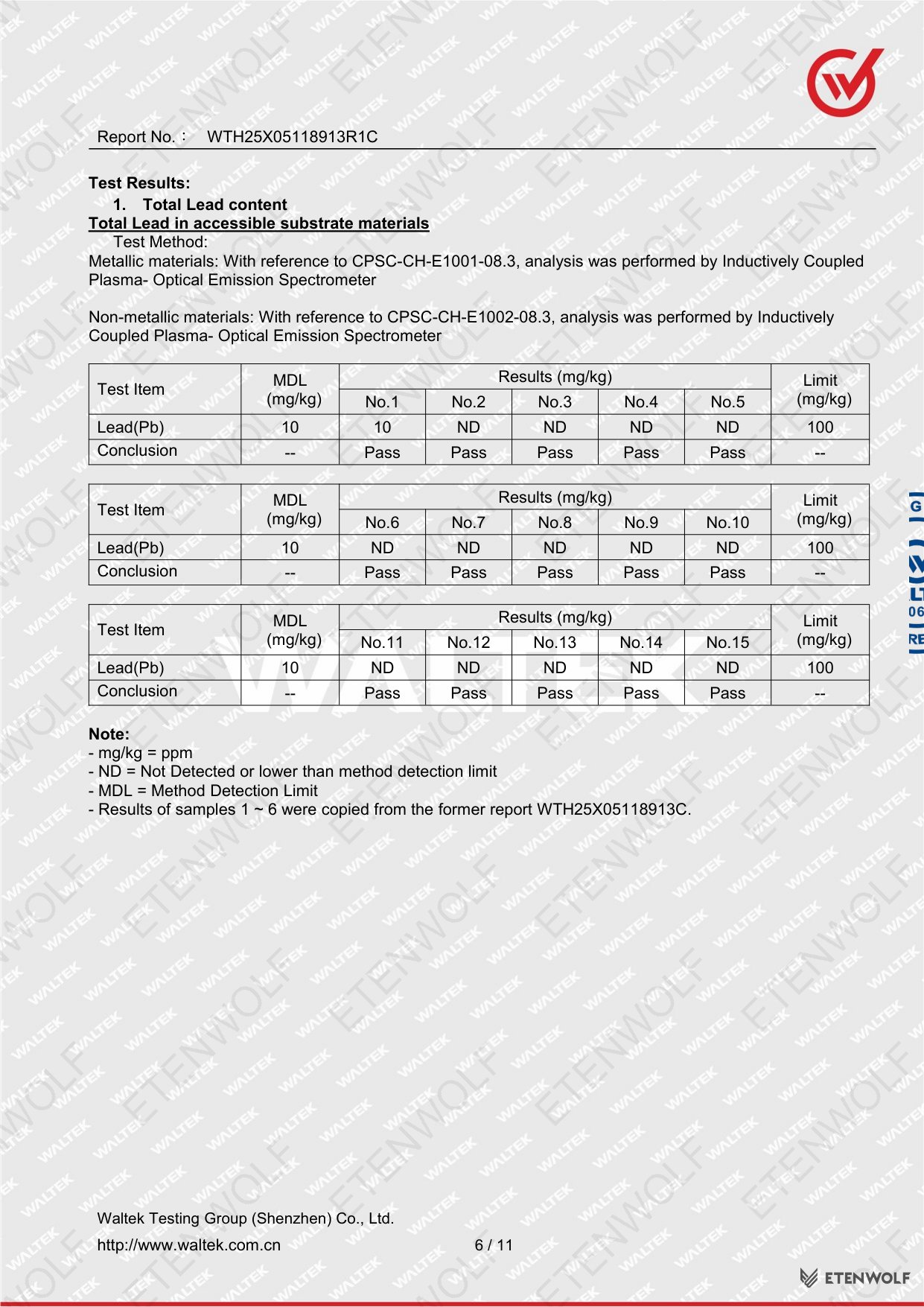
Test method: CPSC-CH-E1001-08.3 (metallic materials) and CPSC-CH-E1002-08.3 (non-metallic materials), both analyzed by Inductively Coupled Plasma – Optical Emission Spectrometry (ICP-OES). The regulatory limit is 100 mg/kg.
| Specimen | MDL (mg/kg) | Lead (Pb) Result (mg/kg) | Limit (mg/kg) | Conclusion |
|---|---|---|---|---|
| No.1 — Blue plastic shell | 10 | 10 | 100 | Pass |
| No.2 — Orange rubber | 10 | ND | 100 | Pass |
| No.3 — Transparent rubber | 10 | ND | 100 | Pass |
| No.4 — Blue plastic ring | 10 | ND | 100 | Pass |
| No.5 — Transparent plastic | 10 | ND | 100 | Pass |
| No.6 — Black woven rope | 10 | ND | 100 | Pass |
| No.7 — Black plastic | 10 | ND | 100 | Pass |
| No.8 — Black plastic | 10 | ND | 100 | Pass |
| No.9 — Blue woven rope | 10 | ND | 100 | Pass |
| No.10 — Black plastic sticker | 10 | ND | 100 | Pass |
| No.11 — Blue plastic sticker | 10 | ND | 100 | Pass |
| No.12 — White plastic sticker | 10 | ND | 100 | Pass |
| No.13 — Multicolor plastic sticker | 10 | ND | 100 | Pass |
| No.14 — Multicolor plastic sticker | 10 | ND | 100 | Pass |
| No.15 — White paper | 10 | ND | 100 | Pass |
ND = Not Detected or below method detection limit. mg/kg = ppm. Results for specimens 1–6 were carried forward from prior report WTH25X05118913C.
Phthalates Content Results
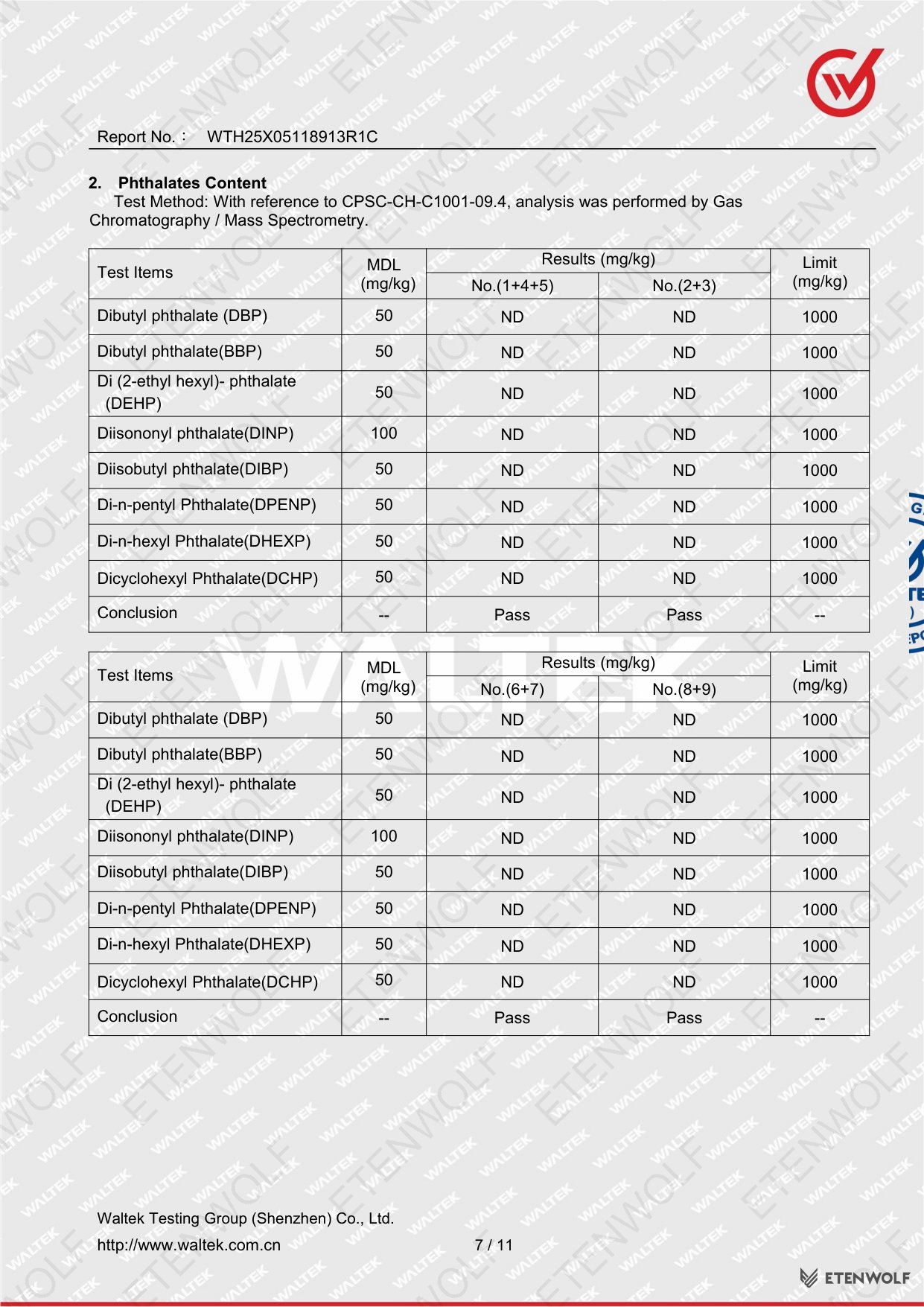
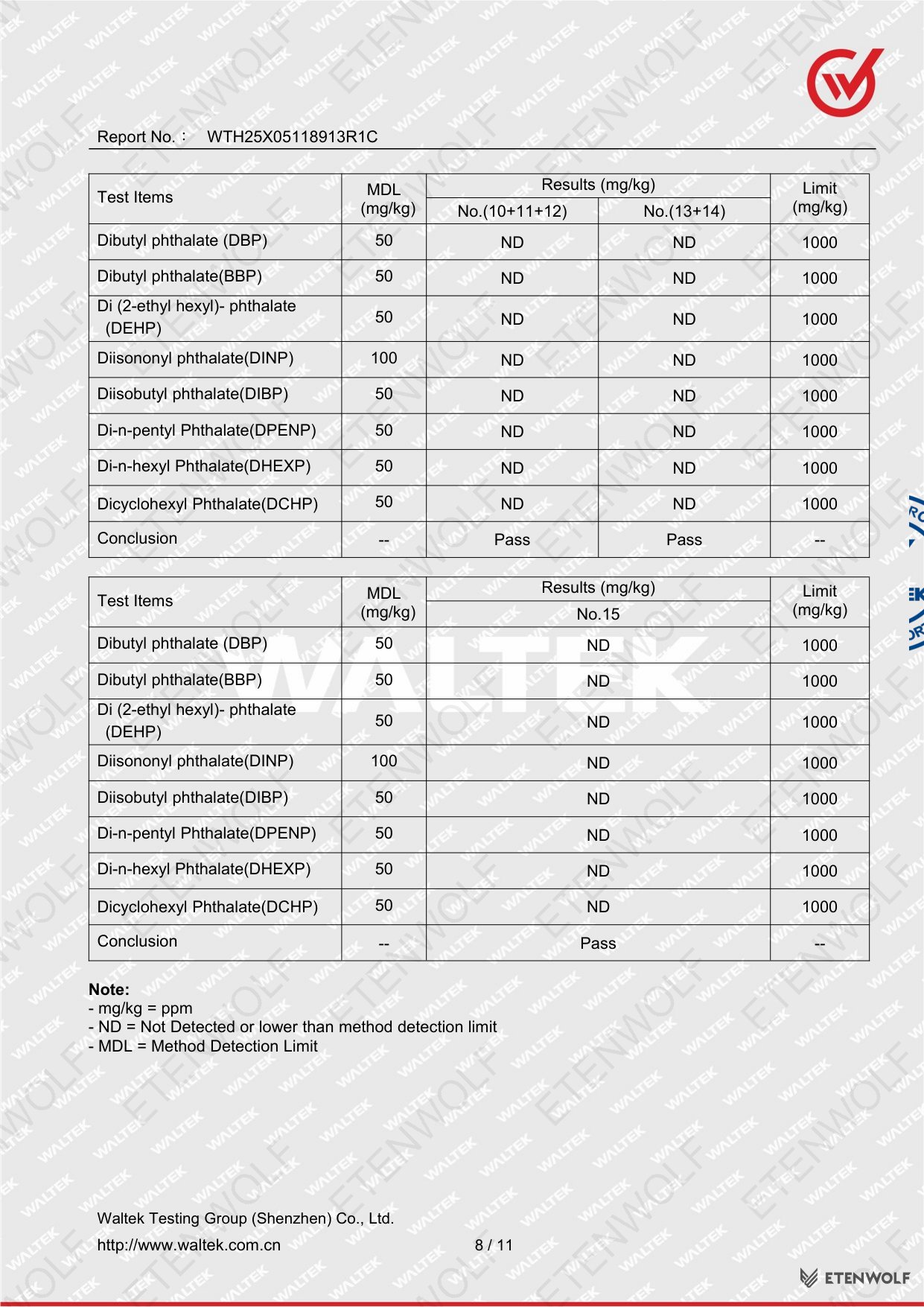
Test method: CPSC-CH-C1001-09.4, analyzed by Gas Chromatography/Mass Spectrometry (GC/MS). Eight regulated phthalates were evaluated. The regulatory limit for each is 1000 mg/kg (0.1%). All grouped specimen combinations returned ND across all eight phthalates.
| Phthalate | MDL (mg/kg) | Limit (mg/kg) | All Groups Result | Conclusion |
|---|---|---|---|---|
| Dibutyl phthalate (DBP) | 50 | 1000 | ND | Pass |
| Benzyl butyl phthalate (BBP) | 50 | 1000 | ND | Pass |
| Di(2-ethylhexyl) phthalate (DEHP) | 50 | 1000 | ND | Pass |
| Diisononyl phthalate (DINP) | 100 | 1000 | ND | Pass |
| Diisobutyl phthalate (DIBP) | 50 | 1000 | ND | Pass |
| Di-n-pentyl phthalate (DPENP) | 50 | 1000 | ND | Pass |
| Di-n-hexyl phthalate (DHEXP) | 50 | 1000 | ND | Pass |
| Dicyclohexyl phthalate (DCHP) | 50 | 1000 | ND | Pass |
Phthalate groupings tested: No.(1+4+5), No.(2+3), No.(6+7), No.(8+9), No.(10+11+12), No.(13+14), and No.15 individually. All groups passed without exception.
Standards & Compliance
The ETENWOLF L1 Mini Torch was tested in compliance with the following U.S. federal statutes, regulations, and CPSC test methods:
| Standard / Regulation | Scope |
|---|---|
| US Public Law 110-314 (CPSIA 2008) | Lead content limit of 100 mg/kg in accessible substrate materials for children’s products |
| 16 CFR Part 1307 | Prohibition of specified phthalates in children’s toys and childcare articles; effective April 25, 2018 |
| CPSC-CH-E1001-08.3 | Test method for total lead in metallic accessible substrate materials (ICP-OES) |
| CPSC-CH-E1002-08.3 | Test method for total lead in non-metallic accessible substrate materials (ICP-OES) |
| CPSC-CH-C1001-09.4 | Test method for phthalates content by GC/MS |
These requirements apply to children’s products sold in the United States. CPSIA Section 101 sets the lead limit at 100 ppm for accessible substrate materials. The phthalates rule under 16 CFR Part 1307 restricts eight specific phthalates to no more than 0.1% (1000 mg/kg) by weight of any plasticized component.
Validity & Certification Body
The test report bearing number WTH25X05118913R1C was issued on 2025-07-25 by Waltek Testing Group (Shenzhen) Co., Ltd., an accredited third-party testing laboratory. This is a revised report (R1C suffix) that extends the original certification scope to include the lanyard and sticker accessories added to the ETENWOLF L1 Mini Torch.
| Field | Detail |
|---|---|
| Report Number | WTH25X05118913R1C |
| Date of Issue | 2025-07-25 |
| Testing Laboratory | Waltek Testing Group (Shenzhen) Co., Ltd. |
| Lab Address | 1/F., Room 101, Building 1, Hongwei Industrial Park, Liuxian 2nd Road, Block 70, Bao’an District, Shenzhen, Guangdong, China |
| Lab Website | http://www.waltek.com.cn |
| Lab Contact (Tel) | +86-755-33663308 |
| Lab Contact (Fax) | +86-755-33663309 |
| Lab Contact (Email) | [email protected] |
| Report Signed By | Hugo Chen, Waltek Testing Group (Shenzhen) Co., Ltd. |
Important caveats noted in the report: results apply only to the tested samples; the report may not be partially reproduced without prior written permission; the report requires the lab’s specific stamp and authorized signatures to be valid. If the accreditation recognized seal is absent, the report is limited to internal quality control, scientific research, or educational use and may not be submitted as supporting compliance data to external parties.
Frequently Asked Questions
- What does report number WTH25X05118913R1C cover that the original report did not?
- The suffix R1C indicates this is a revised version of the original report WTH25X05118913C. The revision extends the CPC certification scope to include a lanyard (woven rope) and stickers that are now attached to or packaged with the ETENWOLF L1 Mini Torch. Specimens 7–15 in this report represent those newly added components, while specimens 1–6 carry over results from the original report.
- What is the lead content limit under CPSIA, and did the L1 Mini Torch pass?
- Under CPSIA Section 101, children’s products must not contain more than 100 mg/kg (100 ppm) of lead in accessible substrate materials. All 15 specimen parts of the L1 Mini Torch tested at or below the method detection limit of 10 mg/kg, well under the 100 mg/kg regulatory limit. The overall conclusion is Pass.
- Which phthalates are regulated under 16 CFR Part 1307, and were any detected in the L1 Mini Torch?
- 16 CFR Part 1307 restricts eight phthalates — DBP, BBP, DEHP, DINP, DIBP, DPENP, DHEXP, and DCHP — to a maximum of 1000 mg/kg (0.1%) in plasticized components of children’s toys and childcare articles. None of these phthalates were detected in any of the tested specimen groups of the L1 Mini Torch. All groups passed.
- Can this test report be used as the sole basis for issuing a Children’s Product Certificate (CPC)?
- A CPC must be supported by qualifying third-party testing from a CPSC-accepted laboratory. This report from Waltek Testing Group satisfies the testing requirement for lead and phthalates under CPSIA. However, the report is valid only when it bears the lab’s official accreditation stamp and the signatures of the compiler and approver, as stated in the report remarks. Additional product-specific safety standards may also apply depending on the product category.
Related Documents
The following certification and compliance documents are typically required or recommended for a children’s product such as the ETENWOLF L1 Mini Torch sold in the United States and other key markets:
- Children’s Product Certificate (CPC) — The formal declaration of conformity required by CPSIA for all children’s products, referencing this test report as supporting evidence.
- ASTM F963 Toy Safety Test Report — If the product is classified or marketed as a toy, compliance with the ASTM F963 standard is mandatory under CPSIA.
- California Proposition 65 (Prop 65) Compliance Documentation — Required for products sold in California; covers heavy metals, phthalates, and other listed chemicals beyond federal CPSIA limits.
- FCC ID Certification — Required if the L1 Mini Torch incorporates any wireless or electronic emission components subject to FCC Part 15 rules.
- UN 38.3 Battery Safety Test Report — Required for products containing lithium batteries for air transport compliance.
- RoHS / REACH Compliance Declaration — Relevant for EU market entry, confirming restriction of hazardous substances in electrical and electronic equipment.
- CE Declaration of Conformity — Mandatory for placing the product on the European market, covering applicable EU directives such as LVD and EMC.
Document Pages