Document Overview
Document Overview This page presents the findings of Test Report WTH25X05118913C, a CPSIA-based Children’s Product Certificate (CPC) compliance test report issued by Waltek Testing Group (Shenzhen) Co., Ltd. The report covers two regulatory determinations required under US federal law for children’s products sold in the…
- Document type
- Certification Report
- Prepared by
- Michelle Torres
- Published
- Last reviewed
- Topics
- Lighting Gear
Document Overview
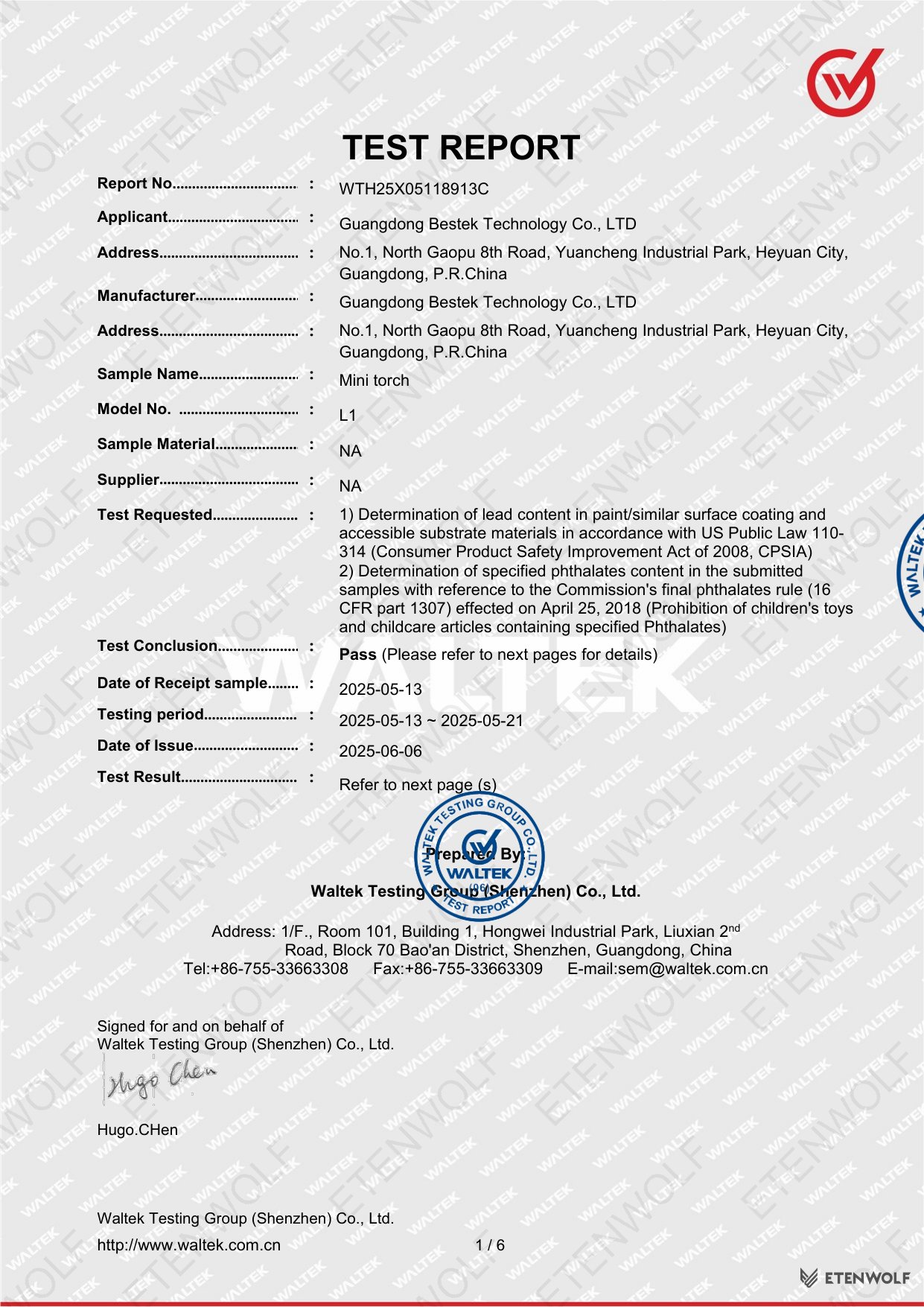
This page presents the findings of Test Report WTH25X05118913C, a CPSIA-based Children’s Product Certificate (CPC) compliance test report issued by Waltek Testing Group (Shenzhen) Co., Ltd. The report covers two regulatory determinations required under US federal law for children’s products sold in the United States:
- Determination of total lead content in paint, surface coatings, and accessible substrate materials pursuant to US Public Law 110-314 (Consumer Product Safety Improvement Act of 2008, CPSIA).
- Determination of specified phthalates content with reference to the Commission’s final phthalates rule 16 CFR Part 1307, effective April 25, 2018 (Prohibition of children’s toys and childcare articles containing specified phthalates).
The overall test conclusion is Pass. The report was issued on 2025-06-06 following a testing period of 2025-05-13 to 2025-05-21. Samples were received on 2025-05-13.
Product Information
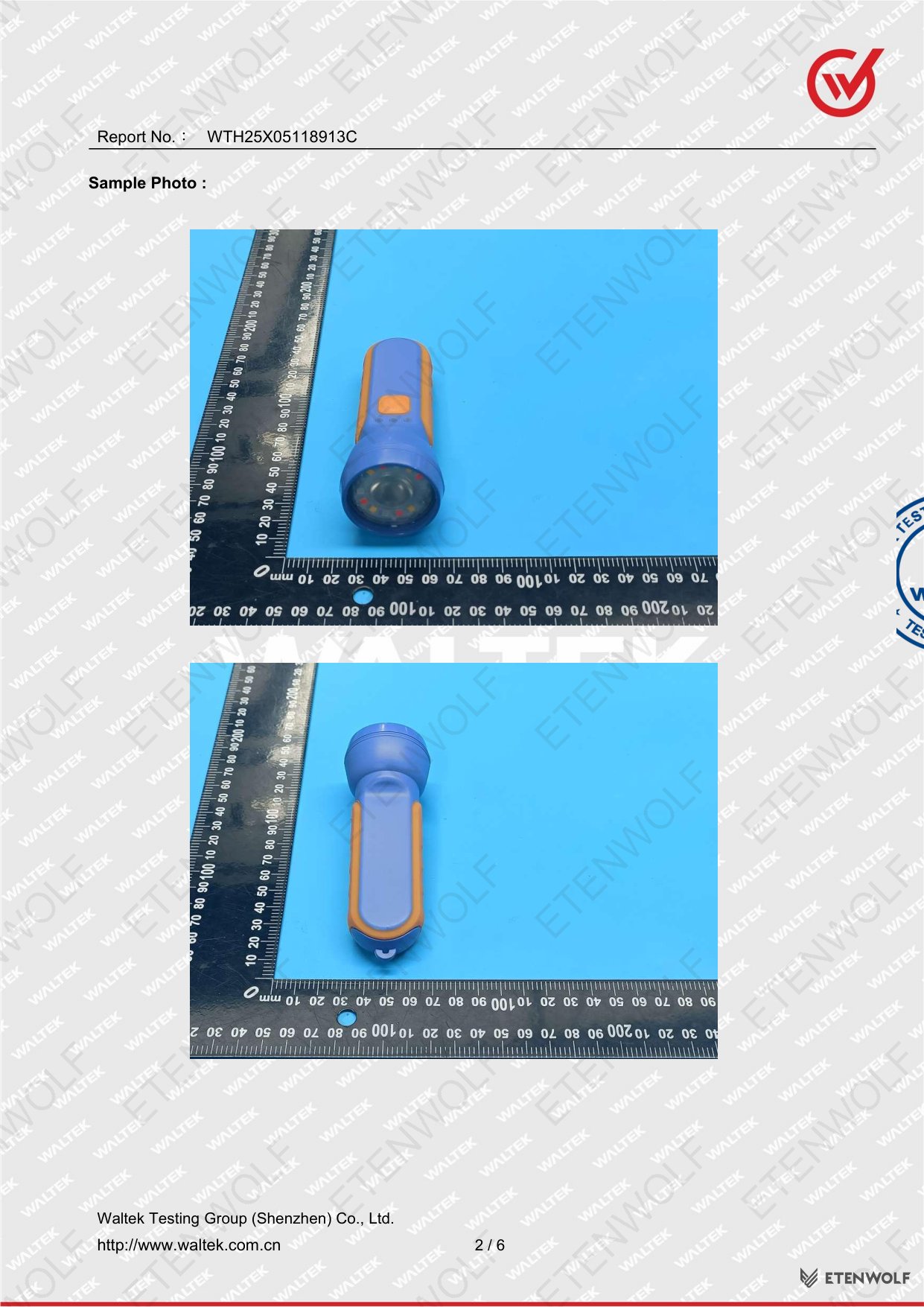
The tested product is the ETENWOLF L1 Mini Torch, a compact handheld lighting device. Full product details as recorded in the test report are listed below.
| Field | Details |
|---|---|
| Sample Name | Mini Torch |
| Model Number | L1 |
| Sample Material | NA (not specified) |
| Applicant | Guangdong Bestek Technology Co., LTD |
| Applicant Address | No.1, North Gaopu 8th Road, Yuancheng Industrial Park, Heyuan City, Guangdong, P.R.China |
| Manufacturer | Guangdong Bestek Technology Co., LTD |
| Manufacturer Address | No.1, North Gaopu 8th Road, Yuancheng Industrial Park, Heyuan City, Guangdong, P.R.China |
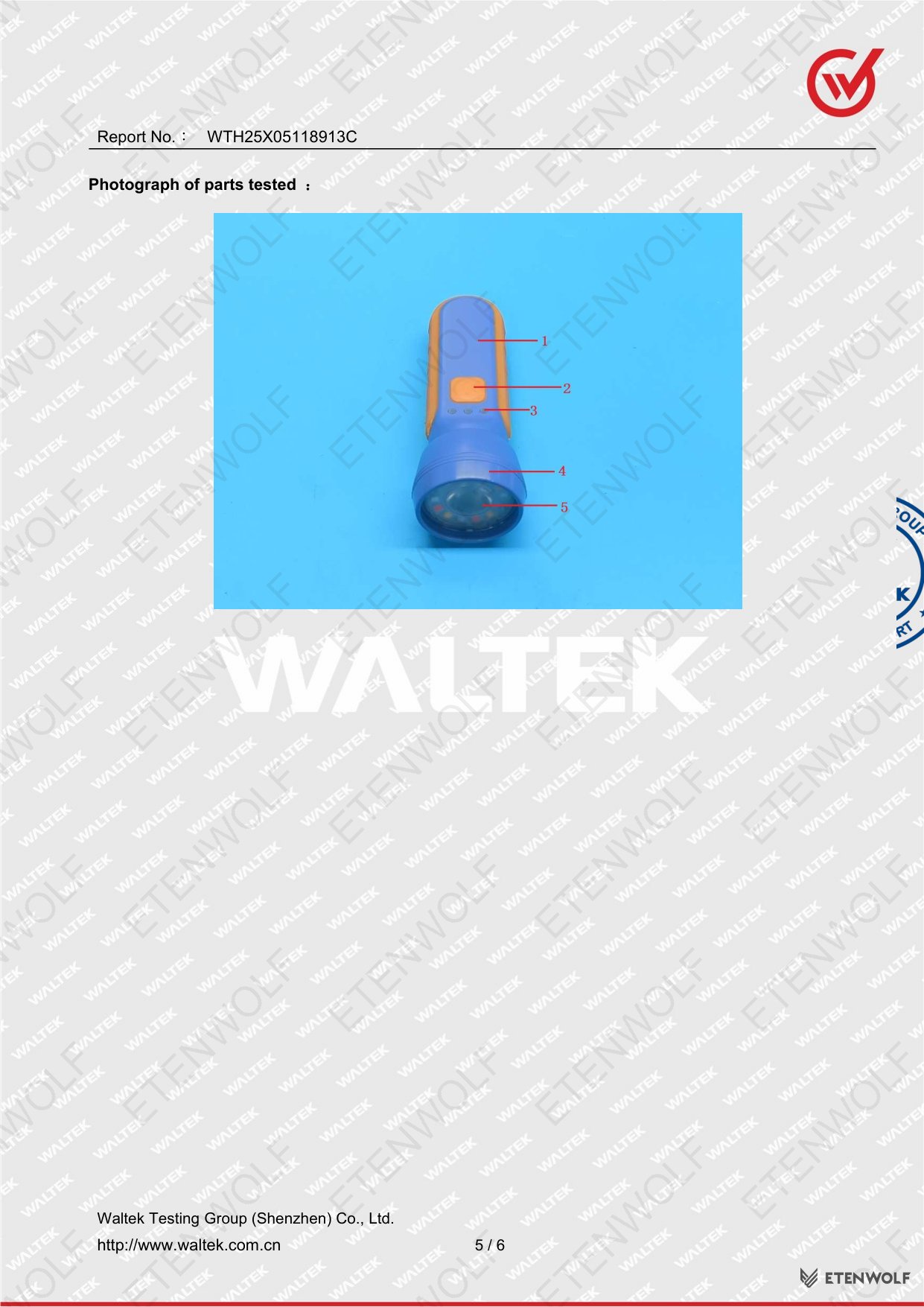
The L1 Mini Torch is designed as a portable, compact lighting tool. For CPSIA testing, the product was disassembled into five distinct component specimens for individual analysis.
Key Details
The following tables summarize test results for all five specimen components identified during testing.
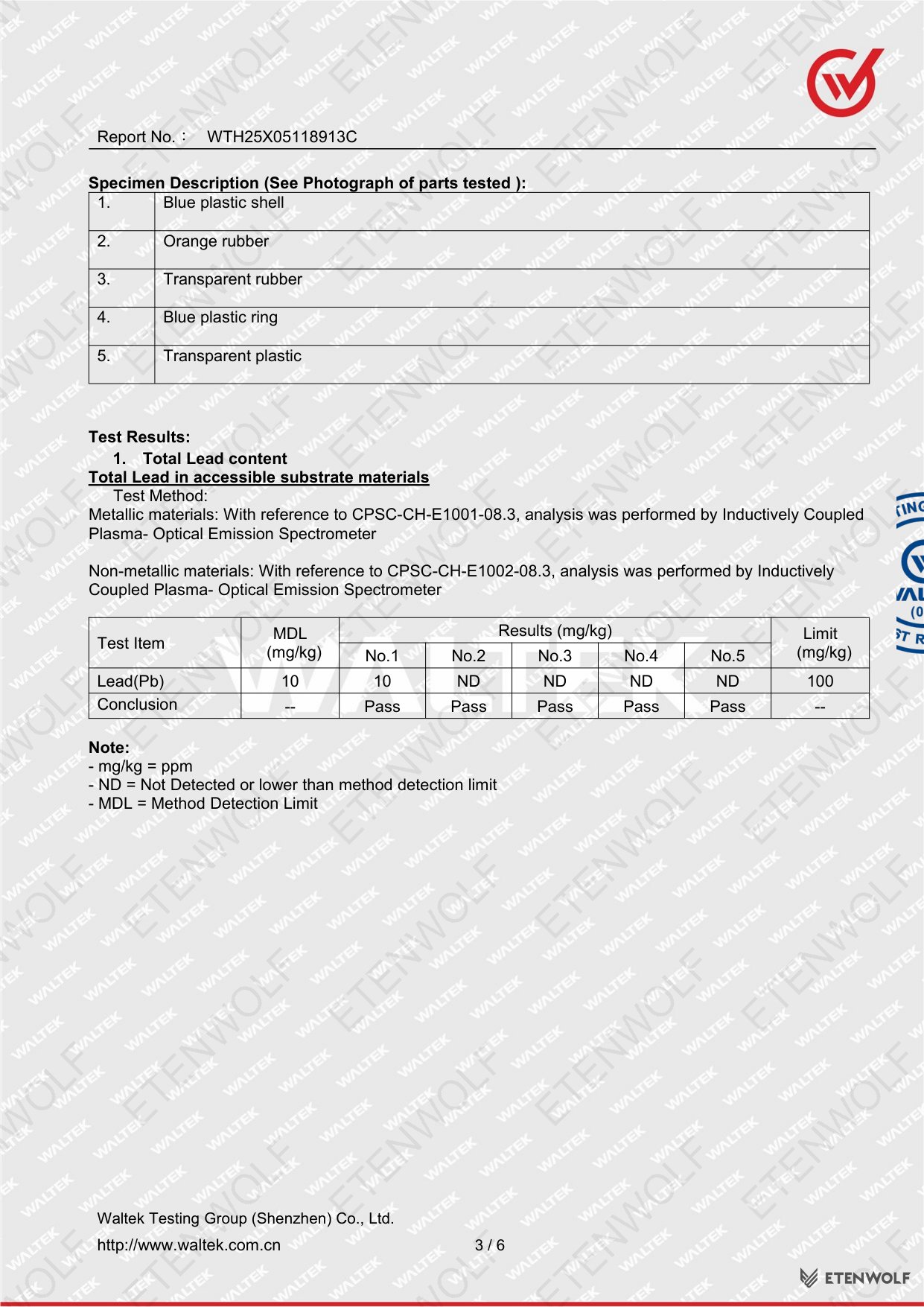
Specimen Component Descriptions
| Specimen No. | Description |
|---|---|
| No.1 | Blue plastic shell |
| No.2 | Orange rubber |
| No.3 | Transparent rubber |
| No.4 | Blue plastic ring |
| No.5 | Transparent plastic |
Test 1 — Total Lead Content in Accessible Substrate Materials
Test methods applied: CPSC-CH-E1001-08.3 (metallic materials) and CPSC-CH-E1002-08.3 (non-metallic materials), both analyzed by Inductively Coupled Plasma – Optical Emission Spectrometer (ICP-OES).
| Test Item | MDL (mg/kg) | No.1 | No.2 | No.3 | No.4 | No.5 | Limit (mg/kg) | Conclusion |
|---|---|---|---|---|---|---|---|---|
| Lead (Pb) | 10 | 10 | ND | ND | ND | ND | 100 | Pass |
ND = Not Detected or below method detection limit. mg/kg = ppm. MDL = Method Detection Limit.
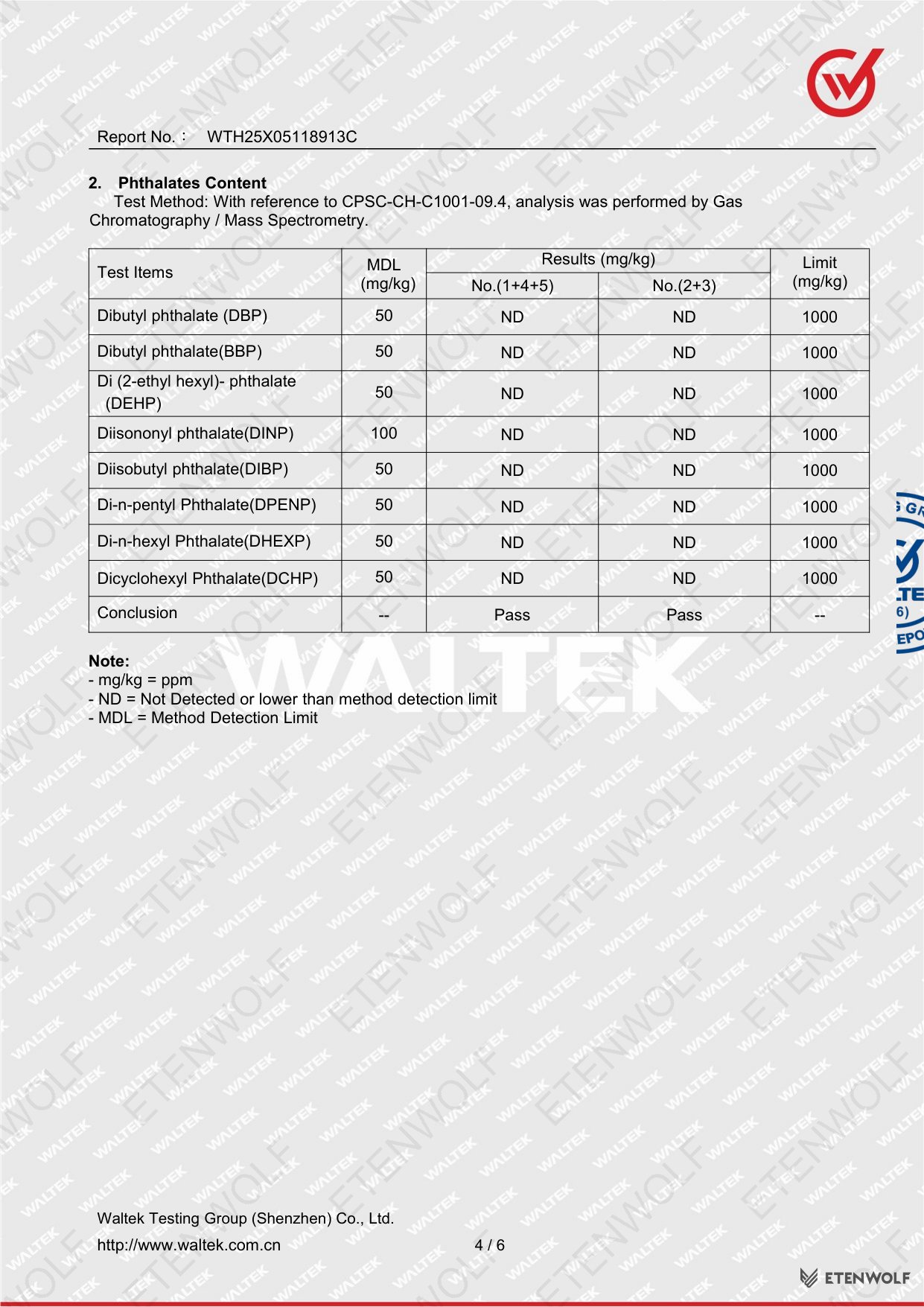
Test 2 — Phthalates Content
Test method applied: CPSC-CH-C1001-09.4, analyzed by Gas Chromatography / Mass Spectrometry (GC/MS). Specimens were grouped as No.(1+4+5) and No.(2+3) for phthalates analysis.
| Test Item | MDL (mg/kg) | No.(1+4+5) | No.(2+3) | Limit (mg/kg) | Conclusion |
|---|---|---|---|---|---|
| Dibutyl phthalate (DBP) | 50 | ND | ND | 1000 | Pass |
| Benzyl butyl phthalate (BBP) | 50 | ND | ND | 1000 | Pass |
| Di(2-ethylhexyl) phthalate (DEHP) | 50 | ND | ND | 1000 | Pass |
| Diisononyl phthalate (DINP) | 100 | ND | ND | 1000 | Pass |
| Diisobutyl phthalate (DIBP) | 50 | ND | ND | 1000 | Pass |
| Di-n-pentyl phthalate (DPENP) | 50 | ND | ND | 1000 | Pass |
| Di-n-hexyl phthalate (DHEXP) | 50 | ND | ND | 1000 | Pass |
| Dicyclohexyl phthalate (DCHP) | 50 | ND | ND | 1000 | Pass |
ND = Not Detected or below method detection limit. mg/kg = ppm. MDL = Method Detection Limit.
Standards & Compliance
The L1 Mini Torch was evaluated against the following US federal regulations and CPSC test methods:
| Regulation / Standard | Scope | Test Method |
|---|---|---|
| US Public Law 110-314 (CPSIA 2008) | Lead content limit in paint and accessible substrate materials for children’s products | CPSC-CH-E1001-08.3 (metallic); CPSC-CH-E1002-08.3 (non-metallic) |
| 16 CFR Part 1307 | Prohibition of specified phthalates in children’s toys and childcare articles (effective April 25, 2018) | CPSC-CH-C1001-09.4 (GC/MS) |
Lead limit: 100 mg/kg (ppm) in accessible substrate materials. Phthalates limit: 1000 mg/kg (ppm) per restricted substance. All tested specimens were either Not Detected (ND) or below 100 mg/kg for lead, and ND for all eight regulated phthalates, confirming full compliance.
Validity & Certification Body
The test report was prepared and issued by Waltek Testing Group (Shenzhen) Co., Ltd., an accredited third-party testing laboratory. Key administrative details are as follows:
| Field | Details |
|---|---|
| Report Number | WTH25X05118913C |
| Date of Sample Receipt | 2025-05-13 |
| Testing Period | 2025-05-13 to 2025-05-21 |
| Date of Issue | 2025-06-06 |
| Prepared By | Hugo Chen, Waltek Testing Group (Shenzhen) Co., Ltd. |
| Laboratory Address | 1/F., Room 101, Building 1, Hongwei Industrial Park, Liuxian 2nd Road, Block 70, Bao’an District, Shenzhen, Guangdong, China |
| Laboratory Website | http://www.waltek.com.cn |
| Tel | +86-755-33663308 |
| Fax | +86-755-33663309 |
| [email protected] |
Important validity notes from the issuing laboratory:
- Test results apply only to the specific samples tested.
- The report may not be reproduced except in full, without prior written permission from Waltek.
- The report is invalid without the specific stamp of the test institute and the signatures of the compiler and approver.
- Applicant name, address, sample, and sample information were provided by the applicant; Waltek has not independently verified their authenticity.
- If the report is not stamped with an accreditation recognized seal, it is valid only for scientific research, education, and internal quality control — not for issuing supporting data to the public.
Frequently Asked Questions
- What does the CPSIA CPC certification mean for the ETENWOLF L1 Mini Torch?
-
The CPC (Children’s Product Certificate) under CPSIA confirms that the L1 Mini Torch has been tested by a CPSC-accepted third-party laboratory and meets the federal lead and phthalates limits required for children’s products sold in the United States. Report WTH25X05118913C, issued 2025-06-06, documents this compliance.
- Which phthalates were tested, and what were the results?
-
Eight phthalates regulated under 16 CFR Part 1307 were tested: DBP, BBP, DEHP, DINP, DIBP, DPENP, DHEXP, and DCHP. All results were Not Detected (ND) across all specimen groups, well below the 1000 mg/kg limit for each substance.
- What lead levels were detected in the L1 Mini Torch components?
-
Lead was tested in all five component specimens of the L1 Mini Torch. Four out of five specimens returned ND (Not Detected). Specimen No.1 (blue plastic shell) returned a value at the method detection limit of 10 mg/kg, which is significantly below the CPSIA limit of 100 mg/kg. All components passed.
- Which laboratory conducted the CPSIA testing for the L1 Mini Torch?
-
Testing was conducted by Waltek Testing Group (Shenzhen) Co., Ltd., located in Bao’an District, Shenzhen, Guangdong, China. Waltek is a CPSC-accepted third-party testing laboratory. The report was signed by Hugo Chen and issued under report number WTH25X05118913C.
Related Documents
The following certification and compliance document types are typically required or recommended for a product such as the L1 Mini Torch intended for the US and global markets:
- FCC Declaration of Conformity — Required for electronic and wireless lighting devices sold in the United States under FCC regulations.
- CE Declaration of Conformity — Required for products marketed in the European Economic Area, covering LVD, EMC, and RoHS directives.
- RoHS Compliance Report — Confirms restriction of hazardous substances (lead, mercury, cadmium, etc.) per EU RoHS Directive 2011/65/EU.
- REACH SVHC Screening Report — Screens for Substances of Very High Concern under EU REACH Regulation (EC) No 1907/2006.
- UN 38.3 Battery Transport Test Report — Required if the L1 Mini Torch contains a lithium battery, for safe transport compliance per UN38.3.
- KC Certification — Required for electronic products sold in South Korea under KC Mark regulations.
- California Proposition 65 (Prop 65) Compliance Statement — Recommended for products sold in California, covering warnings for chemicals known to cause cancer or reproductive harm.
Document Pages