Document Overview
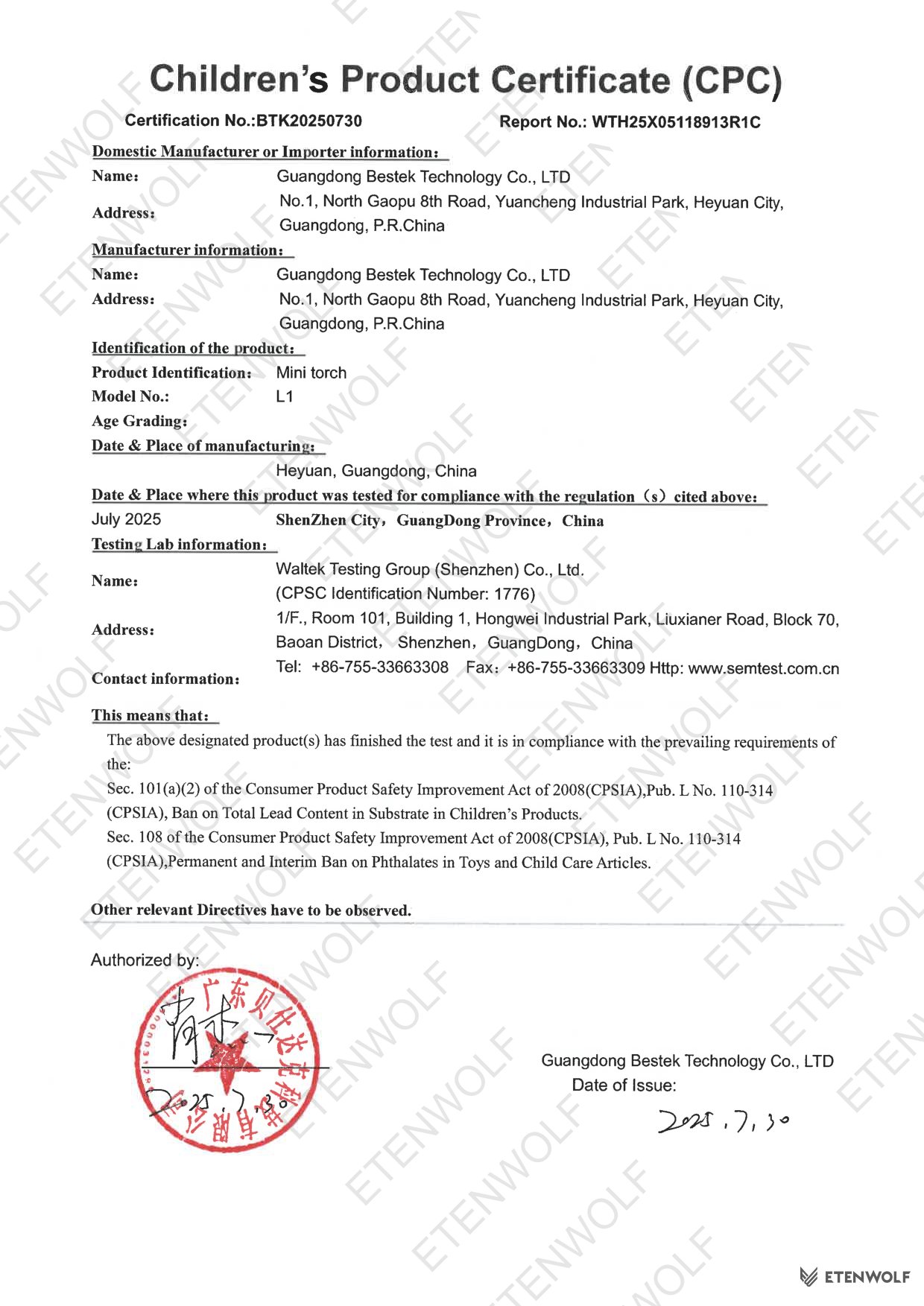
Document Overview This article covers the Children’s Product Certificate (CPC) issued for the ETENWOLF L1 Mini Torch. A Children’s Product Certificate (CPC) is a mandatory document required under the Consumer Product Safety Improvement Act of 2008 (CPSIA) for any children’s product sold in the United…
- Document type
- Certification Report
- Prepared by
- Michelle Torres
- Published
- Last reviewed
- Topics
- Lighting Gear
Document Overview
This article covers the Children’s Product Certificate (CPC) issued for the ETENWOLF L1 Mini Torch. A Children’s Product Certificate (CPC) is a mandatory document required under the Consumer Product Safety Improvement Act of 2008 (CPSIA) for any children’s product sold in the United States. It certifies that the product has been tested by a CPSC-accepted third-party laboratory and meets all applicable federal children’s product safety rules.
- Certificate Type: Children’s Product Certificate (CPC)
- Certification Number: BTK20250730
- Report Number: WTH25X05118913R1C
- Issuing Authority: Guangdong Bestek Technology Co., LTD (Domestic Manufacturer / Importer)
- Date of Issue: July 2025
- Testing Location: Shenzhen City, Guangdong Province, China — July 2025
- Scope: Compliance with CPSIA Section 101(a)(2) – Total Lead Content Ban and CPSIA Section 108 – Phthalates Ban
Product Information
The L1 is a compact mini torch manufactured by Guangdong Bestek Technology Co., LTD under the ETENWOLF brand. Designed with children’s product safety standards in mind, the L1 has been independently tested to confirm it meets United States federal safety requirements for children’s products.
| Field | Details |
|---|---|
| Product Description | Mini Torch |
| Model Number | L1 |
| Age Grading | Children’s Product |
| Date of Manufacturing | Heyuan, Guangdong, China |
| Domestic Manufacturer / Importer | Guangdong Bestek Technology Co., LTD |
| Manufacturer Address | No.1, North Gaopu 8th Road, Yuancheng Industrial Park, Heyuan City, Guangdong, P.R.China |
Key Details
The following table summarizes the regulatory requirements evaluated under this CPC certification for the L1 Mini Torch:
| Regulation | Section | Subject | Result |
|---|---|---|---|
| CPSIA, Pub. L No. 110-314 | Sec. 101(a)(2) | Ban on Total Lead Content in Substrate in Children’s Products | Compliant |
| CPSIA, Pub. L No. 110-314 | Sec. 108 | Permanent and Interim Ban on Phthalates in Toys and Child Care Articles | Compliant |
The CPSIA Section 101(a)(2) restricts total lead content in the substrate (base materials) of children’s products to a maximum of 100 ppm. CPSIA Section 108 permanently bans certain phthalates (DEHP, DBP, BBP) at concentrations above 0.1% in children’s toys and child care articles, with interim bans on additional phthalates (DINP, DPENP, DHEXP, DCHP, DIBP) in toys that can be placed in a child’s mouth. The L1 Mini Torch has been confirmed compliant with both requirements.
Standards & Compliance
The L1 Mini Torch was evaluated against the following U.S. federal safety standards and regulations:
- CPSIA Section 101(a)(2) — Consumer Product Safety Improvement Act of 2008, Pub. L No. 110-314: Sets the enforceable limit for total lead content in substrates of children’s products at no more than 100 ppm (0.01%). This regulation applies to all children’s products sold in the United States and requires third-party testing by a CPSC-accepted laboratory.
- CPSIA Section 108 — Consumer Product Safety Improvement Act of 2008, Pub. L No. 110-314: Establishes a permanent ban on DEHP, DBP, and BBP at concentrations exceeding 0.1% in any children’s toy or child care article, and places interim restrictions on DINP, DPENP, DHEXP, DCHP, and DIBP in toys that can be placed in a child’s mouth.
These regulations are enforced by the U.S. Consumer Product Safety Commission (CPSC). All children’s products subject to a children’s product safety rule must be tested by a CPSC-accepted third-party laboratory before being sold in the United States. The testing laboratory used for this certification, Waltek Testing Group (Shenzhen) Co., Ltd., holds CPSC Identification Number 1776, confirming its accredited status.
Validity & Certification Body
The CPC for the L1 Mini Torch was issued based on testing conducted in July 2025. Under CPSIA regulations, a CPC must be updated whenever the product, production process, or material sourcing changes in a way that could affect compliance. The certificate remains valid as long as the product continues to be manufactured under the same conditions and materials attested herein.
| Field | Details |
|---|---|
| Certification Number | BTK20250730 |
| Report Number | WTH25X05118913R1C |
| Date of Issue | July 2025 |
| Testing Laboratory | Waltek Testing Group (Shenzhen) Co., Ltd. |
| CPSC Lab ID Number | 1776 |
| Lab Address | 1/F., Room 101, Building 1, Hongwei Industrial Park, Liuxianer Road, Block 70, Baoan District, Shenzhen, Guangdong, China |
| Lab Contact | Tel: +86-755-33663308 | Fax: +86-755-33663309 | www.semtest.com.cn |
| Authorized By | Guangdong Bestek Technology Co., LTD |
Frequently Asked Questions
- What is a Children’s Product Certificate (CPC) and why does the ETENWOLF L1 Mini Torch have one?
-
A CPC is a legally required document under the U.S. Consumer Product Safety Improvement Act (CPSIA) for any product intended for children. It certifies that the product has been tested by an accredited third-party laboratory and complies with applicable federal safety rules. The ETENWOLF L1 Mini Torch carries a CPC to confirm it meets U.S. lead content and phthalates requirements, making it eligible for sale in the United States market.
- What does CPSIA Section 101(a)(2) compliance mean for the L1 Mini Torch?
-
CPSIA Section 101(a)(2) limits total lead content in the base materials (substrate) of children’s products to a maximum of 100 ppm. The L1 Mini Torch has been independently tested and confirmed to contain total lead levels below this threshold, ensuring it is safe for children’s use under U.S. federal law.
- Which phthalates are restricted under CPSIA Section 108, and is the L1 compliant?
-
CPSIA Section 108 permanently bans DEHP, DBP, and BBP above 0.1% in children’s toys and child care articles, and places interim restrictions on DINP, DPENP, DHEXP, DCHP, and DIBP in toys that can be placed in a child’s mouth. The ETENWOLF L1 Mini Torch has been tested and confirmed compliant with all applicable phthalate restrictions under this section.
- Who tested the ETENWOLF L1 Mini Torch for CPSIA compliance?
-
Testing was conducted by Waltek Testing Group (Shenzhen) Co., Ltd. (CPSC Identification Number: 1776), a CPSC-accepted third-party laboratory located in Shenzhen, Guangdong, China. Testing was completed in July 2025 at their Shenzhen facility.
Related Documents
For comprehensive product compliance, the following additional certifications and documentation are typically associated with lighting and illumination products such as the L1 Mini Torch:
- FCC Declaration of Conformity — Required for electronic devices sold in the U.S. market, confirming compliance with FCC electromagnetic interference regulations.
- CE Declaration of Conformity — Required for products sold in the European Economic Area, covering Low Voltage Directive (LVD) and Electromagnetic Compatibility (EMC) under CE marking requirements.
- RoHS Compliance Certificate — Confirms restriction of hazardous substances including lead, mercury, cadmium, and other restricted materials under RoHS Directive 2011/65/EU for EU market entry.
- REACH Compliance Statement — Documents compliance with the EU REACH Regulation (EC) No 1907/2006 regarding substances of very high concern (SVHCs) in products.
- UN38.3 Battery Test Report — If the L1 Mini Torch contains a lithium battery, a UN38.3 report is required for safe transportation of lithium cells.
- ASTM F963 Test Report — The standard consumer safety specification for toy safety, frequently required alongside CPSIA compliance documentation for children’s products sold in the U.S.
Document Pages