Document Overview
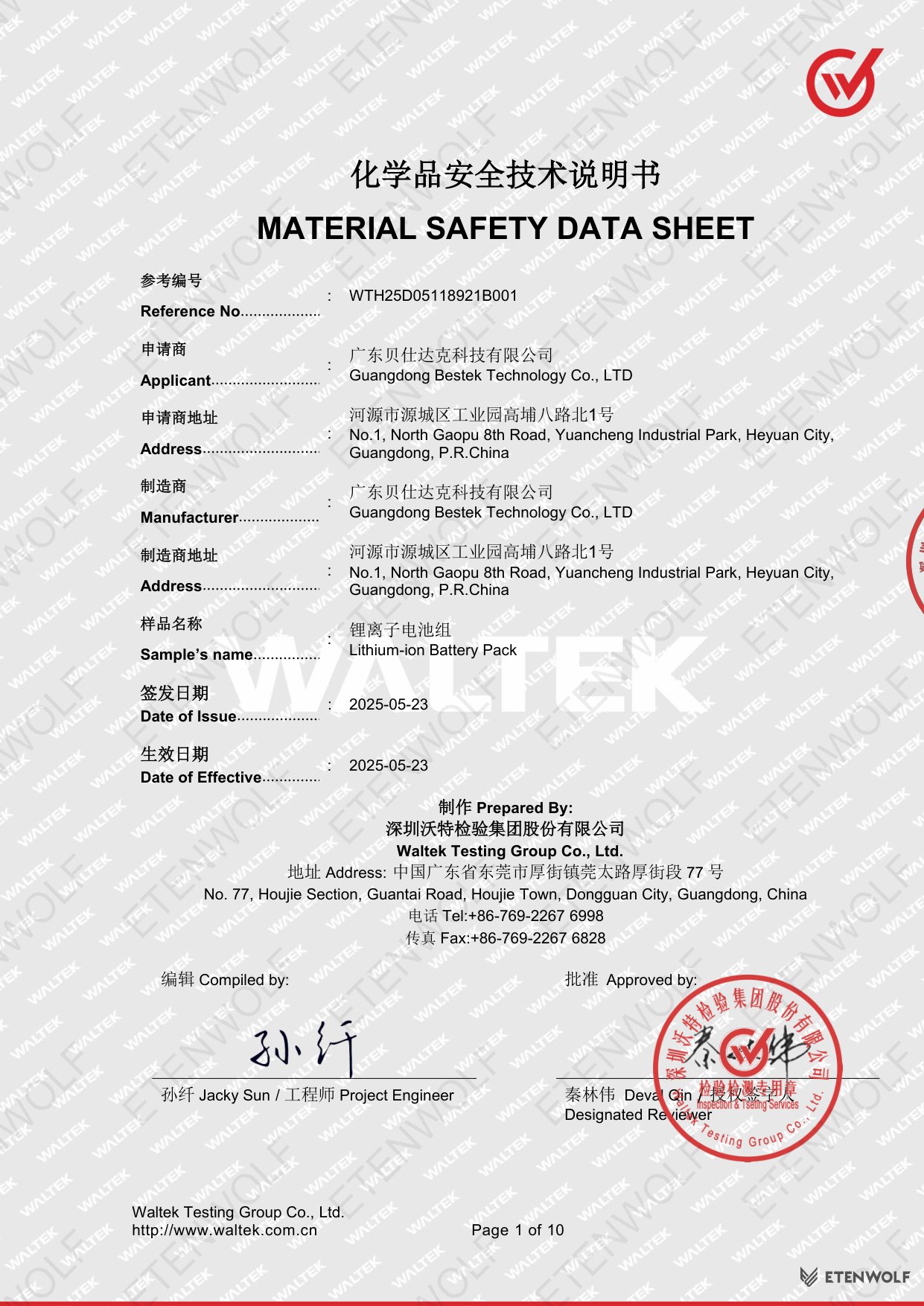
Document Overview This document is a Material Safety Data Sheet (MSDS) prepared in accordance with UN38.3 and international chemical safety standards. It was issued by Waltek Testing Group Co., Ltd., an accredited third-party testing laboratory headquartered in Dongguan, Guangdong, China. Field Detail Reference No. WTH25D05118921B001…
- Document type
- Certification Report
- Prepared by
- Michelle Torres
- Published
- Last reviewed
- Topics
- International Transportation: CB / MSDS / UN38.3
Document Overview
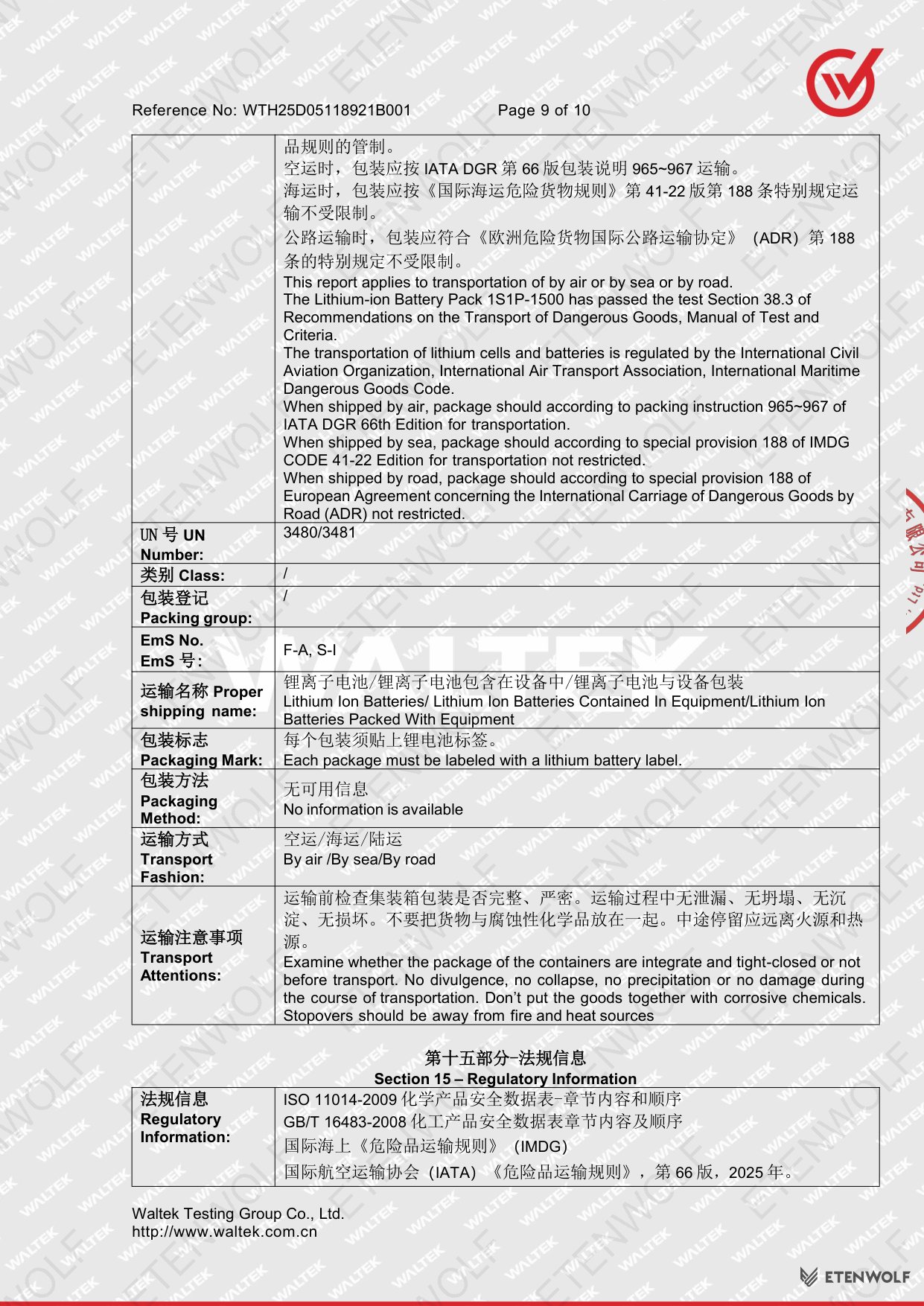
This document is a Material Safety Data Sheet (MSDS) prepared in accordance with UN38.3 and international chemical safety standards. It was issued by Waltek Testing Group Co., Ltd., an accredited third-party testing laboratory headquartered in Dongguan, Guangdong, China.
| Field | Detail |
|---|---|
| Reference No. | WTH25D05118921B001 |
| Document Type | Material Safety Data Sheet (MSDS) |
| Date of Issue | 2025-05-23 |
| Date of Effective | 2025-05-23 |
| Issuing Body | Waltek Testing Group Co., Ltd. |
| Applicant | Guangdong Bestek Technology Co., LTD |
| Scope | Lithium-ion Battery Pack used in the ETENWOLF L1 mini torch |
Product Information
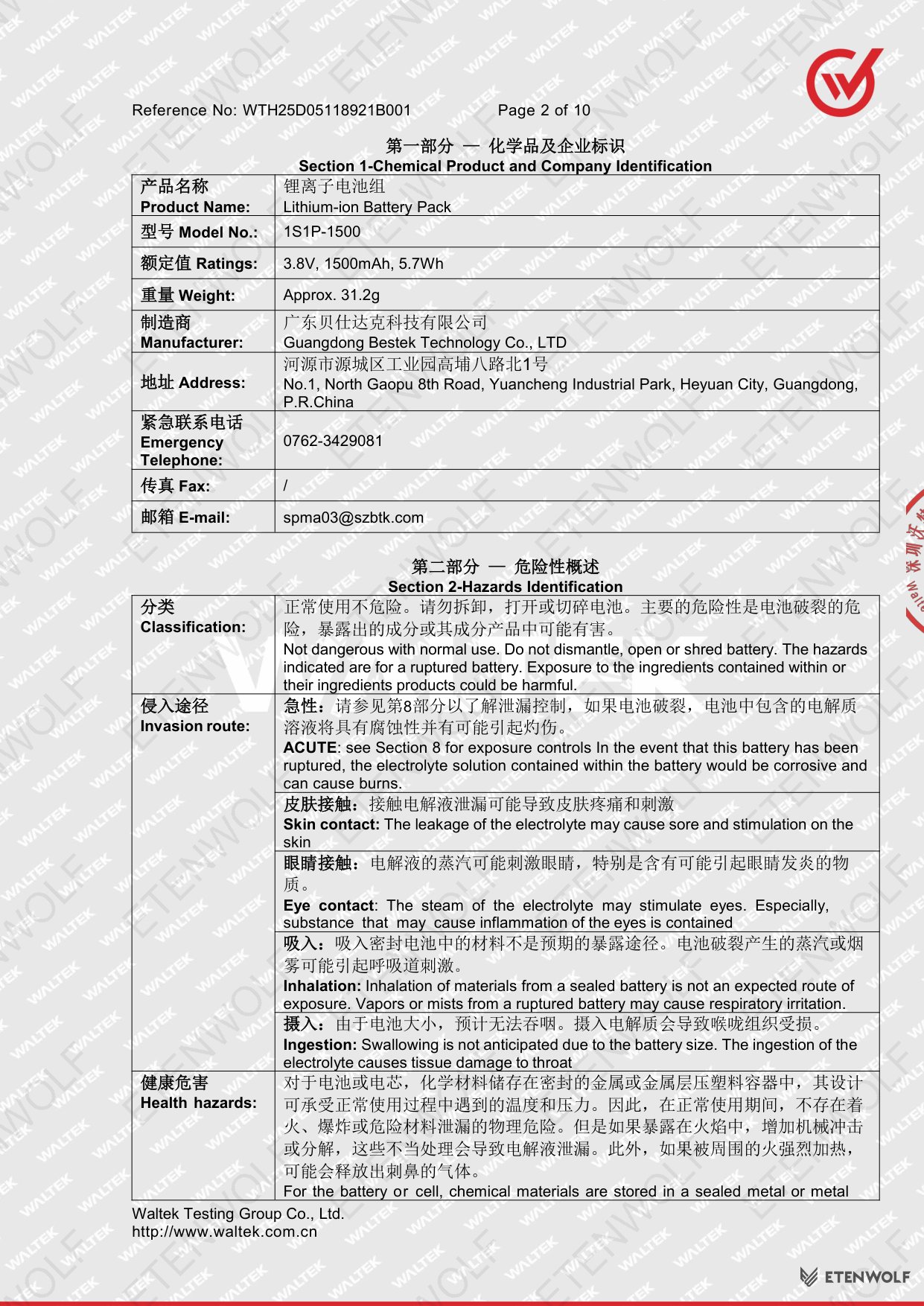
The battery pack covered by this MSDS is installed in the ETENWOLF L1 mini torch. The L1 is a compact, rechargeable mini torch designed for portable lighting use.
| Attribute | Value |
|---|---|
| Product Name | Lithium-ion Battery Pack |
| Model No. | 1S1P-1500 |
| Rated Voltage | 3.8 V |
| Rated Capacity | 1500 mAh |
| Energy | 5.7 Wh |
| Weight | Approx. 31.2 g |
| Manufacturer | Guangdong Bestek Technology Co., LTD |
| Manufacturer Address | No.1, North Gaopu 8th Road, Yuancheng Industrial Park, Heyuan City, Guangdong, P.R.China |
| Emergency Telephone | 0762-3429081 |
| [email protected] |
Key Details
Hazards Identification (Section 2)
The battery pack is not dangerous under normal use conditions. Hazard risks arise only in the event of physical rupture, improper handling, or exposure to fire. Key hazard pathways are summarised below:
| Exposure Route | Description |
|---|---|
| Skin Contact | Electrolyte leakage may cause skin soreness and irritation. |
| Eye Contact | Electrolyte vapour may irritate eyes and cause inflammation. |
| Inhalation | Vapours or mists from a ruptured battery may cause respiratory irritation. |
| Ingestion | Ingestion of electrolyte causes tissue damage to the throat; swallowing is unlikely due to battery size. |
| Environmental | Electrolyte leakage or container rupture may release inner components into the environment. |
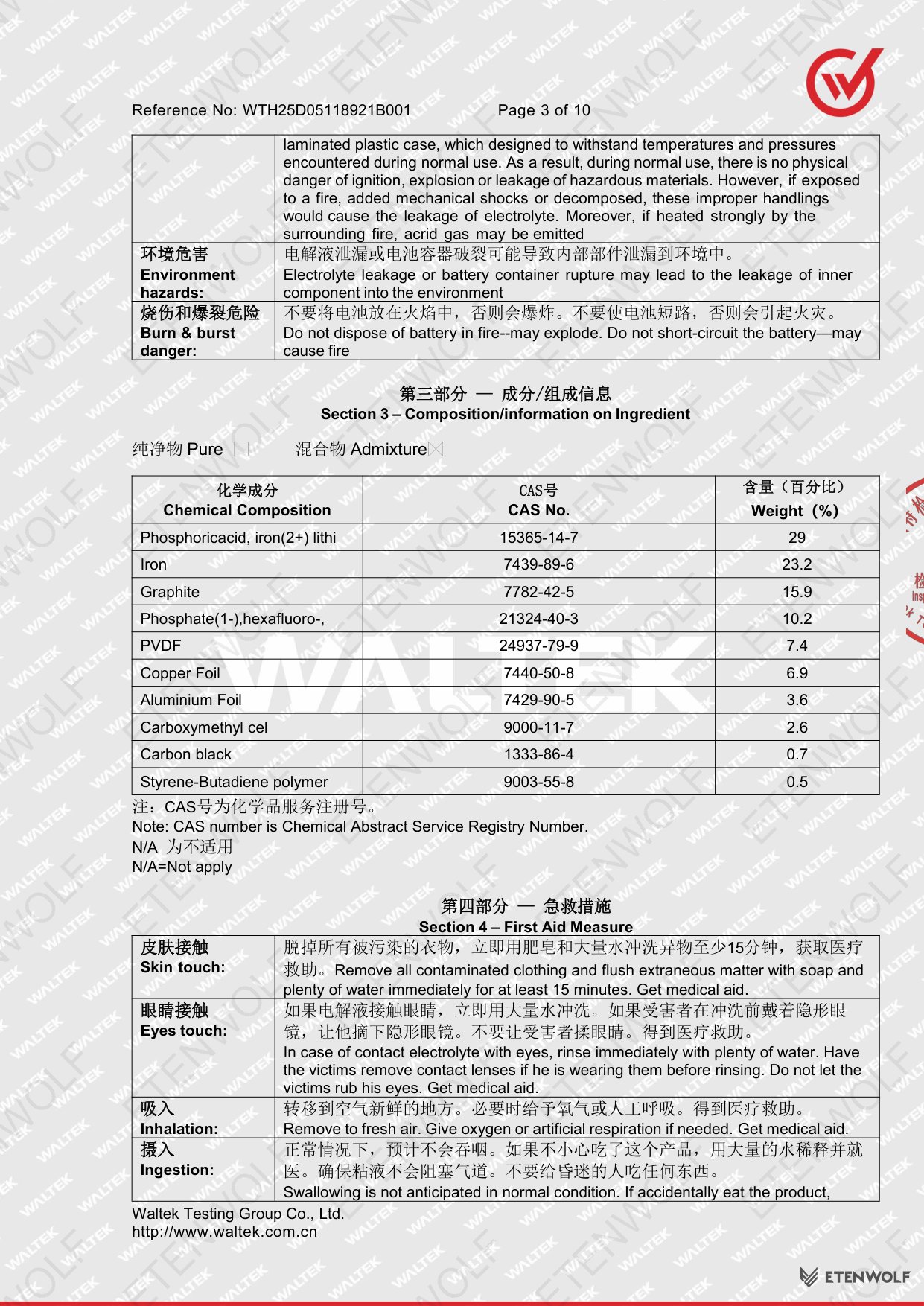
Chemical Composition (Section 3)
| Chemical Component | CAS No. | Weight (%) |
|---|---|---|
| Iron(II) Lithium Phosphate (LiFePO₄) | 15365-14-7 | 29.0 |
| Iron | 7439-89-6 | 23.2 |
| Graphite | 7782-42-5 | 15.9 |
| Hexafluorophosphate (LiPF₆ electrolyte salt) | 21324-40-3 | 10.2 |
| PVDF (Polyvinylidene Fluoride) | 24937-79-9 | 7.4 |
| Copper Foil | 7440-50-8 | 6.9 |
| Aluminium Foil | 7429-90-5 | 3.6 |
| Carboxymethyl Cellulose | 9000-11-7 | 2.6 |
| Carbon Black | 1333-86-4 | 0.7 |
| Styrene-Butadiene Polymer | 9003-55-8 | 0.5 |
First Aid Measures (Section 4)
| Scenario | First Aid Action |
|---|---|
| Skin Contact | Remove all contaminated clothing and flush with soap and plenty of water for at least 15 minutes. Seek medical aid. |
| Eye Contact | Immediately flush eyes with large amounts of water. Seek medical aid if irritation persists. |
| Inhalation | Move to fresh air immediately. Seek medical aid if symptoms persist. |
| Ingestion | Do not induce vomiting. Seek immediate medical aid. |
Standards & Compliance
This MSDS is prepared in conformance with applicable international regulations governing the transport and classification of lithium-based energy storage devices. The document supports compliance with the following frameworks:
- UN38.3 – United Nations Manual of Tests and Criteria, Part III, Section 38.3: Transportation testing for lithium metal and lithium-ion batteries.
- IEC 62133 – Safety requirements for portable sealed secondary lithium cells and batteries.
- RoHS – Restriction of Hazardous Substances Directive compliance for battery chemical content.
- REACH – Registration, Evaluation, Authorisation and Restriction of Chemicals (EU regulation).
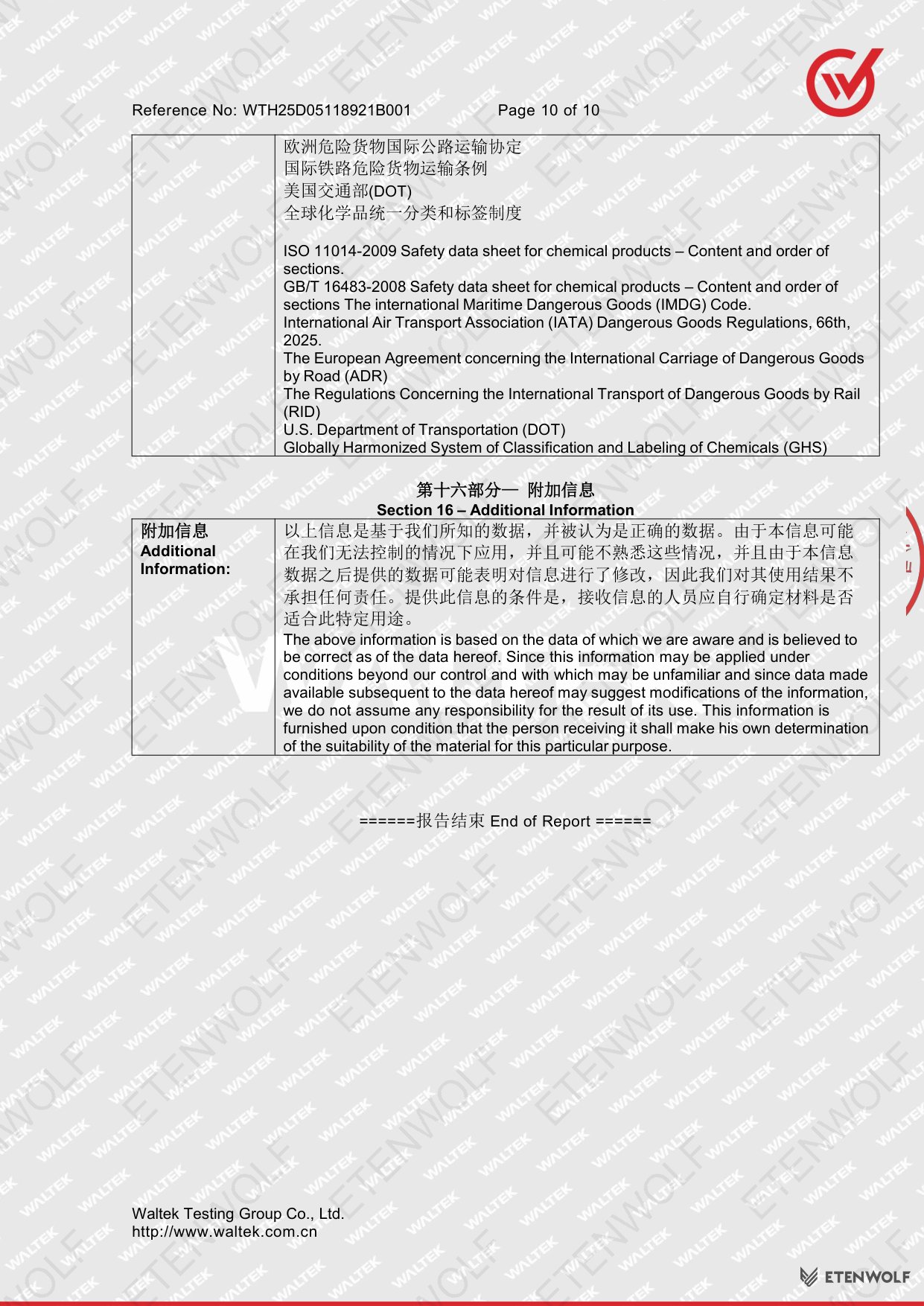
The chemical composition data provided in Section 3 of the MSDS supports REACH substance declaration obligations and hazardous material classification under GHS (Globally Harmonised System).
Validity & Certification Body
| Field | Detail |
|---|---|
| Reference No. | WTH25D05118921B001 |
| Date of Issue | 2025-05-23 |
| Date of Effective | 2025-05-23 |
| Prepared By | Jacky Sun (孙纤) – Project Engineer |
| Approved By | Deval Qin (秦林伟) – Designated Reviewer |
| Issuing Laboratory | Waltek Testing Group Co., Ltd. (深圳沃特检验集团股份有限公司) |
| Laboratory Address | No. 77, Houjie Section, Guantai Road, Houjie Town, Dongguan City, Guangdong, China |
| Telephone | +86-769-2267 6998 |
| Fax | +86-769-2267 6828 |
| Website | www.waltek.com.cn |
MSDS documents of this type are typically reviewed and reissued when the product formulation, manufacturer information, or applicable regulations change. Users should verify that they hold the current revision before relying on this document for regulatory submissions.
Frequently Asked Questions
- What does the UN38.3 test requirement mean for the ETENWOLF L1 battery?
- The UN38.3 standard defines a series of safety tests — including altitude simulation, thermal cycling, vibration, shock, short-circuit, overcharge, and forced discharge — that lithium batteries must pass before they can be transported by air, sea, or road. The battery pack inside the ETENWOLF L1 has successfully passed these tests as documented under reference number WTH25D05118921B001.
- Is the ETENWOLF L1 battery pack safe for air travel?
- Yes. The lithium-ion battery pack (model 1S1P-1500, 3.8V, 1500mAh, 5.7Wh) in the ETENWOLF L1 has an energy content well below the 100Wh per-cell threshold defined by IATA Dangerous Goods Regulations for passenger carry-on baggage. The UN38.3 MSDS reference WTH25D05118921B001 supports this classification. Always check with your airline for the latest carry-on battery policies.
- What should I do if the battery pack in my L1 mini torch leaks or ruptures?
- If the battery pack leaks: avoid skin and eye contact with the electrolyte fluid; if contact occurs, flush immediately with large amounts of water for at least 15 minutes and seek medical attention. Do not attempt to recharge a damaged or leaking battery. Isolate the device in a fire-safe container away from flammable materials and contact ETENWOLF customer support for replacement guidance.
- Where can I find the full MSDS and UN38.3 test report for the L1?
- The MSDS bearing reference number WTH25D05118921B001 was issued on 2025-05-23 by Waltek Testing Group Co., Ltd. For the complete document or the associated UN38.3 transport test report, contact ETENWOLF directly via the ETENWOLF website or reach the manufacturer at [email protected].
Related Documents
The following certification and compliance documents are typically required alongside an MSDS for a lithium-ion battery pack used in a portable lighting product such as the ETENWOLF L1:
- UN38.3 Transport Test Report – Full pass/fail test data for all eight UN38.3 test procedures (T1–T8), typically issued by the same accredited lab.
- IEC 62133 Battery Safety Certificate – Covers electrical and mechanical safety of the rechargeable cell under consumer-use conditions.
- CE Declaration of Conformity – Required for sale in the European Economic Area; covers the complete mini torch including its battery system under the Low Voltage Directive and EMC Directive.
- RoHS Compliance Report – Confirms that the battery and device components are free from restricted hazardous substances (lead, mercury, cadmium, hexavalent chromium, PBB, PBDE).
- REACH SVHC Declaration – Declares the presence or absence of Substances of Very High Concern in the product above the 0.1% w/w threshold.
- FCC / IC Radio Certification – Required for the electronic product, where applicable, when sold in North American markets.
- KC Certification – Required for import and sale of the device and its battery in the Republic of Korea.
Document Pages